This manual is for MAT FPX 2051 Assessment 2, start to submission. The middle deliverable in Discrete Mathematics usually asks you to turn a practical constraint into a structure and then solve it inside that structure. Scheduling problems are the standard case: the model is a graph, the answer is an assignment, and the graded work is defending both the model and the claim that no smaller answer exists. The method our tutors follow is laid out below, with a row-by-row structure and an annotated excerpt. Want a worked version to study? A premium original sample on your own constraint list ships in 24 to 48 hours, with revision free until every row clears. Capella's catalog lists the course as MAT-FPX2051, and some courserooms print MAT2051; both point to this same Assessment 2.
One honesty note before the manual: Capella revises courses and scoring guides over time, so always write to the exact scoring guide attached to your assessment in the courseroom. The course identity above is verified on capella.edu; the method and structure below are our tutors' approach to it, not Capella's official rubric text.
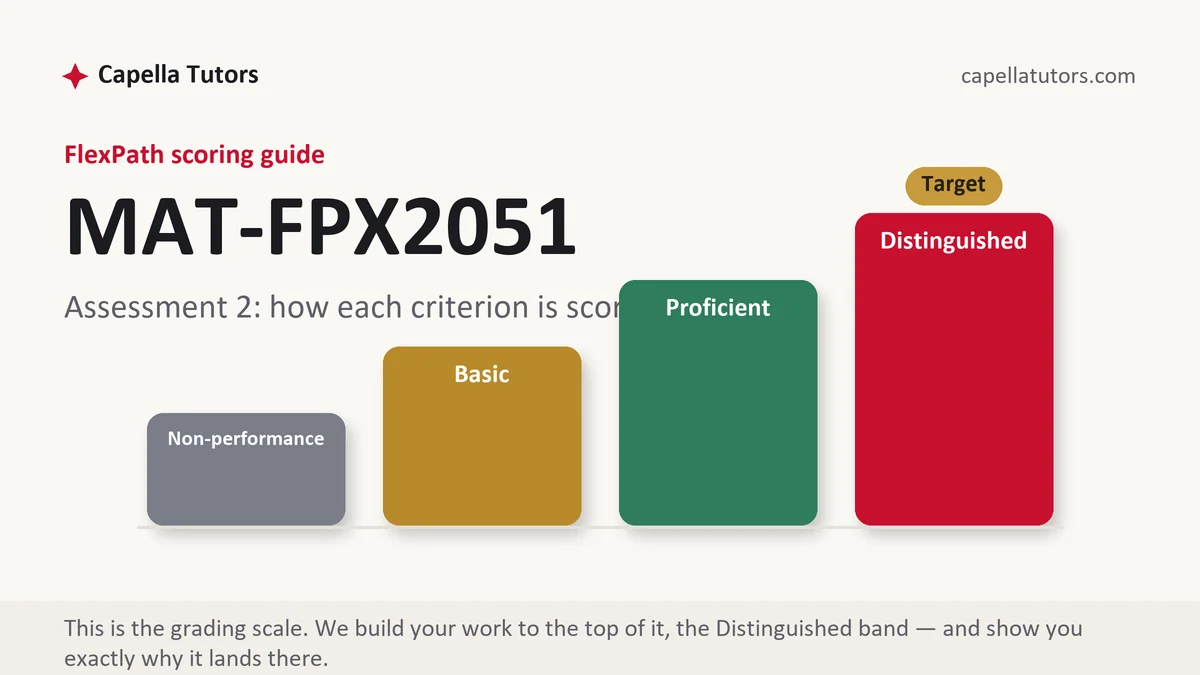
How MAT FPX 2051 Assessment 2 is scored
A FlexPath evaluator assigns levels, not points. Each row takes one of four, and reading the wording of each is how you learn what to write:
| Level | What it means on a graph modeling deliverable |
|---|---|
| Distinguished | What the vertices and edges stand for is stated before the graph is drawn, the assignment is shown to break no constraint, the number used is shown to be the smallest possible by an argument rather than by trying, and the answer is written back as a schedule somebody could publish. |
| Proficient | A valid model and a valid assignment, checked against the constraints. Correct work that never argues for minimality. |
| Basic | A working schedule produced by trial with no model declared, or a count of slots asserted as minimal because nothing smaller was found. |
| Non-performance | A required element never appears, commonly the verification or the minimality argument. Absence sits at the floor. |
Minimality is where the two upper columns separate, and it takes two halves. Exhibit an assignment using that many slots, which proves it is achievable, then find a set of items that all conflict with each other, which proves nothing smaller can work. Three mutually conflicting courses force three slots, and saying so is the argument.
The MAT FPX 2051 Assessment 2 method, step by step
-
Map the criteria before you draw anything
Heading per row, top-level wording beneath. Graph rows usually pair a construction with a justification, and match your numbering to the prompt's so no evaluator has to hunt for the item being scored.
-
Declare what the vertices and edges mean
One sentence: each vertex is a course, and an edge joins two courses whenever at least one student is enrolled in both. A drawing with no key is decoration, and the row asking for the model has nothing to read.
-
Build the conflict list before the picture
Work through the enrollment data and write the conflicting pairs out as a list. Drawing first and listing afterward is how edges go missing, and a missing edge produces a schedule that fails in practice.
-
Find a set that all conflict with each other
Look for three or four items every one of which clashes with every other. That set is your lower bound, and it is the half of the argument most submissions never supply.
-
Assign, then verify edge by edge
Give each vertex a slot and then walk the conflict list, confirming that no pair shares one. Verification against the list rather than against the drawing is what catches the error a picture hides.
-
Write the schedule back into English
Close with the slots and what sits in each, plus what the model leaves out, such as room capacity or invigilator availability. Then self-score every row and submit with two business days to spare.
A structure that maps to the criteria
These are our tutors' planning targets for a modeling task of this kind, not rules; your own guide sets the balance between sections.
| Section | What it must do | Guide word target |
|---|---|---|
| The constraint | What cannot happen at the same time, and the data that establishes which pairs clash. | ~140 words |
| The model | What the vertices are, what an edge means, and the full list of conflicting pairs. | ~200 words |
| The lower bound | A set of mutually conflicting items, and the number of slots it forces. | ~210 words |
| The assignment | Each item given a slot, presented as a table rather than only as a drawing. | ~200 words |
| Verification and limits | Every conflicting pair checked against the assignment, plus what the model does not capture. | ~200 words |
| Notation and sources | Graph terms used as your course defines them, the text and any software cited in current APA. | as needed |
Annotated sample excerpt
A model passage our writers built at the standard the top level asks for. Read how it argues, then argue that way yourself.
Each of the seven courses is a vertex and two vertices are joined whenever at least one student is enrolled in both, which gives the nine conflicting pairs listed in Table 1 and turns the scheduling question into a question about coloring that graph.1 Three of the courses conflict with each other in all three pairs, so those three cannot share a slot with one another in any arrangement whatsoever, and no schedule using two slots can exist.2 Three slots are also enough: assigning slot 1 to the first, fourth, and seventh courses, slot 2 to the second, fifth, and sixth, and slot 3 to the third breaks none of the nine pairs, which can be confirmed by reading the list rather than the diagram, so three is both achievable and minimal.3
- 1The model is declared before the graph is used, and the conflict list is tabled so the argument can refer to it by row rather than gesturing at a picture.
- 2The lower bound is established by a set that mutually conflicts. This is the half of minimality most submissions omit, and it is usually a row on its own.
- 3The assignment is exhibited and then verified against the list, closing the argument from both directions. Achievable and minimal are two separate claims and both are made.
The full premium sample for your exact assessment, written fresh to your scoring guide and issue, is free to request. Study it, revise it into your own voice, and submit work you understand.
The five mistakes that cost Distinguished
- A graph drawn with no key. Unless the vertices and edges are defined in words, the picture cannot be scored as a model of anything.
- Minimality asserted from failed attempts. Not finding a smaller schedule is not an argument, and the mutually conflicting set is what supplies one.
- Verification done against the drawing. Edges are easy to lose in a picture, so the assignment has to be checked against the written conflict list.
- A conflict list built after the diagram. Reading pairs off a sketch reverses the order of the work and is where missing edges come from.
- The schedule never written in English. A colored graph is not a schedule until the slots and their contents are stated as a table a reader could publish.
Pre-submission checklist
- One heading per row, with any question carrying two rows flagged
- Vertices and edges defined in words before any graph appears
- The full list of conflicting pairs tabled and referred to by row
- A mutually conflicting set identified and the lower bound it forces stated
- The assignment exhibited as a table and verified against every pair on the list
- The result written back as a schedule, with what the model omits, every row self-scored
A scheduling problem to model?
Send the questions as they were numbered, plus the criteria. Eight people handle the file, including a second specialist who reworks the problems from the prompt alone so the two answers have to agree. Delivery is 24 to 48 hours with the reasoning written out, revised at no charge until the guide is satisfied.