This manual is for MAT FPX 2051 Assessment 3, start to submission. The closing deliverable in Discrete Mathematics usually asks for a general claim rather than a particular number. Count something, notice the pattern, then prove the pattern holds for every size rather than for the sizes you tried. Induction is the tool, and the marks sit in the base case, the stated hypothesis, and the line where the hypothesis is actually used. Laid out below are our tutors' method, a row-by-row structure, and an annotated excerpt. Rather have the derivations handed to you? A premium original sample for the claim you were set arrives inside 24 to 48 hours, revised free until the criteria are satisfied. Capella's catalog lists the course as MAT-FPX2051, and some courserooms print MAT2051; both point to this same Assessment 3.
One honesty note before the manual: Capella revises courses and scoring guides over time, so always write to the exact scoring guide attached to your assessment in the courseroom. The course identity above is verified on capella.edu; the method and structure below are our tutors' approach to it, not Capella's official rubric text.
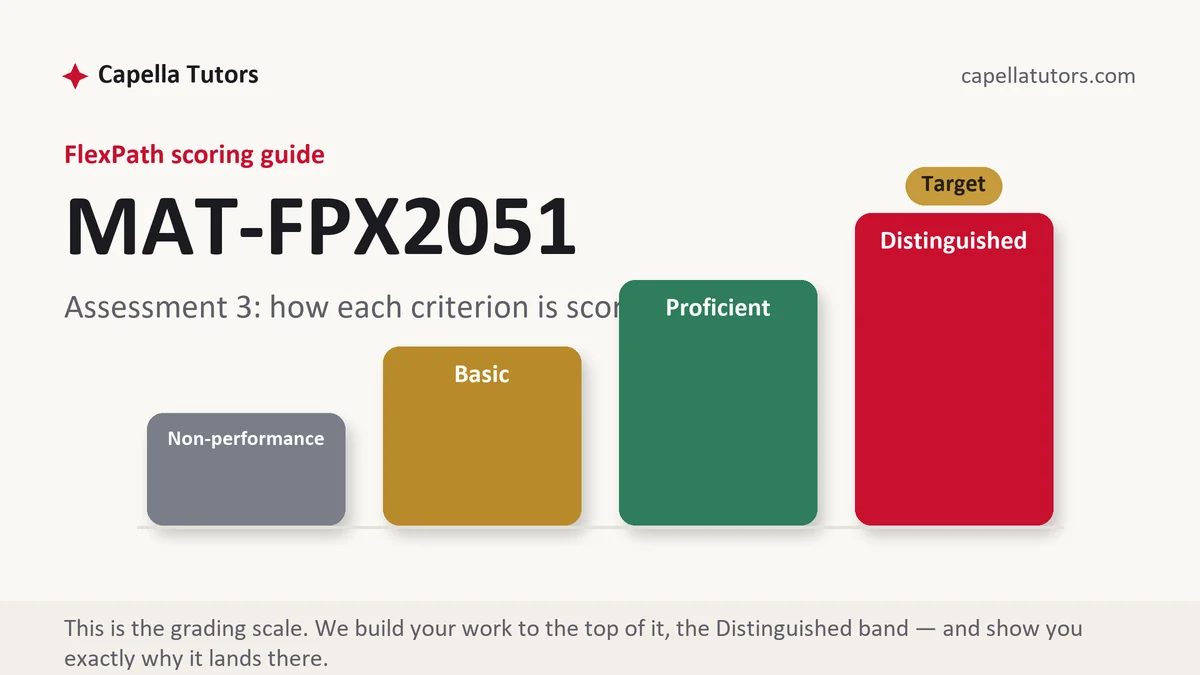
How MAT FPX 2051 Assessment 3 is scored
No number appears on a FlexPath guide. Each criterion is placed at one of four levels, and the words in the level you want are the instruction:
| Level | What it means on a counting and proof deliverable |
|---|---|
| Distinguished | The counting model is declared before any arithmetic, a second model is used as an independent check and reaches the same total, the induction carries a labeled base case and a written hypothesis, and the step marks the point where the hypothesis does its work. |
| Proficient | The count is right and the induction is complete and valid. Sound work that never checks itself by a second route. |
| Basic | A correct total with no model behind it, or an induction whose step would go through untouched if the hypothesis were deleted. |
| Non-performance | A required piece is absent, usually the base case or the explicit hypothesis. An absent element sits at the floor whatever surrounds it. |
Write one proof properly and reuse its shape. Four labeled parts, no gap a reader has to fill: the claim and what is assumed, the base case verified at the smallest size, the hypothesis stated as a sentence rather than implied, and the step that reaches the next size using it. Then name the principle you invoked and the range it covers.
The MAT FPX 2051 Assessment 3 method, step by step
-
Give every criterion a heading, matched to the prompt's numbering
Read the rows carefully enough to notice when one problem is carrying two of them, because those are the problems worth twice the time. Counting rows and proof rows are usually scored separately even inside one question.
-
Declare the counting model before the arithmetic
Say what is being counted, whether order matters, and whether repetition is allowed. Two correct answers to different questions are the standard trap here, and a total with no model attached cannot be credited.
-
Count a second way and compare
Two defensible models reaching the same number is your evidence that neither one double counts. Where they disagree, one is counting an outcome twice or forbidding one it should allow, and finding out which is the exercise.
-
State the claim for a general size
Write the general statement out with its variable and the set that variable ranges over. A proof about every case cannot begin until the every has been written down.
-
Label the base case, the hypothesis, and the step
Verify the smallest size explicitly. Write the hypothesis as a sentence you assume rather than one you imply. Then reach the next size and mark the exact line where the assumption is used, since that line is what makes it an induction.
-
Enumerate a small case as a final check
Where the numbers are small, work the situation out by hand and confirm the formula agrees. Then self-score each row against the guide and submit with two business days in hand.
A structure that maps to the criteria
The counts are what we aim at on a proof deliverable and nothing more binding; the rows on your guide decide where the words go.
| Section | What it must do | Guide word target |
|---|---|---|
| The situation | What is being counted, in what setting, and the particular size the prompt started from. | ~130 words |
| The counting model | Order, repetition, and the rule applied, stated before any number is produced. | ~200 words |
| The second count | An independent route to the same total, with the agreement stated as evidence. | ~190 words |
| The general claim | The statement for every size, with the variable and its set named. | ~150 words |
| The induction | Base case, hypothesis, step, and the marked line where the hypothesis is used. | ~280 words |
| Checks and sources | A small case enumerated by hand, definitions cited to your text in current APA. | as needed |
Annotated sample excerpt
An original excerpt from our team at the level the guide's top column sets. Learn the moves and then produce your own.
The intramural bracket runs 64 teams in single elimination, and since every match eliminates exactly one team and 63 teams must be eliminated for one champion to remain, the tournament needs 63 matches; counting by rounds instead gives 32 + 16 + 8 + 4 + 2 + 1, which is also 63, and the agreement is evidence neither model double counts.1 The general claim is that a single-elimination bracket of n teams requires exactly n - 1 matches for every integer n at least 1.2 Base case: with n = 1 no match is needed and n - 1 is 0, so the claim holds. Assume for some integer k at least 1 that any bracket of k teams takes k - 1 matches. A bracket of k + 1 teams plays one match, which removes one team and leaves a bracket of k teams; by the hypothesis that remainder takes k - 1 matches, so the total is k, which is (k + 1) - 1 as claimed.3
- 1Two independent models are given and their agreement is stated as evidence rather than as a coincidence. One model alone is a total nobody can audit.
- 2The general claim is written out with its variable and the set it ranges over before any proof begins, which is the row about stating what is to be shown.
- 3Base case, hypothesis, and step are each labeled, and the sentence beginning by the hypothesis marks exactly where the assumption does its work. A step that never needs it is not an induction.
The full premium sample for your exact assessment, written fresh to your scoring guide and issue, is free to request. Study it, revise it into your own voice, and submit work you understand.
The five mistakes that cost Distinguished
- A count with no model stated. A number nobody can trace back to a question about order and repetition cannot be given credit.
- Induction that never uses the hypothesis. If the step would work with the assumption deleted, what you wrote is a calculation rather than a proof.
- A base case skipped as obvious. The smallest size is one line and it is a row, and an induction without it establishes nothing.
- The hypothesis implied rather than written. Assume for some k has to appear as a sentence, because the marks are attached to stating it.
- Equals signs used as connective tissue. Strung across a page they assert that a dozen unequal expressions all have the same value, and a step that transforms a claim needs a word like therefore.
Pre-submission checklist
- A section per criterion, numbered exactly as the problem set numbers them
- The counting model declared, with order and repetition settled, before any total
- A second independent count reaching the same figure, with the agreement stated
- The general claim written out with its variable and the set it ranges over
- Base case, hypothesis, and step each labeled, and the line using the hypothesis marked
- A small case enumerated by hand as a check, every row self-scored before submitting
A counting and proof set to hand off?
Send the problems with their numbering intact, plus the criteria. Eight people work the file, ending with an editor who checks a person could follow it, and one specialist reworks every problem independently. Delivery is inside 24 to 48 hours with the base case, hypothesis, and step labeled, revised free until the guide is met.