Upload the prompt, the scoring guide, and any dataset the deliverable attached, and a premium original sample comes back in 24 to 48 hours with the reasoning written out, exact values kept exact, and every graph explained in words. On the transcript it reads MAT FPX 1200, Pre-Calculus, 3 points, one of the Natural Science and Mathematics options inside Capella's general education menu. That menu runs on choice rather than on sequence, asking for at least 22.5 points overall and at least 2 points from each of its four categories, and the same catalog is open to undergraduates across Business, Information Technology, Health Care Administration, Psychology, and Computer Science alike. In Capella's catalog the course code is written MAT-FPX1200.
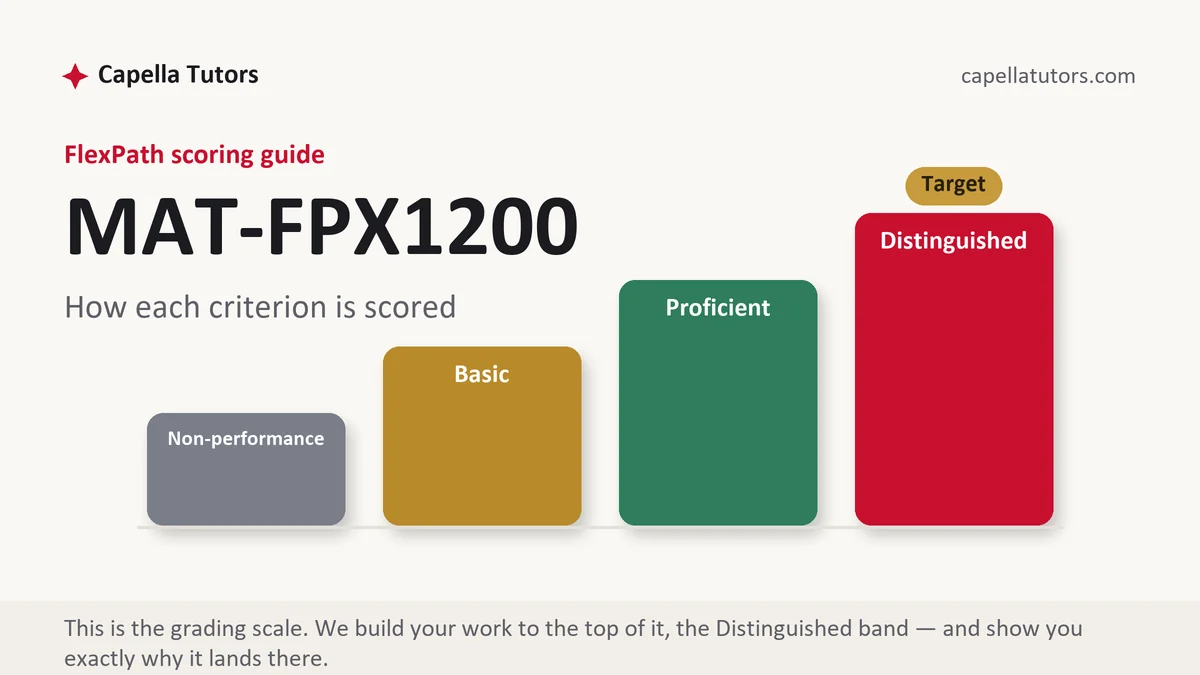
What MAT FPX 1200 actually grades
Pre-Calculus is the point where arithmetic stops being the difficulty and notation starts being it. The assessments in this course usually hand you a function or a set of observations and ask what can be said about it, a question with no single number as its answer. A timed examination would award partial credit for a correct value. A FlexPath criterion is asking whether the behavior of a function was described accurately and completely, so a response that lists a vertical asymptote and misses a removable discontinuity has answered part of a question rather than answered it wrongly. Absorbing that early takes most of the fear out of a subject people arrive braced against, because completeness of description earns more here than speed at solving.
Four families of behavior generate most of the criteria. Transformations are graded on order as much as on effect, since a graph shifted, stretched, and reflected does not land in the same place when the operations run in a different sequence. Composition and inverses are graded on domain, because composing two functions can shrink a domain neither of them had trouble with, and an inverse exists only once the original has been restricted to a stretch passing the horizontal line test. Rational functions then carry the trap that costs the most rows. Take f(x) = (2x^2 - 8)/(x^2 - x - 6), factor it into 2(x - 2)(x + 2) over (x - 3)(x + 2), and the shared factor cancels, yet x = -2 is still missing from the domain, so the graph carries a hole there at a height of 1.6 rather than an asymptote. The vertical asymptote sits at x = 3, the horizontal asymptote at y = 2 because the leading coefficients divide, and a description reporting the asymptotes while forgetting the hole is a correct simplification turned into an incomplete answer.
Exponential and logarithmic work moves past compound interest into solving and rewriting. An equation such as 3^(2x - 1) = 40 is handled by taking a logarithm of both sides, which gives 2x - 1 equal to the natural log of 40 over the natural log of 3, so x is roughly 2.179, and the criterion usually wants the exact expression alongside the decimal. Trigonometry is where the course loses the most learners, almost never for conceptual reasons. Radians are the working unit, 150 degrees is 5 pi over 6, and a calculator left in the wrong mode returns answers that are not close enough to look obviously wrong. Periodic models are the payoff, and a harbor with a high tide of 12.4 feet and a low of 2.6 feet on a 12.4 hour cycle has a midline of 7.5 feet, an amplitude of 4.9 feet, and a coefficient of 2 pi divided by 12.4 inside the cosine. Each of those numbers has to be justified from the situation rather than asserted.
How we help in this course
Pre-Calculus samples from this studio keep exact values exact. A solution that is 5 pi over 6 is written that way, with a decimal added afterward if the prompt wants one, because rounding early creates a mismatch between a stated answer and the graph beside it. Domains and restrictions are declared wherever a composition, an inverse, a logarithm, or a denominator makes them necessary. Graphs are described in the text with intercepts, asymptotes, end behavior, and any holes named in words, so the interpretation criterion has prose to score even when a figure reproduces poorly. Tell us which technology your faculty expects, since a guide naming a graphing utility wants to see it used.
Terms do not change from course to course. The file moves through eight people, opening with a research analyst who reads your scoring guide and closing with an editor, passing a subject writer, a criterion by criterion reviewer, and an APA and originality check, with one full pass reworking every calculation independently. You get the work inside 24 to 48 hours, written toward Distinguished rather than toward Proficient, with revision at no cost until the guide is satisfied. Evaluator feedback comes back into the queue free of charge, which matters where a single unstated domain restriction can pull down more than one row.
The assessments, one by one
Assessment 1
The opening deliverable in Pre-Calculus usually asks what can be said about a function rather than what its answer is. Read the full Assessment 1 manual.
Assessment 2
The middle deliverable in Pre-Calculus usually moves from describing one function to relating two. Read the full Assessment 2 manual.
Assessment 3
The closing deliverable in Pre-Calculus usually asks for a model rather than an answer. Read the full Assessment 3 manual.
How to actually write MAT FPX 1200: where to begin
Begin with the scoring guide and turn each criterion into a question you can answer in a sentence. Pre-Calculus guides reward description more than computation, so a row asking you to analyze the behavior of a function wants domain, range, intercepts, asymptotes, intervals of increase and decrease, and end behavior, whether or not the prompt lists them. Build the document as one section per criterion, and inside each section put the statement first, the supporting work second, and the graph third, because a document that buries its conclusions inside the algebra makes a grader hunt for them.
Then write the mathematics as argument rather than as a transcript. Every step that is not obvious deserves a clause explaining why it is legal: that both sides were exponentiated to undo the logarithm, that the domain was restricted so an inverse would exist, that a factor was cancelled and the excluded value carried forward. Verifying an identity has a convention worth learning once, which is that you work on a single side and transform it into the other, never treating the identity as an equation and operating on both sides, since doing that assumes exactly what you were asked to prove. Give every axis on every figure a label and a scale.
Verification here means testing a description rather than substituting a root. Pick a value on each side of a vertical asymptote and confirm that the sign of the output matches the behavior you claimed, and evaluate the original expression on either side of a hole to show it approaches the height you named. Check an inverse by composing it with the original in both directions and showing that each composition returns the input across the restricted domain. Confirm a periodic model at the two times you already know, so a tide function ought to return 12.4 feet at high water and 2.6 feet half a cycle later, and when it does not the phase shift is wrong rather than the amplitude.
| Section | What goes in it | What Distinguished looks like |
|---|---|---|
| The function | The expression, the family it belongs to, and the domain the algebra or the situation allows. | Domain restrictions derived and stated before any graph is drawn. |
| Transformation or model | The reference function, the operations applied to it, and the order they were applied in. | One labeled point tracked through each operation, with the order justified in words. |
| Key features | Intercepts, asymptotes, holes, extrema, intervals of increase and decrease, end behavior. | Every feature named and located, including removable discontinuities the algebra hid. |
| Exact and approximate | Radicals, logarithms, and multiples of pi held exact, with decimals supplied afterward. | A rounding convention stated once and applied at the end of each result, never mid-working. |
| The graph | A labeled figure with scaled axes, matched by a paragraph describing what it shows. | A description complete enough to stand alone if the figure were removed from the file. |
| Verification and format | Substitution, composition checks, and any technology or data source named in current APA. | Checks performed on the page, with the tool identified and its output explained. |
Developing the analysis
The analysis row in a Pre-Calculus deliverable is usually about fit and about limits, not about accuracy. Whenever a model is built from observations, say why that family was chosen from the shape of the behavior rather than from convenience, so a quantity repeating on a fixed cycle wants a sinusoid and one growing by a constant factor wants an exponential. Test the model on a point you did not use to build it and report the gap in the units of the problem, so a tide model out by four tenths of a foot becomes a stated result instead of a hidden one. Then say where the model stops working. A sinusoidal tide function will happily return a value for a date two years out and it should not be trusted there. Naming the interval across which your function is a reasonable description of reality is the sentence that separates the top column from the one below it.
Citations that survive faculty review
Formulas standard to the course need no citation, so the change of base rule and the Pythagorean identities can be stated plainly. Attribution is owed to three other things. Real data anchoring a model needs a real source, which for these situations usually means NOAA tide and climate records, National Weather Service series for temperature and daylight, Census population tables, or Federal Reserve rate data, each cited with the station or series identifier, the period covered, and the retrieval date. Technology needs naming, whether Desmos, GeoGebra, a TI or Casio model, or a spreadsheet, with a note on what was entered and what came back, since a regression reported without its origin is a number with no provenance. Definitions and theorems taken from a text belong to that text, and current APA handles the citation exactly as it would for a research paper. Check the list in both directions, and give figures and tables numbers and captions so a criterion can point at the one it is scoring.
The mistakes that land Basic instead of Distinguished
- A calculator left in degree mode. Radian problems answered in degrees return plausible looking numbers that fail every check you run afterward.
- A cancelled factor left unmentioned. Simplifying away a common factor removes a point from the domain, and the hole belongs in the description.
- An inverse claimed without a restriction. A function failing the horizontal line test has no inverse until its domain is cut, and saying so is part of the answer.
- Both sides operated on while verifying an identity. Treating the statement as an equation assumes the conclusion, and the method row goes with it.
- Decimals substituted for exact values too early. Rounding a multiple of pi at the start guarantees the final figure disagrees with the graph.
MAT FPX 1200 questions students actually ask
Do I have to show the unit circle work, or can I report what the calculator says?
Report both, and lead with the exact value. A criterion involving trigonometric values is checking whether you know where they come from, so the sine of 5 pi over 6 should appear as one half, with a sentence saying the reference angle is pi over 6 and that the second quadrant keeps the sine positive, and a decimal can follow if the prompt wants one. Calculator output on its own is unverifiable inside a written document and it is fragile as well, because the commonest failure in this course is a device left in the wrong angle mode. Stating the mode you used in a note beside your first trigonometric calculation takes one line and prevents a whole section from being read as wrong.
How do I set out an identity verification in a Word document?
Use a two column layout or a numbered list, with the mathematics in one stream and the justification beside it. Start from the more complicated side, transform it one step at a time, and label each step with the identity or algebraic rule that permits it, so a line rewriting the tangent as sine over cosine says exactly that. Do not touch the other side at all. Close with a sentence stating that the left side has been shown equal to the right, since the closing claim is often a row of its own. If the equation editor is fighting you, plain typed notation is acceptable as long as it is unambiguous, which mainly means parentheses around every numerator, every denominator, and every exponent longer than a single character.
What if my model does not fit the data exactly?
It will not, and a model matching every point is more often suspicious than impressive. Report the mismatch instead of smoothing it. Give the residual at two or three named inputs in the units of the problem, say whether the model runs high or low and where, and offer a reason grounded in the situation, so a tide curve drifting late across a week is telling you the real period is not the round number you used. Where the assessment allows a comparison, fit a second family and say which one describes the data better and by how much. Faculty read an acknowledged limitation as competence and an unacknowledged one as an error you failed to notice.
Pre-Calculus deliverable due?
Send the prompt, the criteria, and any dataset attached. Exact values stay exact and every graph gets a paragraph. The opening premium sample is free.