This manual is for MAT FPX 1200 Assessment 3, start to submission. The closing deliverable in Pre-Calculus usually asks for a model rather than an answer. Something repeats on a fixed cycle, you are given observations of it, and the assessment wants a periodic function fitted to them, tested, and reported with its limits. Every constant has to be justified from the situation rather than asserted. Our tutors' method comes next, together with a structure keyed to the rows and an annotated excerpt. Rather have it fitted for you? A premium original sample fitted to your own data returns in 24 to 48 hours, and revision continues at no cost until the rows clear. Capella's catalog lists the course as MAT-FPX1200, and some courserooms print MAT1200; both point to this same Assessment 3.
One honesty note before the manual: Capella revises courses and scoring guides over time, so always write to the exact scoring guide attached to your assessment in the courseroom. The course identity above is verified on capella.edu; the method and structure below are our tutors' approach to it, not Capella's official rubric text.
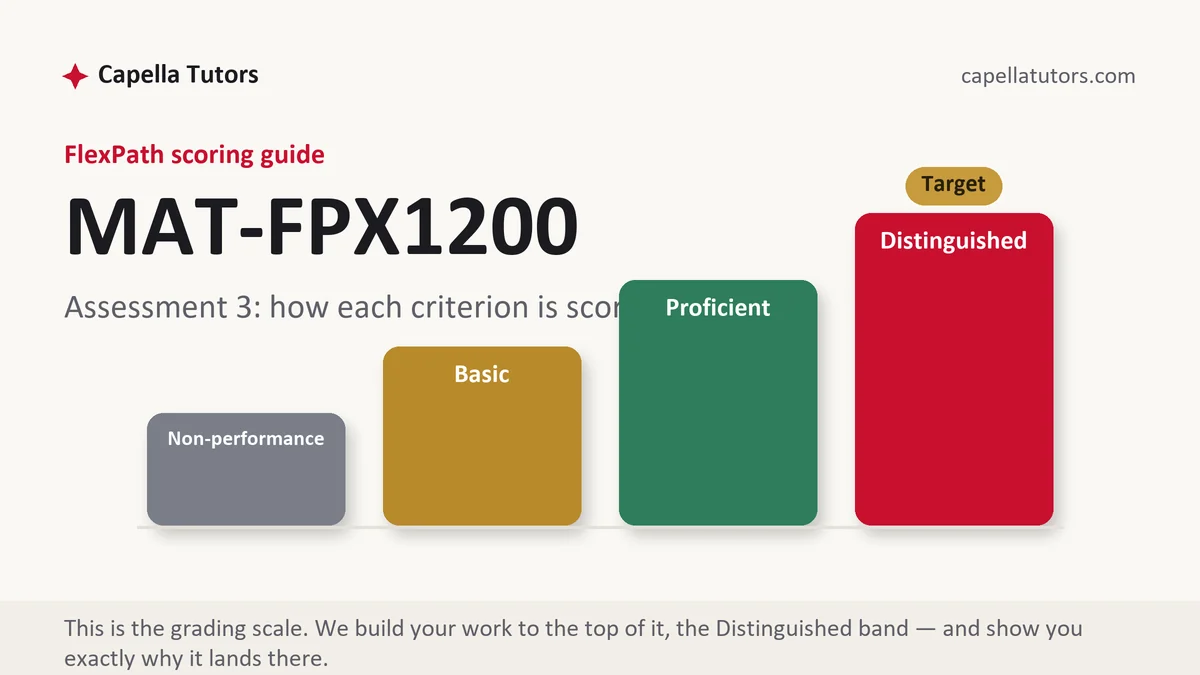
How MAT FPX 1200 Assessment 3 is scored
Levels replace numbers in FlexPath. Each row on your guide lands at one of four, and the sentence attached to each is what your writing has to satisfy:
| Level | What it means on a periodic model deliverable |
|---|---|
| Distinguished | Midline, amplitude, period, and phase are each derived from the observations with the arithmetic shown, the model is tested on a point it was not built from, the residual is reported in the units of the situation, and the span over which the model is worth trusting is named. |
| Proficient | The constants are right and the model reproduces the data it was built from. Correct work that never tests itself. |
| Basic | A sinusoid with plausible constants and no derivation, or a curve fitted by software with no account of what the parameters mean. |
| Non-performance | A required element is absent, commonly the phase shift or the test against data. Absence is scored as absence whatever surrounds it. |
Radians are the working unit, and a calculator left in degree mode returns values close enough to look right and wrong enough to fail every check you run afterward. State the mode you used beside the first trigonometric calculation. One line prevents a whole section from reading as an error.
The MAT FPX 1200 Assessment 3 method, step by step
-
Give every criterion a heading before you fit anything
Periodic rows usually pair a construction with an interpretation, and the interpretation is the half that pays. Put the top-level wording under each heading so you can see which constant each row is actually asking about.
-
Derive the midline and the amplitude from the extremes
Half the sum of the maximum and the minimum is the midline; half their difference is the amplitude. Show both subtractions in units, since a constant produced with no arithmetic behind it forfeits the row that asked where it came from.
-
Get the period, then convert it to a coefficient
The period is the length of one full cycle in the units of the input. Divide two pi by it to get the coefficient inside the function, and write that division out rather than presenting the finished number.
-
Anchor the phase on a moment you know
Choose cosine and align its peak with the observed maximum, or choose sine and align its rise. Say which you chose and which observation set the shift, because a phase asserted with no anchor is the commonest hidden error in this deliverable.
-
Confirm the model where you already know the answer
Evaluate at the maximum and at the minimum and show the model returning them. Then test it at a point you did not use to build it and report the gap in the units of the problem rather than smoothing it away.
-
Say where the model stops describing reality
A sinusoid will happily return a value for a date years out and it should not be trusted there. Name the interval over which it is a reasonable description, then self-score each row and submit with two business days to spare.
A structure that maps to the criteria
Read these as our planning figures for a modeling task, not as a standard; the rows on your own guide set the real proportions.
| Section | What it must do | Guide word target |
|---|---|---|
| The situation and the data | What repeats, over what cycle, and the observations the model will be built from. | ~140 words |
| Deriving the constants | Midline, amplitude, period, and phase, each with the arithmetic that produced it. | ~250 words |
| The model | The function written out with its input and output units, and the interval it covers. | ~170 words |
| Testing the fit | The extremes reproduced, then a point held back and the residual reported in units. | ~220 words |
| Interpretation and limits | What the model answers for the decision at hand, and where it stops being believable. | ~190 words |
| Format and sources | Angle mode stated, exact values kept exact, the data series cited in current APA with its retrieval date. | as needed |
Annotated sample excerpt
An original excerpt our team produced at the level the guide's top column describes. Take the moves from it and build yours.
The published series for this location gives 15.2 hours of daylight at the June maximum, day 172, and 9.1 hours at the December minimum, so the midline is half their sum, 12.15 hours, and the amplitude is half their difference, 3.05 hours.1 One cycle takes 365 days, so the coefficient inside the function is 2 pi divided by 365, and anchoring a cosine peak on day 172 gives D(t) = 12.15 + 3.05 cos(2 pi (t - 172) divided by 365), with t in days and D in hours, all angles in radians.2 Checking a day the model was not built from, day 60 returns about 11.1 hours against 11.3 hours in the published series, a residual near 12 minutes, which is small enough for sizing a panel array and too large for scheduling anything to the minute.3
- 1Each constant is derived from the observations in the sentence that introduces it, in hours. A midline asserted without the halving forfeits the row that asked for the derivation.
- 2The coefficient is shown as a division rather than a decimal, the anchor for the phase is named, and the angle mode is stated. All three are separately gradable.
- 3The model is tested against a point held back, the residual is reported in minutes, and the closing clause says what that error size permits and forbids. That is the analysis row.
The full premium sample for your exact assessment, written fresh to your scoring guide and issue, is free to request. Study it, revise it into your own voice, and submit work you understand.
The five mistakes that cost Distinguished
- A calculator left in degree mode. Radian problems answered in degrees return believable figures that disagree with every verification afterward.
- Constants written down with no derivation. Amplitude and midline each come from one subtraction, and showing it is the whole cost of the row.
- A phase shift with no anchor named. Saying which observation the peak was aligned to is what separates a fitted model from a guessed one.
- The model tested only where it was built. Reproducing the two extremes proves arithmetic, not fit, so a held-back point has to appear.
- A residual smoothed over. An acknowledged gap reads as competence and an unacknowledged one reads as an error you failed to notice.
Pre-submission checklist
- A heading for each criterion, and the constants it asks about identified
- Midline, amplitude, and period each derived with the arithmetic visible
- The phase anchored on a named observation, and the angle mode stated
- The function written out with input and output units
- A held-back point tested and its residual reported in the units of the problem
- The interval of validity named, every row self-scored before the attempt goes in
A periodic model to build this week?
Send the prompt, the criteria, and the data series you were pointed at. Eight people work the file, ending with an editor, and one pass exists only to re-derive every constant from the observations. Delivery is inside 24 to 48 hours, pitched at the top column, with free revision until it lands there.