This manual is for MAT FPX 1200 Assessment 2, start to submission. The middle deliverable in Pre-Calculus usually moves from describing one function to relating two. A parent function is transformed, an inverse is produced, and both the order of the operations and the domains involved are graded as closely as the algebra. Undergraduates lose this one on bookkeeping rather than on understanding. The steps our tutors work through are below, with a structure keyed to the rows and an annotated excerpt. Want the whole thing handled? A premium original sample written against your own criteria ships inside 24 to 48 hours, with revision free until it clears them. Capella's catalog lists the course as MAT-FPX1200, and some courserooms print MAT1200; both point to this same Assessment 2.
One honesty note before the manual: Capella revises courses and scoring guides over time, so always write to the exact scoring guide attached to your assessment in the courseroom. The course identity above is verified on capella.edu; the method and structure below are our tutors' approach to it, not Capella's official rubric text.
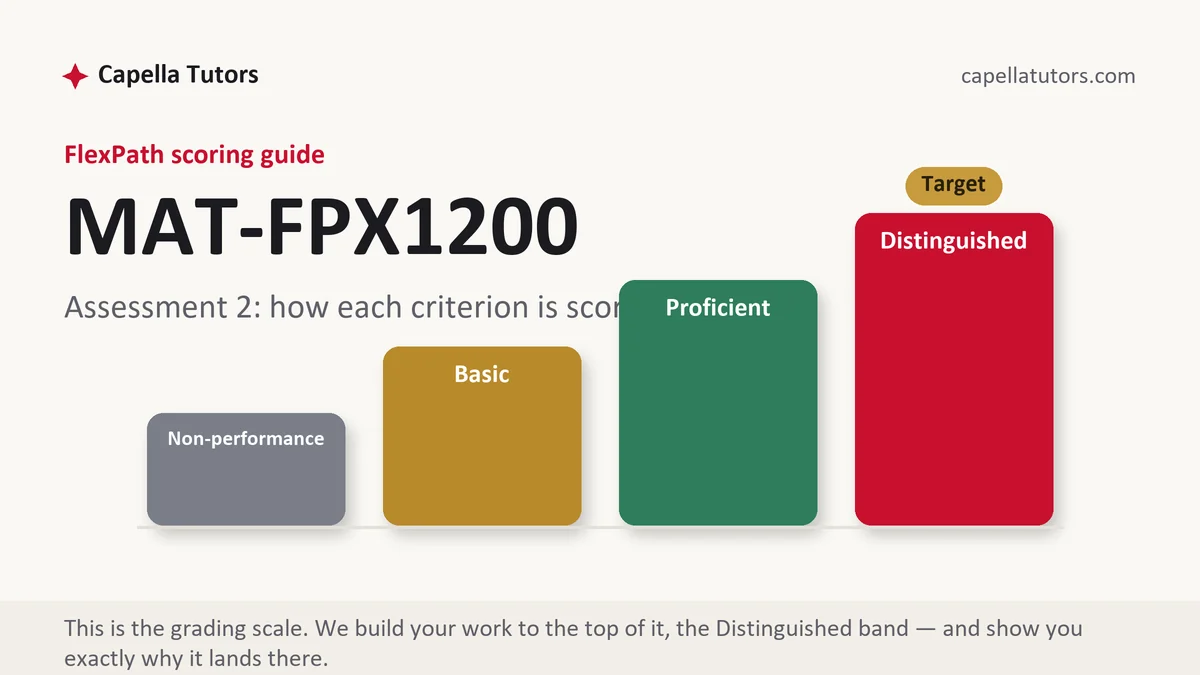
How MAT FPX 1200 Assessment 2 is scored
No score is totalled in this format. Every criterion is assigned one of four levels, and the language of the levels is the assignment:
| Level | What it means on a transformation and inverse deliverable |
|---|---|
| Distinguished | The parent function is named, each operation applied to it is listed in the order it acts, the inverse is produced with its own domain and range stated, the composition is checked in both directions, and any restriction is justified rather than asserted. |
| Proficient | The transformations and the inverse are both correct. Accurate work, with the domains handled quietly instead of explicitly. |
| Basic | A transformed graph with the operations in an unstated order, or an inverse produced by swapping letters with no check that it is one. |
| Non-performance | An element the row required is absent, most often the domain of the inverse or the verification. Missing rather than thin empties the row. |
Order is the whole difference between the two middle columns. A graph shifted, stretched, and reflected does not land in the same place when the operations run in another sequence, so track one labeled point through each step and show where it ends up. That single tracked point answers the ordering demand without a paragraph of explanation.
The MAT FPX 1200 Assessment 2 method, step by step
-
Map the criteria before the algebra
Give each row a heading and read for the hidden second demand, which in this deliverable is usually a domain statement attached to a computation. Rows about inverses almost always pay for the restriction, not for the swap.
-
Name the parent and list the operations
Say which basic function you started from and write the operations as an ordered list: stretched vertically by ten, then shifted by the reference value. Naming the parent is a row on many guides and it costs one sentence.
-
Track one point through every step
Choose a point on the parent graph and carry it through each operation, reporting its coordinates after each one. That is the cheapest possible proof that the order you claimed is the order you used.
-
Decide whether the inverse needs a restriction
A function passing the horizontal line test has an inverse as it stands, and one that fails it has none until the domain is cut. Say which case you are in and why, because a restriction applied silently reads the same as no restriction at all.
-
Produce the inverse and state both sets
Solve for the input, then swap the roles and write the inverse with its own domain and range, which are the range and domain of the original. Keep exact values exact, since a rounded constant will not compose back cleanly.
-
Verify by composing in both directions
Show the original composed with the inverse returning the input, and the inverse composed with the original doing the same across the restricted domain. Then mark yourself against each row and leave two business days for the evaluation.
A structure that maps to the criteria
The counts are our own planning targets for transformation work rather than Capella requirements; your guide decides which parts run long.
| Section | What it must do | Guide word target |
|---|---|---|
| The situation and the parent | What the function measures, the basic function it is built from, and the units on each axis. | ~140 words |
| The transformations | Every operation in the order it acts, with one labeled point tracked through the sequence. | ~230 words |
| Domain and range | Both sets for the original, derived from the algebra and from what the situation permits. | ~160 words |
| The inverse | Whether a restriction is needed and why, then the inverse with its own domain and range. | ~240 words |
| Verification and meaning | Both compositions shown, then a sentence saying what the inverse answers in the situation. | ~190 words |
| Format and sources | Exact values kept beside decimals, technology named with its input, references in current APA. | as needed |
Annotated sample excerpt
A model passage from our team, written at the standard the top level names. Study its structure, then write your own version.
Let I be sound intensity in watts per square meter, so the level in decibels is L(I) = 10 log (I divided by 10 to the negative 12), which is the common logarithm stretched vertically by a factor of ten after a horizontal compression by the reference intensity.1 Every logarithmic function is one-to-one across its domain, so no restriction is needed here and the inverse exists as it stands, which is worth saying rather than assuming: solving for I gives I(L) = 10 to the negative 12, times 10 to the power L over 10, with L in decibels and I positive.2 At the 85 decibel ceiling the studio's meter enforces, intensity is about 3.16 times 10 to the negative 4 watts per square meter, and doubling that intensity raises the level by 10 log 2, roughly 3 decibels rather than double.3
- 1The parent function is named and the operations acting on it are given in order, which answers the ordering demand in one clause instead of a paragraph.
- 2The question of a restriction is raised and settled with a reason rather than passed over. Saying why none is needed earns the same row as imposing one that is.
- 3The inverse is used to answer something the situation actually asks, and the closing clause corrects the intuition the scale invites. That is the interpretation row.
The full premium sample for your exact assessment, written fresh to your scoring guide and issue, is free to request. Study it, revise it into your own voice, and submit work you understand.
The five mistakes that cost Distinguished
- Transformations listed with no order. Shift, stretch, and reflect land in different places under different sequences, and an unordered list cannot be scored as correct.
- An inverse produced by swapping letters. Swapping x and y is bookkeeping; the row pays for the domain that makes the result a function.
- A restriction imposed without a reason. Cutting a domain silently reads exactly like forgetting to cut it, so the horizontal line test has to appear in words.
- Only one composition checked. Verification means both directions, since one of them can succeed while the other fails on the restricted set.
- Constants rounded before composing. A decimal substituted for an exact value early guarantees the composition returns something close to the input rather than the input.
Pre-submission checklist
- One labeled section per row, with the hidden domain demand noted in each
- The parent function named and the operations listed in the order they act
- One labeled point tracked through the whole sequence of transformations
- Domain and range stated for the original and for the inverse
- Any restriction justified by the horizontal line test, in words
- Both compositions shown returning the input, every row self-scored before submitting
Transformations and inverses to hand off?
Send the prompt, the criteria, and whichever graphing tool your faculty expects. Eight people handle the file, including a reviewer who marks it row by row as an evaluator will and a second mathematician who redoes the algebra from the prompt alone. Delivery is 24 to 48 hours, revised free until the guide is satisfied.