Hand over the prompt, the criteria, and whatever figures the assessment told you to work from, and a premium original sample returns within 24 to 48 hours with the arithmetic laid out step by step and each result translated back into a decision a person could act on. The catalog entry reads MAT FPX 1150, Essential Math for Everyday Life, worth 3 points, and it sits among the Natural Science and Mathematics choices on Capella's general education menu. Undergraduates assemble that menu themselves, taking at least 22.5 points across it and no fewer than 2 points from each of the four categories, which makes this a course you may elect rather than one your program hands you, whichever bachelor's degree you are enrolled in. In Capella's catalog the course code is written MAT-FPX1150.
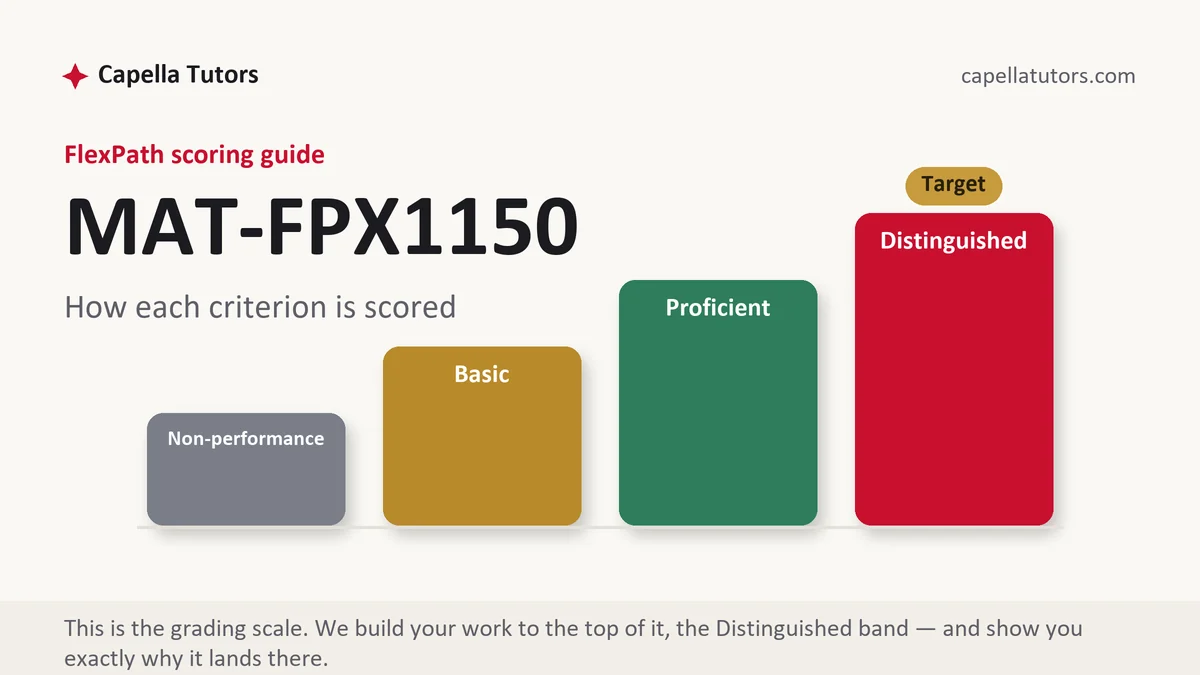
What MAT FPX 1150 actually grades
Learners arrive here expecting a test and find something closer to a short report. The mathematics is deliberately ordinary, which unsettles people who assumed the difficulty would live in the symbols rather than in the explaining. A criterion in an everyday mathematics guide typically asks whether you selected an appropriate operation, whether you carried it out accurately, and whether you communicated the outcome to an audience that does not do arithmetic for a living. Two of those three are writing tasks. Someone who has been dreading numbers since school usually discovers the first attempt is graded on how clearly the reasoning reads, and someone quick with figures usually loses rows for writing nothing down at all.
Percentage work carries the largest share of the criteria and produces the largest share of the errors. Percent change and percentage points are different quantities, so a savings rate moving from 4 percent to 5 percent has risen by one percentage point and by 25 percent, and an assessment can mark that distinction on its own. Discounts do not add. A $180 coat at 30 percent off comes to $126, a further 20 percent at the register brings it to $100.80, and the combined reduction is 44 percent rather than the 50 percent the signage seems to promise. Unit rates settle comparison questions that intuition gets wrong, since 64 ounces at $7.49 works out to 11.7 cents an ounce against 10.9 cents for 128 ounces at $13.99, a margin narrow enough that spoilage could reverse it. Carrying the units through the working is what stops a conversion running the wrong way, so 55 miles per hour becomes 55 times 5,280 feet divided by 3,600 seconds, about 80.7 feet every second.
Money arithmetic and basic probability fill out the rest of the graded ground. Loan questions want the payment formula used properly rather than a bank calculator quoted, so $18,500 borrowed over 60 months at 7.9 percent gives a monthly payment near $374, a total repaid of about $22,453, and roughly $3,953 of interest, and the interest figure is the one an assessment normally asks you to comment on. Simple and compound interest have to be told apart out loud, and an annual percentage rate stops equalling an annual percentage yield the moment compounding enters. Probability questions reward natural frequencies over notation. A screening test that catches 95 percent of true cases and wrongly flags 10 percent of healthy people, applied to 10,000 people of whom 1 percent are affected, produces 95 true positives against 990 false ones, so a positive result carries under a 9 percent chance of being right. Stating that in counts rather than in conditional symbols is what makes the answer legible to the reader the criteria have in mind.
How we help in this course
Samples for this course are built around the reader rather than around the equation. Every calculation is shown, and each one is bracketed by a sentence saying what question it answers and a sentence saying what the answer means for the person in the scenario. Money is carried to cents, tables are labeled so a figure in the narrative can be traced to the row it came from, and every comparison ends in a recommendation. Where the prompt asks for household figures of your own, tell us the numbers you are willing to share, since a budget deliverable written on invented amounts reads as invented.
Everything else matches what we quote elsewhere. A file passes through eight hands before it reaches you, among them a research analyst who reads your guide, a writer who does the mathematics, a reviewer who scores the draft against each criterion the way an evaluator will, an APA and originality check, and a final editor, with one pass reserved for recalculating the figures from scratch. Work lands inside 24 to 48 hours, aimed at the top of the four criterion levels rather than the middle of them, and revision continues without charge until the guide is met. If your evaluator sends comments back, those enter the same process at no cost, and since a submitted attempt takes two business days to assess, repairing a weak row beforehand is always cheaper in calendar time than resubmitting.
The assessments, one by one
Assessment 1
The opening deliverable in this course usually asks you to put a month of ordinary money onto a page, keep the totals honest, and then explain what the arithmetic implies to somebody who does not enjoy arithmetic. Read the full Assessment 1 manual.
Assessment 2
The middle deliverable in this course usually stops describing money and starts choosing between two versions of it. Read the full Assessment 2 manual.
Assessment 3
The third deliverable in this course usually turns on chance rather than on totals. Read the full Assessment 3 manual.
How to actually write MAT FPX 1150: where to begin
Read the scoring guide first and notice who it says the writing is for. Everyday mathematics rubrics tend to name an audience, and that audience sets the register for the whole document. Then map each criterion onto a heading and place the calculation that serves it directly underneath. Restate the question in your own words at the top of each section, because a restatement that is slightly wrong is the cheapest place to catch a misunderstanding.
The prose around the numbers follows three habits that will carry you through every deliverable in the course. Name the quantity before you name its value, so write that the monthly grocery total came to $612 rather than opening a sentence with a bare figure. Attach a base and a period to every rate, since 18 percent means nothing until it is 18 percent of something across a stated span. Show the operation in words beside the operation in symbols, so a reader learns that you divided total cost by number of ounces to reach a price per ounce, which is precisely the sentence that earns the criterion about selecting an appropriate method.
Estimate before you compute and you will catch nearly every serious error yourself. Rounding $7.49 for 64 ounces to about 12 cents an ounce tells you in two seconds what magnitude the exact answer must have, so a keystroke slip returning 1.17 or 117 announces itself immediately. Do the same with money over time, where payments multiplied by their number must exceed the sum borrowed, and with percentages, where a discount can never drive a positive price below zero. Then finish each section with a sentence naming what the number does not settle, whether that is the cost of a longer term or the risk that next month looks nothing like this one.
| Section | What goes in it | What Distinguished looks like |
|---|---|---|
| The question | The decision being made, the person making it, and the figures supplied or gathered. | The question restated in your own words, with the audience for the answer named. |
| The data | Amounts, rates, and periods used, with a source for anything not given in the prompt. | Figures organized into a labeled table that the narrative refers to by row. |
| The calculation | The operation chosen, performed in visible steps, with units carried down every line. | The choice of operation justified in a sentence before the arithmetic starts. |
| Estimate and check | A rough answer worked out first, and a plausibility test applied to the exact one. | An error caught and described, or a stated reason the result is the right size. |
| The recommendation | What the person in the scenario should do, and what that choice costs or saves. | A recommendation with a number attached and a condition that would reverse it. |
| Presentation | Currency to cents, rates to a stated precision, tables and outside sources in current APA. | Rounding consistent throughout and a reference list that matches the citations both ways. |
Developing the analysis
The analysis criterion in an everyday mathematics course is asking one specific thing: what does this number change. A total is not analysis, and neither is a comparison, until you say what follows from it. If the sixty month loan costs about $3,953 in interest, the analysis is that a thirty six month term costs far less in interest while raising the monthly payment, which makes the choice a question about cash flow rather than arithmetic. If the larger container saves eight tenths of a cent per ounce, the analysis is the yearly saving at your actual rate of use, set against the odds of throwing half of it away. Trade-offs are the substance of the row, so name at least two options, price both, say which one you would take, and give the condition that would flip the decision, because a recommendation that survives one honest objection reads as reasoning while a recommendation with no alternative reads as a preference.
Citations that survive faculty review
Most of the numbers in this course come from the prompt or from your own life, and those need labeling rather than citing, so state plainly that the grocery totals are your own from a named month. Everything imported from outside needs a real source, and consumer topics have unusually good ones. The Bureau of Labor Statistics publishes the Consumer Price Index and average prices for named goods, the Federal Reserve reports consumer credit and average rates by loan type, and the Internal Revenue Service publishes the brackets and standard deductions that any tax question turns on. Cite the agency, the publication or series, the period the figure covers, and the date you retrieved it, all in current APA. Steer clear of personal finance blogs and retailer pages, which age badly and rarely say where their own numbers came from, and never quote a rate without the year attached.
The mistakes that land Basic instead of Distinguished
- Percent change confused with percentage points. The two describe different movements, and a rubric mentioning either one will notice.
- Successive discounts added together. Each reduction applies to what is left, so the combined saving is always smaller than the sum of the signs.
- A rate quoted without its base or its period. A percentage floating free of what it measures cannot be checked and cannot be credited.
- Money rounded before the last line. Rounding partway through a payment schedule shifts the total by dollars and invites a query about the entire table.
- An answer with no decision attached. The communication row wants advice a reader could follow, not a correct total sitting on its own.
MAT FPX 1150 questions students actually ask
Do I have to use my own real household numbers?
Only where the prompt says so, and even then you have more room than the wording suggests. Faculty are not auditing your finances. They are checking that the figures hang together and that the reasoning built on them holds, so a household modeled on your real pattern with the amounts adjusted for privacy is acceptable provided you say that is what you did. Label the set as representative in one line, keep the relationships between the figures realistic, and make certain the totals add. A budget whose categories do not sum to the stated income is the quickest way to lose an accuracy criterion, and it is a far worse outcome than an openly estimated amount.
Can I do the work in a spreadsheet?
Yes, and for anything running past a handful of rows you should. Build the table in Excel or Google Sheets, paste the values into your document with the headings intact, and add one sentence per table naming the formula that generated each calculated column. The reason to name it is that a criterion about method cannot be satisfied by a column of results, however correct they are. Keep the workbook, because if an evaluator queries a figure you can point at the cell behind it. Set the display to two decimal places for currency instead of rounding the underlying values, so the numbers on the page and the numbers in the file never drift apart.
How precise should my rounding be?
Let the quantity decide, and state the rule once at the start rather than defending it line by line. Currency goes to cents. Unit prices usually need three or four decimal places to be comparable at all, since a gap of eight thousandths of a dollar per ounce is exactly the kind of margin these questions are built on. Rates go to one or two places unless the prompt asks for more. Counts of people or objects are whole numbers, and they round upward when the context is capacity, because half a delivery van does not exist. The rule that outranks the rest is to round at the end and only once, holding full precision inside the calculation, and to make the figure in your narrative match the figure in your table exactly.
Budget or consumer math deliverable due?
Send the criteria and the amounts you were asked to work with. Back comes a document a non-mathematician could read. The first premium sample is free.