This manual is for MAT FPX 1150 Assessment 1, start to submission. The opening deliverable in this course usually asks you to put a month of ordinary money onto a page, keep the totals honest, and then explain what the arithmetic implies to somebody who does not enjoy arithmetic. Two thirds of that is writing. The sections that follow give our tutors' method, a structure keyed to the rows, and an annotated excerpt. Prefer to hand this one off? A premium original sample for the prompt you were handed lands in 24 to 48 hours, revised at no charge until every row clears. Capella's catalog lists the course as MAT-FPX1150, and some courserooms print MAT1150; both point to this same Assessment 1.
One honesty note before the manual: Capella revises courses and scoring guides over time, so always write to the exact scoring guide attached to your assessment in the courseroom. The course identity above is verified on capella.edu; the method and structure below are our tutors' approach to it, not Capella's official rubric text.
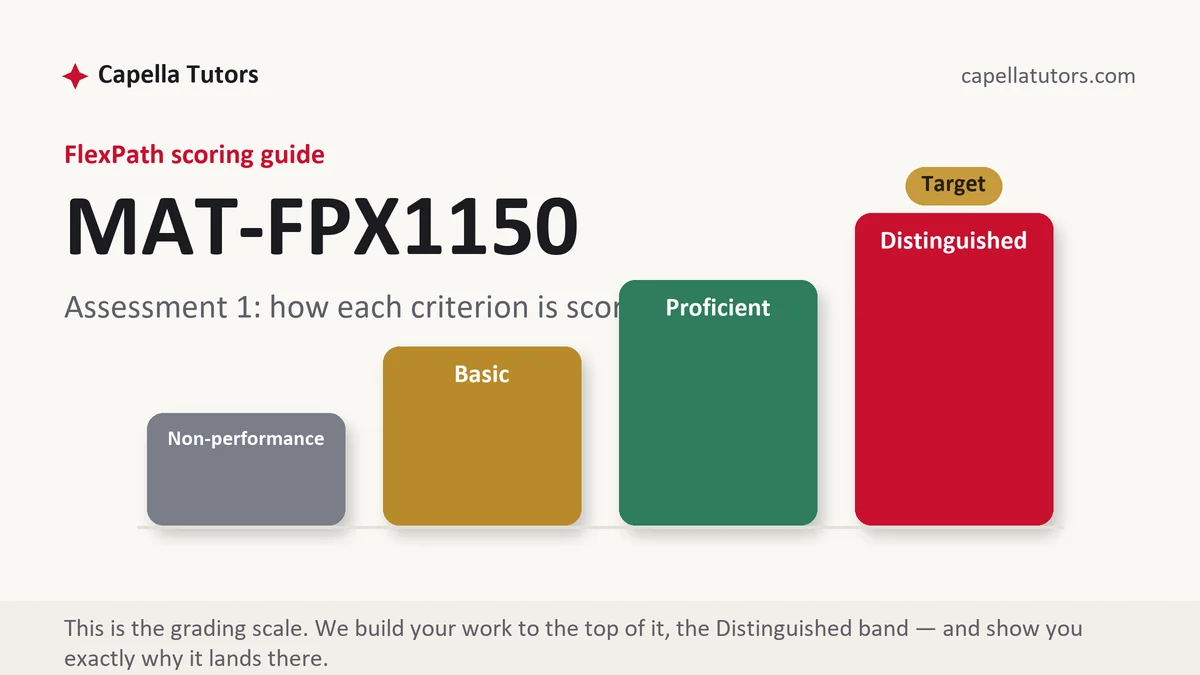
How MAT FPX 1150 Assessment 1 is scored
Grades in FlexPath are level names, not numbers. Each criterion on the guide is placed at one of four of them, and the wording of each is the brief:
| Level | What it means on a budget deliverable |
|---|---|
| Distinguished | Every figure is labeled and sourced, the totals reconcile to the stated income, the unknown category is solved for algebraically rather than guessed at, and the closing advice names a trade-off with a number on it. The further act sits in the row's own wording; locate it and carry it out. |
| Proficient | The table is complete and correct and the totals agree. Accurate work, with the advice left general. |
| Basic | A tidy list of amounts with no method visible and no recommendation attached to it. Where a first attempt usually comes to rest. |
| Non-performance | A required element never appears, most often the reconciliation or the advice. A row is emptied by something missing, not by something thin. |
One arithmetic fault outweighs the rest here. If the categories do not sum to the income you stated, every row downstream inherits the doubt, so total the column twice and say in one line that it balances.
The MAT FPX 1150 Assessment 1 method, step by step
-
Read the criteria and find the audience
Budget rubrics usually name who the writing is for, and that person sets the register for the whole document. Give each criterion its own heading before you enter a single figure, and keep nothing that does not belong under one of them.
-
Fix the income and label every amount
Work from take-home pay rather than salary, and say which one you used. Where the prompt lets you use your own household, adjust the amounts for privacy and state in one line that the set is representative. Unlabeled numbers cannot be checked and are not credited.
-
Separate what is fixed from what you control
Rent, insurance, a car payment, and childcare arrive the same size each month. Groceries, fuel, and everything discretionary move. Sorting the two is what makes the algebra possible, since only the second group can absorb a change.
-
Write the budget as an equation, then solve it
Set the sum of the categories equal to the income, put a letter where the unknown category sits, and solve for it. That one line is the difference between a spreadsheet and a piece of mathematics, and it is usually the row about method.
-
Estimate first, then reconcile the totals
Round the fixed obligations to the nearest fifty dollars and see what should be left. Then add the exact column and confirm it lands where the estimate said. Currency runs to cents, and the figure in the narrative has to match the figure in the table exactly.
-
End on a decision with a number attached
Name what the household should do, price it, and give the condition that would reverse the advice. Then self-score each row against the guide before submitting, allowing for the two business days an evaluation can take.
A structure that maps to the criteria
The counts are targets our tutors plan around on budget work, not Capella rules; the rows on your guide decide where the length should go.
| Section | What it must do | Guide word target |
|---|---|---|
| The situation | Whose money it is, the take-home figure, the month covered, and where the amounts came from. | ~140 words |
| The budget table | Every category with its amount, fixed and variable separated, columns totaled and labeled. | ~200 words |
| The algebra | The budget written as an equation, the unknown category isolated, and the solution shown. | ~240 words |
| Estimate and reconciliation | A rough check made first, then the exact totals confirmed against the stated income. | ~160 words |
| The recommendation | What to change, what it saves per month, and the condition that would reverse the advice. | ~200 words |
| Presentation and sources | Currency to cents, the rounding rule stated once, outside figures cited in current APA. | as needed |
Annotated sample excerpt
A model opening from our team at the register the highest level describes. Use it to see the moves, then make the same moves yourself.
Combined take-home pay is 4,180 dollars a month and the six fixed obligations total 2,774 dollars, so writing 2,774 + 240 + 300 + g + s = 4,180 puts the fuel and discretionary lines in place and leaves g for groceries and s for savings.1 The household wants s to be 8 percent of take-home, which is 334.40 dollars, so g = 4,180 - 2,774 - 240 - 300 - 334.40, or 531.60 dollars a month.2 For four people that is about 122.68 dollars a week, close to 4.37 dollars per person a day, which the household can test against last month's receipts instead of against a feeling.3
- 1The equation is written before anything is solved, with a letter in each open slot. This line is what turns a list of amounts into work a method row can score.
- 2The savings target is converted into dollars in the same sentence it appears in, because a percentage with no base attached cannot be checked.
- 3The result is restated in units the reader lives in, per week and per person, and pointed at evidence they already hold. That is the interpretation row.
The full premium sample for your exact assessment, written fresh to your scoring guide and issue, is free to request. Study it, revise it into your own voice, and submit work you understand.
The five mistakes that cost Distinguished
- Categories that do not sum to the income. A column off by eleven dollars puts every later figure in question and costs the accuracy row outright.
- Gross pay used as the spendable figure. Budgets are built on what arrives in the account, and mixing the two overstates every category below.
- A savings rate quoted with no base. Eight percent means nothing until it is eight percent of a stated amount across a stated month.
- Amounts rounded before the total. Rounding each line to whole dollars first shifts the total by enough to invite a query about the whole table.
- A closing paragraph with no number in it. Advice to spend less is not advice; the row wants an amount, a category, and a monthly figure.
Pre-submission checklist
- Each row of the criteria answered under a heading of its own
- Take-home pay named as such, with the month and the source of the amounts
- Fixed and variable categories separated, every figure labeled
- The budget written as an equation and the open category solved for on the page
- Totals reconciled to the stated income, currency carried to cents
- A recommendation with a monthly dollar figure and a condition that reverses it
A budget deliverable due this week?
Send the criteria and the amounts you were told to work with. A team of eight, including a research analyst and two QA reviewers, returns a premium original sample in 24 to 48 hours with every total recomputed independently, written so a reader who avoids arithmetic can follow it, and revised free until the rows clear.