This manual is for MAT FPX 1150 Assessment 2, start to submission. The middle deliverable in this course usually stops describing money and starts choosing between two versions of it. You are given a borrowing decision, asked to price both options properly, and then asked which one you would take and why. The arithmetic is a formula; the marks are in the trade-off. Our tutors' method appears below, along with a structure keyed to the rows and an annotated excerpt. Want it taken off your hands? A premium original sample on your own figures comes back in 24 to 48 hours, with free revision until the criteria are satisfied. Capella's catalog lists the course as MAT-FPX1150, and some courserooms print MAT1150; both point to this same Assessment 2.
One honesty note before the manual: Capella revises courses and scoring guides over time, so always write to the exact scoring guide attached to your assessment in the courseroom. The course identity above is verified on capella.edu; the method and structure below are our tutors' approach to it, not Capella's official rubric text.
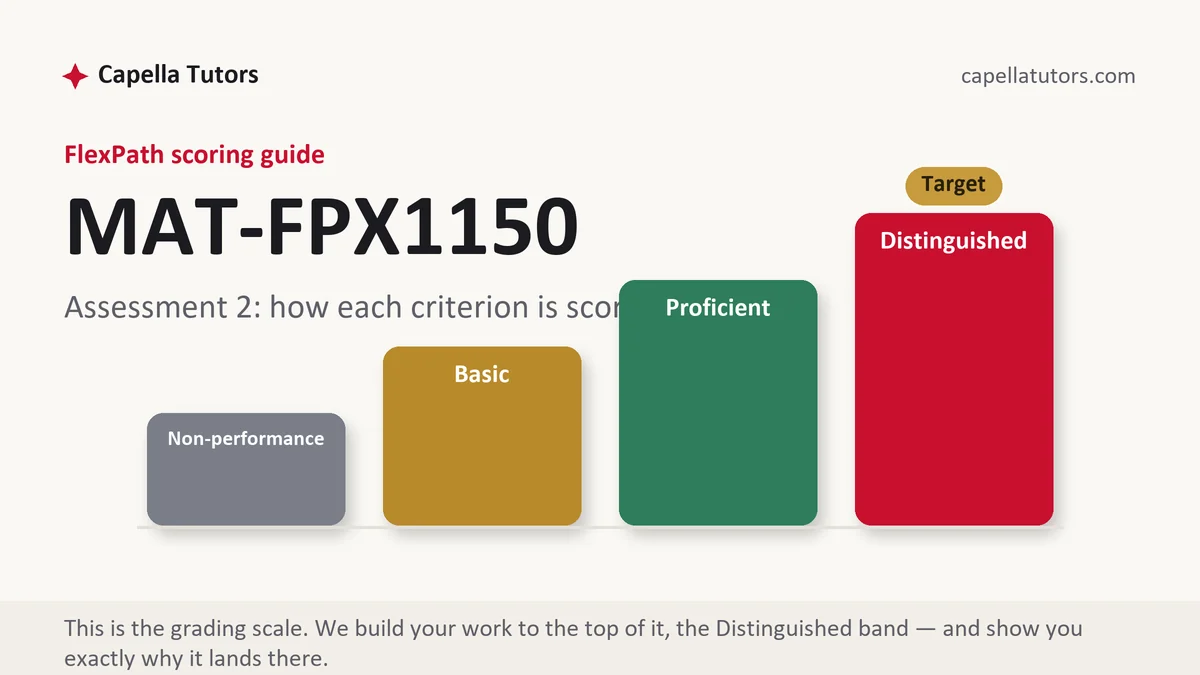
How MAT FPX 1150 Assessment 2 is scored
A FlexPath evaluator marks levels rather than totals. Each criterion sits at one of four, and the sentence describing your level is the specification:
| Level | What it means on a loan comparison deliverable |
|---|---|
| Distinguished | The payment is produced from the formula with the periodic rate and the number of periods shown, both options are priced on the same basis, total repaid and total interest are separated, and the recommendation names what the cheaper option costs in cash flow. |
| Proficient | Both payments are correct, the interest is correct, and a choice is stated. Accurate, with the trade-off left implied. |
| Basic | Figures quoted from an online calculator with no method visible, or two options priced and no recommendation made between them. |
| Non-performance | A required piece is missing, commonly the total interest or the comparison itself. An absent element sits at the floor whatever else is right. |
Watch the periodic rate. An annual rate has to be divided by the number of payments a year before it enters the formula, and an annual percentage rate stops equalling an annual percentage yield the moment compounding appears. Most wrong answers in this deliverable are one division away from being right.
The MAT FPX 1150 Assessment 2 method, step by step
-
Map the criteria and note the audience
Each row becomes a heading before any figure is entered. Consumer finance rubrics usually name the person the advice is for, and that person decides how technical the writing may be.
-
List the terms of both options side by side
Amount borrowed, annual rate, payments a year, and number of payments, in a small labeled table. Options priced on different bases cannot be compared, and the table is where a mismatch becomes visible.
-
Convert the annual rate into a periodic one
Divide the annual rate by the payments per year and write the result down. Say which formula you are using and what each symbol stands for, because the method row is asking for exactly that.
-
Compute the payment, then the totals
Payment first, then payment times number of periods for the total repaid, then total repaid minus the amount borrowed for the interest. Keep full precision inside the formula and round the answer once, to cents.
-
Sanity-check before you write a word about it
Payments multiplied by their count must exceed the sum borrowed, and the longer term must carry more interest and a smaller payment. If either fails, the periodic rate or the exponent went in wrong.
-
Recommend, and price the trade-off
Say which term you would take, what the shorter one costs each month, and what the longer one costs in total interest. Give the circumstance that flips the answer, then self-score each row before submitting.
A structure that maps to the criteria
Take the counts as our internal planning figures for a comparison of this kind; your scoring guide, not this table, decides the weighting.
| Section | What it must do | Guide word target |
|---|---|---|
| The decision | Who is borrowing, what for, and the two options being weighed against each other. | ~130 words |
| The terms | Amount, annual rate, payments per year, and term for each option, in a labeled table. | ~150 words |
| The calculation | The periodic rate derived, the formula named, and each payment computed in visible steps. | ~260 words |
| Total repaid and interest | Both totals for both options, with the interest separated from the principal. | ~180 words |
| The recommendation | The option chosen, the monthly cost of choosing it, and the condition that would reverse the choice. | ~210 words |
| Presentation and sources | Currency to cents, the rate's source and date in current APA, tables labeled and referenced by row. | as needed |
Annotated sample excerpt
An original passage our writers produced at the level the top column asks for. Read it for its moves and then build your own.
The amount financed is 14,800 dollars at an annual rate of 8.4 percent, so the periodic rate is 0.084 divided by 12, which is 0.007 per month, and the same figure applies to both options.1 Over 48 payments the monthly amount is 364.11 dollars, giving 17,477.28 dollars repaid and about 2,677 dollars of interest, while over 72 payments it falls to 262.43 dollars, giving about 18,895 dollars repaid and about 4,095 dollars of interest.2 The longer term saves 101.68 dollars a month and costs about 1,418 dollars more overall, which makes this a question about monthly cash flow rather than about arithmetic.3
- 1The periodic rate is derived out loud and shown to be shared by both options. Comparing terms priced on different bases is the fastest way to lose the accuracy row.
- 2Payment, total repaid, and interest are reported separately for each option. A single total hides the quantity the assessment is usually asking you to comment on.
- 3The comparison closes as a trade-off with both numbers on it, which is what an analysis row means by weighing two options rather than listing them.
The full premium sample for your exact assessment, written fresh to your scoring guide and issue, is free to request. Study it, revise it into your own voice, and submit work you understand.
The five mistakes that cost Distinguished
- An annual rate dropped straight into the formula. Skipping the division by twelve returns a payment far too high, and the error survives every later line.
- A payment quoted from a bank calculator. The row asks how the figure was reached, so the formula and the symbols behind it have to appear.
- Total interest never separated out. The amount repaid and the cost of borrowing are different quantities, and the second is the one under discussion.
- Money rounded inside the schedule. Rounding partway through shifts the total by dollars and invites a query about the entire table.
- A recommendation with no cash flow in it. Choosing the cheaper total is easy; the row wants the monthly cost of that choice named.
Pre-submission checklist
- One heading per criterion, with the top-level wording pasted beneath it
- Both options tabled with amount, annual rate, payments per year, and term
- The periodic rate derived on the page and the payment formula named
- Payment, total repaid, and total interest reported separately for each option
- A plausibility check shown: payments times count exceeding the amount borrowed
- A recommendation carrying both the monthly figure and the total interest figure
A borrowing comparison to write up?
Send the criteria and the terms you were given. Eight people handle the file, among them a reviewer who grades the draft row by row as a Capella evaluator would and one pass devoted to recomputing every payment from scratch. It returns inside 24 to 48 hours, revised at no charge until the guide is satisfied.