Send the prompt, the scoring guide, and any data table your instructor attached, and a premium original sample comes back inside 24 to 48 hours with every step written out and every result read back in plain language. The course appears on your transcript as MAT FPX 1050, College Algebra, carrying 3 points in the Natural Science and Mathematics category of Capella's general education menu. That menu asks for at least 22.5 points in total and at least 2 points drawn from each of its four categories, so this is one of several mathematics options rather than a required stop, and it is open to undergraduates in every Capella bachelor's program that runs in FlexPath. In Capella's catalog the course code is written MAT-FPX1050.
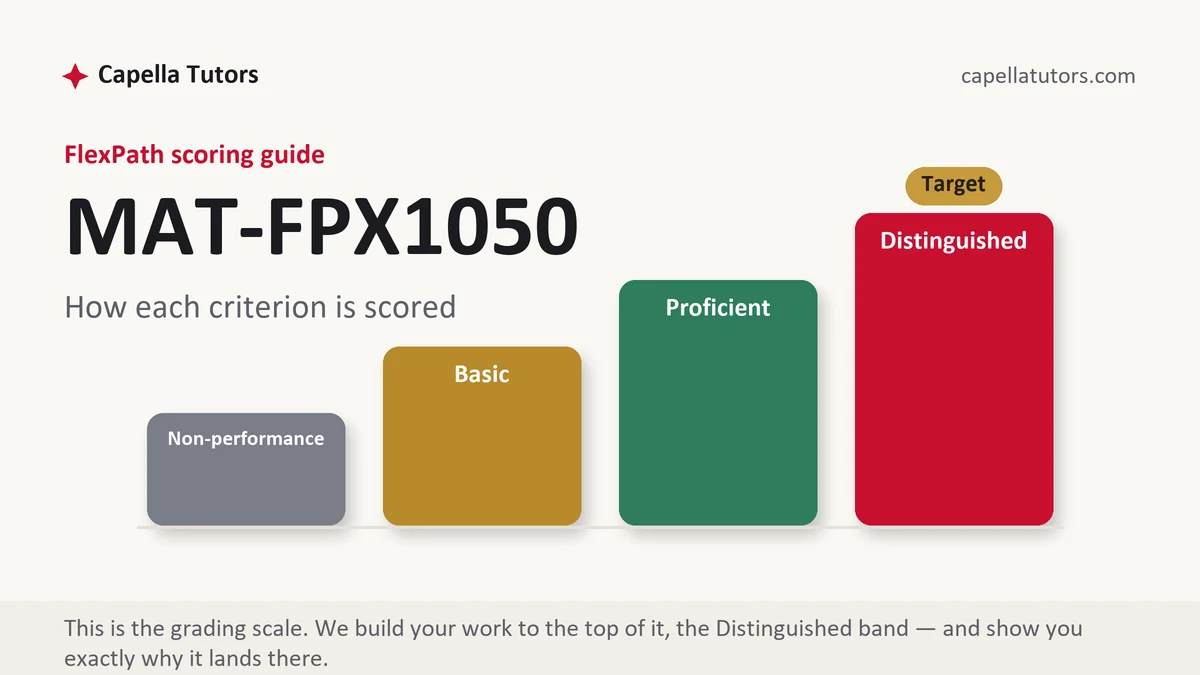
What MAT FPX 1050 actually grades
This course is not scored the way the algebra class you remember was scored. A timed test totals correct answers. A FlexPath criterion describes a level of performance and is judged on the evidence you left behind, which means the marker reads your setup, your notation, your method, and your interpretation, and only then your arithmetic. A learner who builds the right equation, names the variable with its units, solves cleanly, and misreads one digit on the way to the final line will usually still hold the criterion covering method. A learner who prints a correct number with nothing around it has given the evaluator nothing to measure against a Distinguished descriptor, which asks for work that could be followed and rechecked by somebody who did not watch it happen. Anxiety about mathematics is mostly anxiety about being caught out by a single wrong figure, and that is not the risk this format carries.
The content runs along the standard College Algebra spine, and the assessments in this course usually build around functions rather than around isolated equations. Expect to be handed a situation and asked to choose a model: linear where a quantity changes by the same amount each period, quadratic where something rises and then falls, exponential where the change is proportional to what is already there. Function notation carries more weight than students expect, because f(3) = 47 and f(x) = 47 are different questions, the first an evaluation and the second an equation to solve, and confusing them answers something nobody asked. Domain is the other quiet grader, since a cost function built on units produced has no meaning at x = -4 or at x = 2.5 units, and a strong answer says so rather than solving into territory the situation does not contain.
Three techniques carry most of the graded weight. Quadratics arrive as optimization in disguise, so 240 feet of fencing around a rectangular yard set against an existing wall gives A = w(240 - 2w), a vertex at w = 60, and a largest available area of 7,200 square feet. The discriminant answers a question before any solving happens, since 3x^2 - 5x + 4 has a discriminant of 25 minus 48, which is negative, and the accurate sentence is that no real solution exists rather than that the equation resisted you. Logarithms appear wherever an unknown sits in an exponent, so $6,400 invested at 4.5 percent compounded monthly for nine years grows to roughly $9,588, and asking how long it needs to double returns about 15.4 years. Radical and rational equations bring the trap that catches everyone, because squaring both sides of an equation setting the square root of (x + 7) equal to x - 5 produces x = 9 and x = 2, and only x = 9 survives substitution into the original.
How we help in this course
Our 1050 samples are written so the method is visible before the answer is. Each problem opens with the variable defined in words and units, the model named and justified, the algebra running downward with the operation on each line stated beside it, and a closing line in plain English rather than a boxed number. Send the exact wording of your prompt, since College Algebra criteria often name a specific technique, and a problem solved correctly by factoring can still miss a row that asked for the quadratic formula.
The commercial terms are the studio's standing ones. Eight people handle a file in sequence: a research analyst reads the scoring guide, a subject writer builds the solutions, a scoring-guide reviewer marks the draft row by row as a Capella evaluator would, an APA and originality pass checks the citations against the reference list, and an editor reads last, with one pass given over entirely to recomputing every number independently. Delivery is inside 24 to 48 hours, pitched at the Distinguished descriptor rather than at a pass, and revisions continue at no charge until the guide is satisfied. Faculty comments rejoin the same queue free, which is worth knowing when an attempt takes two business days to evaluate.
The assessments, one by one
Assessment 1
The opening deliverable in College Algebra usually hands you a situation in ordinary words and asks for three things: a function built to describe it, that function solved for whatever the situation actually cares about, and a sentence saying what the solution means in the units of the problem. Read the full Assessment 1 manual.
Assessment 2
The middle deliverable in College Algebra usually moves from describing a situation to optimizing one. Read the full Assessment 2 manual.
Assessment 3
The closing deliverable in College Algebra usually asks for the family of function that undergraduates find least intuitive and evaluators grade most closely. Read the full Assessment 3 manual.
How to actually write MAT FPX 1050: where to begin
Open the scoring guide before you open the problem set, and read it as a list of things you have to make visible. Mathematics criteria in FlexPath usually separate four jobs that learners collapse into one: choosing a model, executing a procedure, checking a result, and interpreting it in context. Give every problem its own heading, restate what is being asked in a single sentence, define the variables with their units, then work downward with a short line of text before each block of algebra saying what you are about to do and why.
Writing mathematics in prose is the skill this course is really teaching, and it is the one nobody warns undergraduates about. Sentences carry the reasoning and equations are quoted inside them the way a source would be. Write that both sides were divided by 4 to isolate the variable, not merely the line that results, and say what a symbol means the first time it appears. Numbers need units and a period attached wherever the problem has a context, because 1,240 is not an answer and 1,240 subscribers after eight months is. Round once, at the end, to a precision the situation can support, and state the rule you used, since money rounds to cents and a count of people does not round to a decimal at all.
Then build in the check, because it is free marks and most submissions skip it. Substitute your solution into the original equation and show the two sides agreeing. Ask whether the answer is the right size, so a monthly payment larger than the amount borrowed means an error happened somewhere above, and a negative count of anything physical is a signal rather than a result. Extraneous roots from squaring and from clearing denominators are where a written check earns its keep, and performing it on the page is what separates a criterion saying the result was verified from one saying a result was produced.
| Section | What goes in it | What Distinguished looks like |
|---|---|---|
| The situation | The quantity being modeled, the variable standing for it, and the units it carries. | Variables defined in words before any symbol appears, with the domain the context allows. |
| The model | The function chosen, why that family fits the behavior described, and where the constants came from. | A justification tied to the pattern in the situation rather than to the chapter the problem sits in. |
| The work | Every algebraic step in order, with the operation on each line named in words. | Steps a reader could reproduce without guessing, and the technique named when the guide names one. |
| The check | Substitution back into the original, plus a plausibility test on size and on sign. | Extraneous roots and excluded values identified by you rather than discovered by the grader. |
| The interpretation | A sentence saying what the number means for the situation, with units and a time frame. | An answer to the question that was asked, including what the model cannot settle. |
| Format and sources | Equations typed legibly, tables and figures labeled, outside data cited in current APA. | Notation consistent throughout, software output named, and the rounding rule stated once. |
Developing the analysis
Analysis in a mathematics course means saying what your result is worth, and undergraduates lose that row by stopping at the number. A model is a set of assumptions wearing an equation, and the assumptions are the interesting part. An exponential growth function assumes the rate holds steady, which is why a projection built on three months of data turns ridiculous by year four. A linear cost model assumes the price per unit never moves, so a bulk discount breaks it at a threshold you can name. Where an assessment gives you data instead of a formula, choose the family deliberately, fit the constants, then test the fit against a point you did not use to build it, and state which range of inputs your answer covers and where it stops meaning anything at all.
Citations that survive faculty review
Mathematics has its own citation habits and they are not the ones a composition course teaches. A standard formula is common knowledge and needs no source, so the quadratic formula and the compound interest formula can be stated bare. Anything drawn from outside the problem does need attribution: a price, an interest rate, a population, a tax bracket, a wage. Federal statistical sources are the ones faculty accept without argument, meaning Bureau of Labor Statistics series for prices and wages, Census tables for population, and Federal Reserve or FRED data for rates, each cited with the series title, the period it covers, and the retrieval date. Your textbook is a legitimate reference for a definition, a named theorem, or a worked method, and a poor one for anything else. Software counts as a source of a kind, so name the tool, whether Excel, Desmos, GeoGebra, or a calculator model, and say what you asked it to do, because a grader who cannot tell how a graph was produced cannot credit it.
The mistakes that land Basic instead of Distinguished
- An answer with no visible method. A number on its own cannot be scored against a criterion asking how the result was reached.
- Function notation used loosely. Evaluating a function at a value and solving it for a value are different tasks with different answers.
- Rounding at every step. Truncating intermediate figures pushes the final result far enough off to look like an error in the algebra.
- Solutions never substituted back. Squaring and clearing denominators both invent roots, and the unchecked one is the one that gets marked.
- A result left as a bare number. Units, a time frame, and a sentence of meaning are usually a separate row from the arithmetic beneath them.
MAT FPX 1050 questions students actually ask
Do I lose the criterion if my final answer is wrong?
Not automatically, and this is the largest single difference between a criterion-scored assessment and the timed algebra tests most people are remembering. Criteria are written about performance, and a mathematics guide usually carries separate rows for setting up the model, executing the procedure, verifying the result, and explaining it. An arithmetic slip damages the row it lives in and often nothing else, provided the setup is sound and the reasoning is visible on the page. What sinks a submission is invisible work, because a marker cannot award a method row for a method that was never written down. There is a second chance built into the format as well: FlexPath submits on grade, your evaluator has two business days to respond, and the feedback names the row that fell short so the next attempt can be aimed at it.
Can I solve the problems with a graphing tool instead of by hand?
Usually yes, and sometimes the guide requires it, but the tool does not remove the writing. If you locate an intersection in Desmos or fit a trend in Excel, say which tool produced it, describe what you entered, and reproduce enough of the reasoning that a reader without your file can follow the argument. Then confirm the result algebraically wherever that is quick, since a value read off a screen carries the precision of the pixel and an exact solution does not. The failure to avoid is a screenshot standing in for a paragraph. A picture of a parabola with its vertex marked shows that software was opened, and it does not show that you know why the vertex answers the question the prompt asked.
How much writing does a College Algebra assessment actually need?
More than the arithmetic feels like it deserves and far less than an essay. A workable ratio is a short paragraph wrapped around every problem: one or two sentences framing what is being found and by what method, the solution laid out in visible steps, then one or two sentences saying what the result means for the situation described. That gives every row of a scoring guide something to grade, and it is well short of the page of narrative some learners produce out of nerves. Write in ordinary sentences with plain punctuation, and do not apologize inside the document. Faculty read hedging as uncertainty about the mathematics, and it costs the interpretation criterion more often than a genuine slip does.
Algebra assessment due?
Send the prompt, the scoring guide, and any data table you were handed. Every step comes back written out. The opening premium sample costs nothing.