This manual is for MAT FPX 1050 Assessment 3, start to submission. The closing deliverable in College Algebra usually asks for the family of function that undergraduates find least intuitive and evaluators grade most closely. Something changes in proportion to how much of it is already there, you are asked when it reaches a stated level, and the unknown ends up sitting in an exponent where only a logarithm can reach it. The synthesis part is what the model can and cannot promise. Set out below are our tutors' method, a structure keyed to the rows, and an annotated excerpt. Would you sooner it were handled for you? A premium original sample written to your own guide ships in 24 to 48 hours, and revision keeps going free until it clears. Capella's catalog lists the course as MAT-FPX1050, and some courserooms print MAT1050; both point to this same Assessment 3.
One honesty note before the manual: Capella revises courses and scoring guides over time, so always write to the exact scoring guide attached to your assessment in the courseroom. The course identity above is verified on capella.edu; the method and structure below are our tutors' approach to it, not Capella's official rubric text.
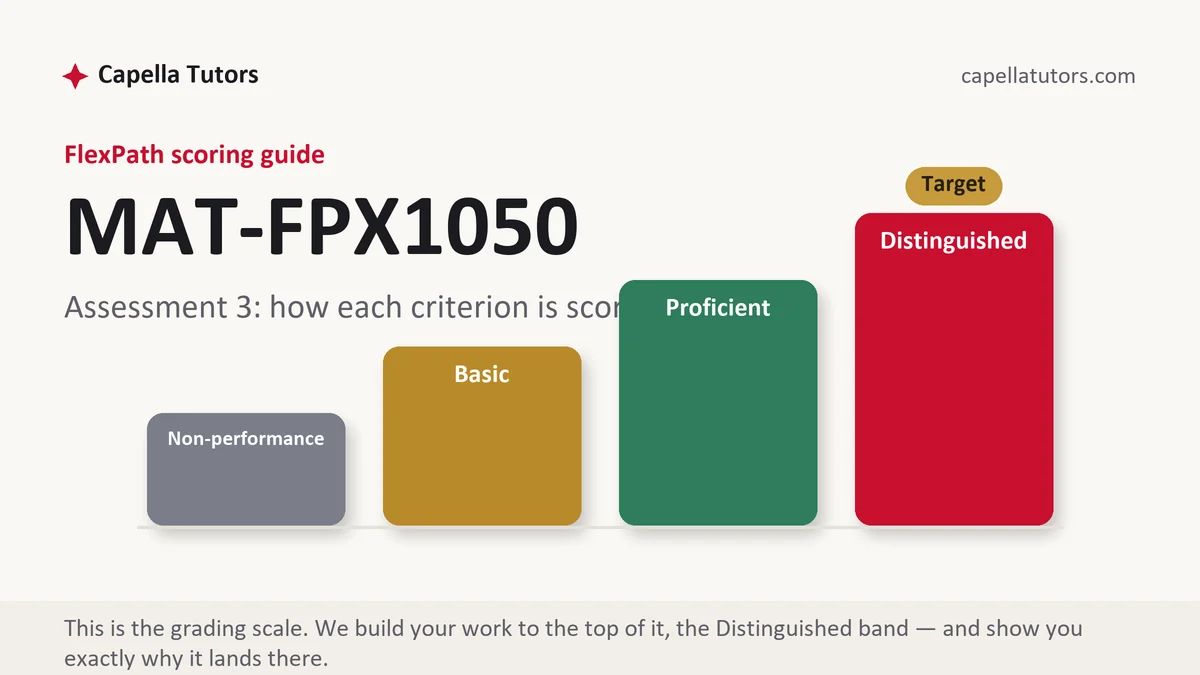
How MAT FPX 1050 Assessment 3 is scored
No percentage is recorded anywhere. Your scoring guide places each criterion at one of four levels, and those levels describe the writing you owe:
| Level | What it means on an exponential and logarithmic deliverable |
|---|---|
| Distinguished | The base or rate is derived from the situation rather than guessed, the exponential form is written with its meaning stated, the logarithm is applied to the correct side and the base is named, the answer is rounded once to a precision the context supports, and the paper says over what span the model is worth trusting. |
| Proficient | The model is built correctly, the logarithm is used correctly, and the answer is right. Accurate, and silent about precision and about limits. |
| Basic | A growth or decay factor lifted from the prompt with no account of where it came from, or a correct answer with the logarithmic step compressed into one unexplained line. |
| Non-performance | Something the row demanded is not there at all, most often the interpretation or the stated assumption behind the rate. A piece that never appears sits at the floor no matter how clean the working above it is. |
One convention saves more rows here than extra practice does. Keep the rate and the base straight, since a decline of 14 percent a year means a multiplier of 0.86, and writing 1.14 or negative 0.14 in that slot returns figures that look plausible and fail every check you run afterward.
The MAT FPX 1050 Assessment 3 method, step by step
-
Map each criterion before you touch the numbers
Heading per row, top-level wording underneath, nothing written that does not belong to one of them. Exponential rows tend to pair a computation with an explanation of what the base means, and the explanation is the half that gets left out.
-
Derive the multiplier from the wording
A quantity falling 14 percent a year keeps 86 percent, so the multiplier is 0.86 and the model is an initial amount times 0.86 raised to the number of years. Write that sentence out, because a base copied off the page costs the row asking where the constants came from.
-
Say what the function means before you solve it
One sentence naming the input, the output, and their units: V(t) gives the truck's value in dollars t years after purchase. Then state the span the situation allows, since a resale model built on eight years of observation says nothing useful about year forty.
-
Isolate the power, then take the logarithm
Divide before you take a logarithm, never the other way around. Then apply the logarithm to both sides, name the base you used, and bring the exponent down with the power rule stated in words. The compressed one-line version of this step is the most frequently marked gap.
-
Round once, at the end, to a precision the context can hold
State the rule in a single line and apply it only to the final figure. Money goes to cents, a count of years to a sensible fraction of a year, a population to whole people. Rounding partway and feeding the value onward puts the answer far enough off to look like an algebra error.
-
Check the answer against the situation, then self-score
Substitute the solution back and show the model returning the level you were solving for. Ask whether the size makes sense, since a value rising under decay means a sign or a base went wrong. Then grade yourself row by row and submit with two business days to spare.
A structure that maps to the criteria
These counts are our planning figures for a deliverable of this kind and carry no official standing; your own guide sets what each part is worth.
| Section | What it must do | Guide word target |
|---|---|---|
| The situation | The quantity, its starting level, the rate at which it changes, and the units of time. | ~130 words |
| Building the model | The multiplier derived from the stated percentage, the function written out, and what its input and output mean. | ~220 words |
| Solving for the unknown | The power isolated, the logarithm applied with its base named, and the exponent brought down with the rule stated. | ~250 words |
| Precision and check | The rounding rule given once, the solution substituted back, and the result tested for size and sign. | ~170 words |
| Interpretation and limits | The answer in the units of the decision, plus the span over which the constant rate is believable. | ~190 words |
| Format and sources | Exact forms kept beside decimals, any published rate or price cited in current APA with its retrieval date. | as needed |
Annotated sample excerpt
An original excerpt from our writers, pitched at the level the guide's top column describes. Study how it moves, then write yours.
The truck cost 31,500 dollars and its make loses about 14 percent of its value a year, so it retains 86 percent annually and V(t) = 31500(0.86) raised to the power t gives the resale value in dollars t years after purchase.1 The dealer's trade-in floor is 12,000 dollars, so solving 31500(0.86) to the t equal to 12000 starts by dividing both sides by 31,500, which isolates the power and leaves 0.86 to the t equal to about 0.38095.2 Taking the natural logarithm of both sides and applying the power rule gives t times the natural log of 0.86 equal to the natural log of 0.38095, so t is about 6.4 years, partway through the seventh year of ownership.3
- 1The multiplier is derived from the stated percentage in the sentence that introduces it, and the function is defined with its input in years and its output in dollars. Both are gradable moves.
- 2The power is isolated by division before any logarithm appears. Reversing that order is the commonest wrong turn here and a grader sees it immediately.
- 3The base of the logarithm is named, the power rule is stated in words rather than performed silently, and the rounded answer is translated into the year of ownership a reader cares about.
The full premium sample for your exact assessment, written fresh to your scoring guide and issue, is free to request. Study it, revise it into your own voice, and submit work you understand.
The five mistakes that cost Distinguished
- A base copied instead of derived. Writing 0.86 with no sentence explaining that a 14 percent loss leaves 86 percent behind forfeits the row asking where the constants came from.
- The logarithm taken before the power is isolated. Applying a logarithm to an unreduced equation produces a line that cannot be repaired further down.
- Percent decline written as the multiplier. A 0.14 or a 1.14 in the base slot returns figures that look reasonable and disagree with every check you run.
- Rounding introduced at the first opportunity. Truncating a quotient of logarithms to two places early moves the threshold year by months and reads as arithmetic failure.
- A constant rate treated as a fact. Fourteen percent a year is borrowed from the past, and naming the span over which it stays credible is the sentence the top column pays for.
Pre-submission checklist
- A labeled section for each row of the guide, kept in the guide's own order
- The multiplier derived in a sentence from the percentage the prompt supplied
- Input, output, and units defined before the equation is solved
- The power isolated first, then the logarithm applied with its base named
- One rounding rule stated and applied only to the final figure, exact form kept beside it
- The solution substituted back, the span of validity stated, every row self-scored
Exponential and logarithm problems due?
Send the prompt, the guide, and the figures you were given. Eight people handle the file, ending with an editor and including one pass devoted to recomputing every logarithm independently. It returns inside 24 to 48 hours with the exact forms kept beside the decimals, and revisions continue at no charge until the rows clear.