This manual is for MAT FPX 1050 Assessment 1, start to submission. The opening deliverable in College Algebra usually hands you a situation in ordinary words and asks for three things: a function built to describe it, that function solved for whatever the situation actually cares about, and a sentence saying what the solution means in the units of the problem. Undergraduates reliably do the middle one and skip the other two. What follows is the method our tutors apply, a structure lifted from the criteria, and an annotated excerpt. Prefer to send it out instead? A premium original sample worked from the prompt you were handed returns in 24 to 48 hours, and revision runs free until every row clears. Capella's catalog lists the course as MAT-FPX1050, and some courserooms print MAT1050; both point to this same Assessment 1.
One honesty note before the manual: Capella revises courses and scoring guides over time, so always write to the exact scoring guide attached to your assessment in the courseroom. The course identity above is verified on capella.edu; the method and structure below are our tutors' approach to it, not Capella's official rubric text.
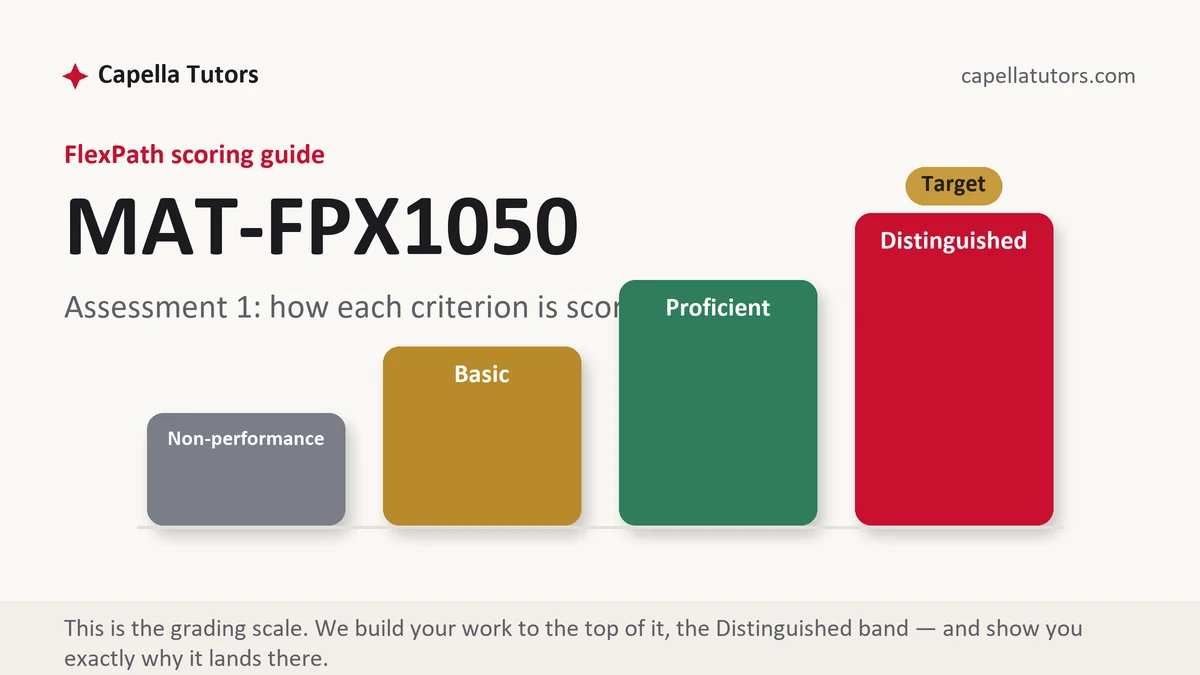
How MAT FPX 1050 Assessment 1 is scored
FlexPath hands out no letter grades at all. Every criterion on your scoring guide is marked at one of four named levels, and that level wording is what you write toward:
| Level | What it means on an applied function deliverable |
|---|---|
| Distinguished | The variable arrives defined with its units and its domain, the family of function is justified from the behavior described, the algebra runs where a reader can follow it, the solution is checked on the page, and the result is stated as something a person in the situation could act on. The additional act is written into the row itself; find it and do it. |
| Proficient | A sound model, solved correctly, with the answer given. Accurate work, one act short of the column above it. |
| Basic | A correct figure with the route to it missing, or a model produced with no reason offered for choosing that family. Where most first attempts in College Algebra come to rest. |
| Non-performance | A required piece is absent, most often the interpretation sentence or the substitution check. Missing rather than thin is what drops a row to the floor. |
The practical effect is that arithmetic and reasoning sit in separate rows. One misread digit damages the row it lives in and leaves the others standing, provided the method is legible above it. Work nobody can see is the expensive failure, because no row about method can be awarded for a method that was never written down.
The MAT FPX 1050 Assessment 1 method, step by step
-
Turn the scoring guide into your outline
Read the criteria before the problem set, and give each one its own heading in an empty document, with the top-level wording parked underneath. Anything outside those headings is unpaid work, and in a mathematics deliverable that usually means paragraphs of definition nobody asked for.
-
Name the quantity, then name its units
Write one sentence per variable, in words, before a symbol appears: let p be the number of pages copied in a month. Add the inputs the situation allows, since a count of pages cannot be negative and cannot be a fraction. Two sentences of setup earn a row that costs nothing.
-
Choose the family from the behavior, not from the chapter
A quantity that changes by the same amount each period is linear. One that rises and then falls is quadratic. One that changes in proportion to what is already there is exponential. Say which pattern the wording describes and then name the family, because the justification is usually scored separately from the model itself.
-
Run the algebra downward with each operation named
One line per step, with a short clause beside it: both sides divided by the difference in the per-page rates to isolate the count. Keep the notation honest, since evaluating a function at a value and solving it for a value are different tasks with different answers.
-
Check the solution, then check its size
Substitute the result back into the original relation and show the two sides agreeing. Then ask whether the answer could be true, since a break-even below zero pages or a cost that falls as usage rises is a signal rather than a result. Extraneous roots are caught here or by your evaluator.
-
Close with a sentence somebody could act on
Every problem ends in plain English with units and a time frame attached, not in a boxed number. Then read the draft against the guide one row at a time and mark each row yourself. Go in early in the week, since an evaluation may take two business days to come back.
A structure that maps to the criteria
The word counts are our tutors' planning targets for a deliverable of this type rather than Capella rules; your scoring guide decides how much each part deserves.
| Section | What it must do | Guide word target |
|---|---|---|
| Situation and variables | The quantity being modeled, the letter standing for it, the units it carries, and the inputs the context permits. | ~120 words |
| The model | Each function written out, with the behavior in the wording that justified choosing that family. | ~200 words |
| The solution | Every algebraic step in order, each line carrying the operation that produced it in words. | ~280 words |
| The check | The solution put back into the original relation, and its size and sign tested against the situation. | ~140 words |
| Interpretation | What the number means for the person in the situation, with units and a period attached. | ~180 words |
| Format and sources | Equations typed legibly, tables labeled, any outside figure cited in current APA. | as needed |
Annotated sample excerpt
An original model opening from our team, written at the register the guide's top level describes. Treat it as study material and rebuild it in your own words.
Let p be the number of pages the print shop copies in one month, a whole count with no meaning below zero.1 Contract A charges a 145 dollar monthly fee plus 1.8 cents a page, so A(p) = 145 + 0.018p, and Contract B charges no fee and 4.6 cents a page, so B(p) = 0.046p; both are linear because each adds the same amount for every extra page.2 Setting A(p) equal to B(p) gives 145 = 0.028p, so p is about 5,179 pages, and Contract B is cheaper below that figure while Contract A is cheaper above it.3
- 1The variable is defined in words, with its units and the inputs the situation allows, before any symbol is used. Most undergraduates leave this row on the table.
- 2Both functions are written out and the choice of family is defended from the wording of the contracts rather than from the unit the problem came from. That defense is usually its own row.
- 3The solution is carried into the decision it answers, in pages per month, with both sides of the crossing named, so the interpretation row has a sentence to grade.
The full premium sample for your exact assessment, written fresh to your scoring guide and issue, is free to request. Study it, revise it into your own voice, and submit work you understand.
The five mistakes that cost Distinguished
- The family chosen by chapter. Calling a relationship linear because the current unit is about lines, rather than because the quantity climbs by a fixed amount per page, empties the justification row.
- Units dropped at the first line of algebra. A solution reading 5,179 with no pages and no month attached answers a question nobody in the situation asked.
- A crossing point with no sides. A break-even figure earns its row only once you say which option wins above it and which below.
- Intermediate rates rounded early. Cutting a per-page cost to two decimals partway through moves the crossing point by hundreds of pages, and the drift reads as an algebra error.
- Inputs the situation cannot hold. Solving into negative pages or half a page shows the permitted range was never considered, and stating the restriction is part of the answer.
Pre-submission checklist
- Every row on the guide has a labeled section of its own in the document
- Each variable defined in words, with units, before any symbol appears
- The family of each function justified from the behavior the prompt described
- Each algebraic line carrying the operation that produced it, in words
- The solution substituted back, and its size and sign tested against the situation
- A closing sentence per problem with units and a period, self-scored before submitting
Applied algebra problems due this week?
Send the prompt, the scoring guide, and any figures the assessment handed you. A team of eight, including a research analyst and two QA reviewers, returns a premium original sample written to the top of the guide in 24 to 48 hours, with one whole pass spent recomputing every number independently, and revisions until the rows clear.