This manual is for MAT FPX 1050 Assessment 2, start to submission. The middle deliverable in College Algebra usually moves from describing a situation to optimizing one. The assessment tends to hand you a quantity that rises and then falls, ask for the input that makes it largest or smallest, and then ask what the answer is worth to whoever has to make the decision. Quadratics are the tool, and the vertex is only half the marks. The method our tutors work to is set out below, with a criterion-keyed structure and an annotated excerpt. Rather hand the whole thing over? A premium original sample built on your own prompt arrives inside 24 to 48 hours, with revision continuing free until the guide is met. Capella's catalog lists the course as MAT-FPX1050, and some courserooms print MAT1050; both point to this same Assessment 2.
One honesty note before the manual: Capella revises courses and scoring guides over time, so always write to the exact scoring guide attached to your assessment in the courseroom. The course identity above is verified on capella.edu; the method and structure below are our tutors' approach to it, not Capella's official rubric text.
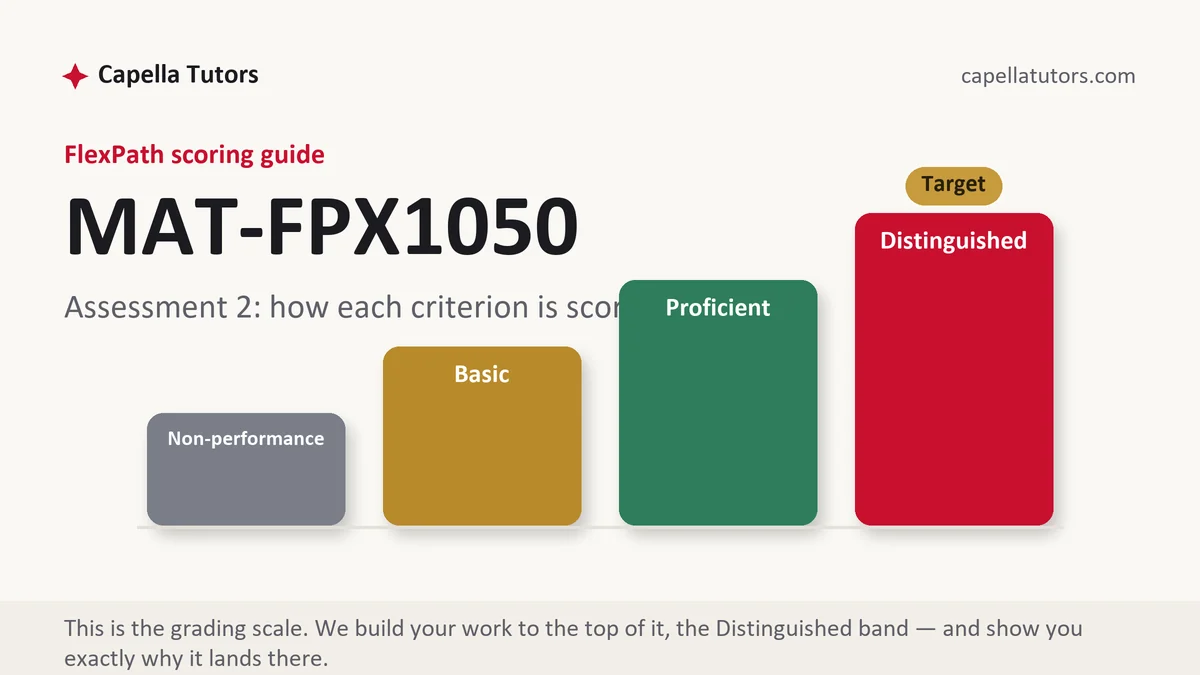
How MAT FPX 1050 Assessment 2 is scored
Marks here are levels rather than percentages. Each row of your scoring guide is placed at one of four levels, and the level text is your brief:
| Level | What it means on a quadratic optimization deliverable |
|---|---|
| Distinguished | The quantity being optimized is built as a function of one variable, the substitution that reduced two variables to one is shown, the vertex is found and defended as a maximum or a minimum rather than asserted, the domain the situation permits is stated, and the answer is given with units and a caution about where the model stops describing reality. |
| Proficient | The function is correct, the vertex is correct, and the answer is stated. Solid work that leaves the defense and the limits unwritten. |
| Basic | A vertex computed from a formula with no account of what the input and output mean, or an optimum announced with no reason it is not a minimum instead. |
| Non-performance | An element the row required never appears, commonly the domain or the classification of the critical value. Absence, not weakness, is what empties a row. |
An optimization row is usually a checklist wearing a sentence: the quantity, the constraint, the reduction to one variable, the vertex, the classification, the domain, and the interpretation. Write those seven pieces in that order and the row is answered whether or not the arithmetic behaves.
The MAT FPX 1050 Assessment 2 method, step by step
-
Copy the criteria into the document first
Each row becomes a heading before you compute anything, with its top-level description sitting underneath. Optimization criteria often bury two demands in one sentence, one about producing the optimum and one about explaining it, and reading them apart on paper is how you notice the second exists.
-
Write down what is being made largest
Name the quantity being optimized in one sentence and say what it is measured in. Revenue in dollars, area in square feet, cost per week. Confusion between the thing being maximized and the thing you control is the most common wrong turn here, and one sentence prevents it.
-
Use the constraint to reduce to one variable
Most situations arrive with two moving quantities and a relationship tying them together. Solve the relationship for one and substitute, and show that substitution rather than presenting the finished single-variable function as though it had appeared on its own. That line is frequently the graded part.
-
Find the vertex and then classify it
Locate the vertex by completing the square or by the standard formula, and say which you used. Then state why it is a maximum, which for a quadratic is the sign of the leading coefficient. A critical value with no classification is a candidate, and the row can tell the difference.
-
State the domain and check the endpoints
Give the interval the situation actually allows, since a ticket price cannot be negative and attendance cannot exceed the room. Evaluate the ends as well as the vertex, because an optimum outside the permitted interval means the best available choice sits at a boundary instead.
-
Answer in the language of the decision
Close with the input, the output, and the units in one sentence, then add what the model assumes and where that assumption breaks. Mark every row against the guide yourself before submitting, and leave room for the two business days an evaluation can take.
A structure that maps to the criteria
Read the counts as planning targets we work to on optimization tasks, not as requirements; the guide attached to your assessment decides the weighting.
| Section | What it must do | Guide word target |
|---|---|---|
| The decision | What is being chosen, what is being maximized or minimized, and the units of each. | ~130 words |
| Building the function | The relationship between the quantities, the substitution that reduced it to one variable, and the resulting expression. | ~220 words |
| The optimum | The vertex located, the method named, and the sign of the leading coefficient used to classify it. | ~230 words |
| Domain and endpoints | The interval the situation permits, with the boundary values evaluated rather than assumed away. | ~160 words |
| Interpretation | The recommendation with its units, plus what the model assumes and where it stops holding. | ~200 words |
| Format and sources | A labeled table or graph, any outside price or figure cited in current APA, and the rounding rule stated once. | as needed |
Annotated sample excerpt
A model passage our team wrote to show the register the top level asks for. Learn the moves from it, then produce your own version.
At 6 dollars a ticket the club sold 120 tickets last term, and every 50 cent increase cost it about 8 buyers, so let x be the number of 50 cent increases applied to the price.1 Price is then 6 + 0.5x dollars and attendance is 120 - 8x people, so revenue is R(x) = (6 + 0.5x)(120 - 8x), which expands to 720 + 12x - 4x squared and holds only for x between 0 and 15, where attendance runs out.2 The leading coefficient is negative 4, so the parabola opens downward and the vertex is a maximum; it sits at x = 1.5, giving a price of 6.75 dollars, attendance of 108, and revenue of 729 dollars.3
- 1The controlled quantity is defined as increases of a stated size rather than as a raw price, which keeps both expressions linear. Say what the letter counts.
- 2Both quantities are written in terms of that one variable, the product is expanded, and the interval is pinned to the point where attendance runs out. Those are separate rows on most guides.
- 3The vertex is classified by the sign of the leading coefficient rather than assumed, and the answer arrives as a price, a turnout, and a dollar figure, which is what the decision row wants.
The full premium sample for your exact assessment, written fresh to your scoring guide and issue, is free to request. Study it, revise it into your own voice, and submit work you understand.
The five mistakes that cost Distinguished
- The vertex reported as a bare pair of numbers. An x and a y with no price, no turnout, and no dollars attached leaves the interpretation row unanswered.
- Two variables never reduced to one. A quadratic cannot be optimized while a second unknown is still in it, and the substitution line is where the method row is won.
- A maximum asserted rather than shown. One clause about the sign of the leading coefficient is the whole cost of proving it is not a minimum.
- A domain the situation cannot support. An optimum at a negative price or at a turnout above the room capacity signals that the interval was never written down.
- The model treated as a promise. Attendance falling by exactly eight buyers per increase is an assumption, and naming it is the sentence the top column pays for.
Pre-submission checklist
- One labeled section per criterion, and no text sitting outside those sections
- The constraint written out and the substitution to one variable shown on the page
- The vertex located, the method named, and the optimum classified by the leading coefficient
- The permitted interval stated and both endpoints evaluated
- The answer given as a decision with units, alongside what the model assumes
- Rounding rule stated once, every row self-scored before the attempt is submitted
An optimization problem to hand off?
Send the prompt, the criteria, and any figures the assessment supplied. Eight people work the file, among them a reviewer who marks the draft row by row the way a Capella evaluator will and a second mathematician who reworks every calculation from the prompt alone. Delivery is 24 to 48 hours, written to the top column, revised free until it lands there.