Give us the requirement, the criteria, and whatever you have already written, and a premium original sample lands inside 24 to 48 hours with the class structure justified, the input paths validated, the failure cases handled instead of ignored, and a second reader compiling the whole thing before it is sent. Your transcript will show IT FPX 4527, Java Application Development, catalogued among the IT-FPX courses available as an elective or toward a specialization rather than mandated on every enrollment, offered through FlexPath inside a BS in Information Technology that requires no fewer than 90 program points and at least 27 at the 3000 level or higher. Check what this course is worth, and what it counts toward, on the program evaluation in your own account. In Capella's catalog the course code is written IT-FPX4527.
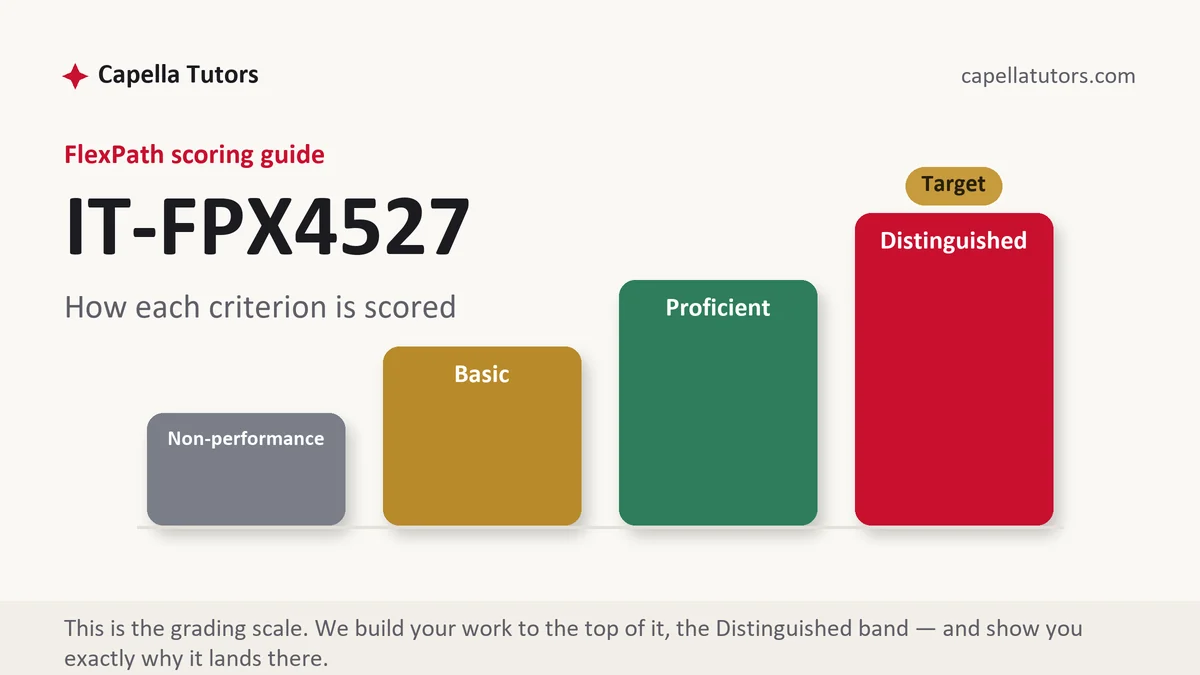
What IT FPX 4527 actually grades
The word development in the title is doing real work, because the criteria here are about the shape of an application rather than about whether a loop runs. Classes are expected to have one reason to exist, fields are expected to be private with behavior exposed instead of raw state, and an interface is expected to appear wherever a contract matters more than an implementation. The distinction between an interface and an abstract class is a favorite grading target, since one describes what a type can do while the other supplies partial machinery that subclasses inherit whether they wanted it or not. Composition is the safer default, because a subclass is coupled to details of its parent that the parent never promised to keep stable. Two more habits separate a competent submission from a passing one: overriding equals without also overriding hashCode, which quietly breaks every hash-based collection the object is put into, and making a class immutable when nothing needs to change in it, which removes an entire category of concurrency defect before it exists.
Runtime behavior is the second graded strand, and it rewards knowing why a choice is right rather than that it works. Collection selection is the clearest example: an array-backed list gives constant-time access by index and pays for insertion in the middle, a linked structure inverts that trade, a hash map gives near constant lookup only while the hash distributes well, and a sorted map buys ordering with logarithmic operations. Exception handling is graded just as closely, since a resource opened in a try block and never closed is a leak, the language construct that closes it automatically exists precisely to remove that mistake, and a catch block with nothing inside it destroys the only evidence anyone would have had. Say which Java release you targeted, because behavior and available syntax differ between them, and a long-term support release such as 17 or 21 is the defensible choice for coursework. Builds belong in this strand too. A project whose dependencies are declared in a build file can be rebuilt by your evaluator, and a project assembled by dragging jar files into a folder cannot.
The third strand is the one that carries the security specialization weight, and it is written into these criteria more often than students expect. Every value arriving from a user, a file, a request parameter, or another system is untrusted until something checks it, and checking means validating against what is allowed rather than filtering out what is known to be bad. Database access is the canonical case, because a query assembled by gluing text together lets input alter the structure of the statement, while a prepared statement with bound parameters sends the shape and the values along separate paths so the value can never become syntax. Secrets do not belong in source files, and a credential committed to a repository is compromised whether or not the repository is private. Dependencies are the exposure nobody inventories, and the remote code execution disclosed in a widely used Java logging library in December 2021, tracked as CVE-2021-44228, is the standing example of a project being breached through a component the developers never chose deliberately. Cite the current edition of the OWASP Top Ten by year and map your handling to its categories rather than gesturing at security in a closing paragraph.
How we help in this course
Development deliverables come out of this studio as working artifacts with the reasoning attached. The class breakdown arrives with a sentence per type saying what it is responsible for and what it deliberately does not do, the persistence path uses bound parameters throughout, exceptions are caught where something can actually be done about them and allowed to propagate where nothing can, and the test set covers the empty case, the boundary case, and the case that is supposed to fail. If the criteria want a document rather than a repository, the code is presented as readable listings with the interpretation beside them instead of as unlabelled screen captures. Tell us the requirement, the Java release your faculty expects, and whether a build tool is mandated, and the submission will match that environment rather than a generic one.
Terms are identical across every course we cover. Delivery is 24 to 48 hours, the writing targets the Distinguished descriptor, and eight people handle the file before it reaches you: research reads the scoring guide and the prompt, a subject specialist designs and writes, a scoring-guide reviewer walks the criteria one at a time in the evaluator's order, an APA and originality pass tidies the citations and the attribution of any borrowed pattern, and an editor closes it out. One pass exists only to build and run what we sent, because code that does not compile on a clean machine fails a criterion no amount of prose recovers. Revisions are unlimited and free until the guide is satisfied, faculty feedback re-enters the queue at no charge, and since an evaluated attempt can take two business days to come back, early submission is worth more than fast typing.
The assessments, one by one
Assessment 1
The opening deliverable in a Java development course usually asks you to restate a requirement as something testable and then design the types that will satisfy it, with each class given one reason to exist and each boundary between logic, interface, and storage argued rather than assumed. Read the full Assessment 1 manual.
Assessment 2
The middle deliverable in this course usually asks you to build the application and then show that it treats every value arriving from outside as untrusted, with data access parameterized, collections chosen for the access pattern, and failures handled where something can be done about them. Read the full Assessment 2 manual.
Assessment 3
The final deliverable in this course usually asks you to prove the application does what the requirements said, with tests that name what they cover, results reported honestly including failures, and coverage discussed as a limit rather than as a score. Read the full Assessment 3 manual.
How to actually write IT FPX 4527: where to begin
Read the criteria before you open an editor, then write the requirements down as a numbered list in your own words, because almost every deduction in a development course traces to a requirement that was implemented approximately. Decide what the program must accept, what it must produce, what it must refuse, and what it must record, and keep that list beside you as the acceptance test. Then sketch the types before the code: which classes exist, what each one owns, which ones talk to each other, and where the boundary between the interface, the logic, and the storage sits. A design settled on paper in twenty minutes prevents the class that ends up doing all three jobs and losing the design criterion on its own.
Work the security example through once, because it is the difference between a paper that mentions safe coding and one that demonstrates it. Suppose a sign-in lookup is built by concatenating the submitted user name into the text of a select statement. A user name consisting of a single quote, the word or, a comparison that is always true, and a comment marker closes the literal early, makes the condition universally true, and comments out whatever followed, so the query now returns the first row in the table and the caller treats that as a successful match. Rewriting the same lookup as a prepared statement with a placeholder and a bound value removes the possibility entirely, because the driver never re-parses the value as part of the statement. Then add the part most students omit: binding protects values, not identifiers, so a column name or a sort direction taken from a request has to be checked against a fixed list of permitted names before it goes anywhere near the query. Say that in the document and the analysis criterion has something specific to reward.
Finish with evidence that the thing works, which means tests rather than assertions of confidence. Write each test in three visible parts, the setup, the single action being exercised, and the assertion about the result, and name the method so the failure message alone tells a reader what broke. Cover the cases that actually fail in practice: the empty collection, the single element, the null argument, the value one past the limit, and the input that is supposed to be rejected, verified by asserting that the expected exception was thrown rather than by hoping it was. Report the results honestly, including anything still failing, and treat coverage as a floor rather than a proof, because a suite that executes ninety percent of the lines without asserting anything meaningful has measured nothing except how much code ran.
| Section | What goes in it | What Distinguished looks like |
|---|---|---|
| Requirements | What the application accepts, produces, refuses, and records, numbered and in plain language. | Each requirement written so a reader could test it without asking you a question. |
| Design and class structure | The types, their responsibilities, the interfaces between them, and the layering decision. | Single responsibility defended per class, with composition chosen over inheritance for a stated reason. |
| Implementation | The code itself, the collection and data type choices, and the Java release targeted. | Data structure choices justified by access pattern, with the release named and the build reproducible. |
| Input handling and errors | Validation at every boundary, parameterized data access, and exceptions caught where they can be handled. | Allow-list validation, bound parameters throughout, and no catch block that discards the failure. |
| Testing evidence | Test cases, what each one proves, results including failures, and the boundary cases covered. | Negative and edge cases tested explicitly, with coverage discussed as a limit rather than a score. |
| Sources and format | Language and library documentation by version, secure coding references, current APA both ways. | Primary specifications cited directly, and any borrowed pattern attributed rather than absorbed. |
Developing the analysis
Java gives you a genuine design argument to take a side in, which is the value of checked exceptions, and an evaluator can tell instantly whether you have thought about it. The defense is that a checked exception is a compile-time contract, so a method that can fail in a recoverable way forces every caller to acknowledge that fact rather than discover it in production. The attack is empirical: in real code bases the requirement produces enormous amounts of ceremony, and the path of least resistance is a catch block that logs nothing and continues, which is strictly worse than having no contract at all. Later language designers largely declined to repeat the feature, which is evidence rather than proof. The position worth writing is a rule instead of a preference. Use a checked exception when a caller can plausibly do something different in response, such as retry, fall back, or ask the user again. Use an unchecked exception for a defect in the program itself, such as an argument that should never have been null, because there is nothing a caller can do about a bug except stop. Never write an empty catch, and when you cannot handle a failure, wrap it with context and let it travel. Argue that in three sentences and you have demonstrated the judgment the analysis criterion is looking for.
Citations that survive faculty review
Development papers get graded on the same referencing standard as any other assessment, and four families of source cover the ground. Language and platform specifications come first, meaning the language specification and the application programming interface documentation for the exact release you targeted, since behavior differs between versions and an undated reference to the documentation is worthless. Secure coding guidance is the second family, principally the vendor secure coding guidelines for the platform, the coding standard for Java published by the Software Engineering Institute, and the OWASP Top Ten cited by its edition year alongside the Application Security Verification Standard where a criterion asks for requirements rather than examples. Vulnerability records are the third, so when you cite a specific weakness use its identifier from the national vulnerability database and name which version of the common vulnerability scoring system produced the severity you quoted, because the scoring method changed and the numbers are not interchangeable. Peer-reviewed software engineering research through the Capella library carries any claim about defect rates, review effectiveness, or maintainability. One habit matters more than the rest here: a forum answer that fixed your compile error is a debugging aid and not a source, so find the documentation that explains why the fix works and cite that instead, and attribute any code pattern you adapted rather than presenting it as your own.
The mistakes that land Basic instead of Distinguished
- One class handling input, business rules, and storage. The design criterion is looking for boundaries, and a single class with everything in it has none to point at.
- Queries built by joining strings together. Concatenation lets a value rewrite the statement, and no amount of filtering afterward makes it safe.
- Catch blocks that discard the exception. Swallowing a failure removes the only record of what went wrong and hides the defect from your own testing.
- equals overridden while hashCode is left alone. The object then behaves correctly in a comparison and incorrectly in every hash-based collection.
- No stated release and no build file. An evaluator who cannot rebuild the project has to grade a screenshot instead of the software.
IT FPX 4527 questions students actually ask
How much of the application is allowed to be library code?
The criteria decide, and the usual reading is that libraries are expected for infrastructure and discouraged for whatever the assessment was built to teach. Nobody wants you to hand-roll a database driver, a logging framework, or a testing harness, and using the standard collections is not outsourcing anything. Pulling in a library that performs the exact transformation the requirement asked you to implement is a different matter, and it converts a development exercise into a configuration exercise. Where you do take a dependency, name it, name its version, say what it is doing for you, and check that it has not been superseded because of a published vulnerability. That last step turns a routine choice into evidence for the security criterion.
What counts as enough testing at this level?
Enough that every requirement on your numbered list has at least one test pointing at it, and every branch that can reject input has a test proving it rejects. Undergraduate work is not expected to reach the coverage standards of a regulated code base, but it is expected to show intent rather than volume, so five well-chosen cases beat forty that all exercise the same happy path. Include at least one test that expects a failure, since asserting that bad input produces the right exception is the clearest demonstration that your validation is real. Then write two sentences interpreting the results, because the criterion usually asks what the testing showed rather than that testing happened.
Should I be using checked or unchecked exceptions in my submission?
Use the recoverability test rather than a habit. If the caller can reasonably respond to the failure by retrying, choosing another path, or asking the user for different input, a checked exception documents that obligation in the signature and is the right choice. If the failure means the program contains a bug, such as an index outside a bounds check or a required argument arriving null, an unchecked exception is correct because no caller can repair a defect at runtime. Whichever you pick, add a message that says what was being attempted and with what value, since a stack trace with no context costs an evaluator time and costs you the impression of care. Document the choice in a sentence in your design section and it becomes a graded strength instead of an invisible detail.
Application due and half built?
Send the requirement, the criteria, and the code you have. It comes back designed, validated, tested, and compiling on a clean machine. Nothing is charged for the first premium sample in your queue.