This manual is for IT FPX 4527 Assessment 1, start to submission. The opening deliverable in a Java development course usually asks you to restate a requirement as something testable and then design the types that will satisfy it, with each class given one reason to exist and each boundary between logic, interface, and storage argued rather than assumed. Grading happens criterion by criterion against the guide sitting in your courseroom. Everything below is the tutor method, the section plan we build from the criteria, and one excerpt with notes. Want our writers on it instead? A premium original sample for this exact deliverable is back with you in 24 to 48 hours, revised at no charge until the guide is satisfied. Capella's catalog lists the course as IT-FPX4527, and some courserooms print IT4527; both point to this same Assessment 1.
One honesty note before the manual: Capella revises courses and scoring guides over time, so always write to the exact scoring guide attached to your assessment in the courseroom. The course identity above is verified on capella.edu; the method and structure below are our tutors' approach to it, not Capella's official rubric text.
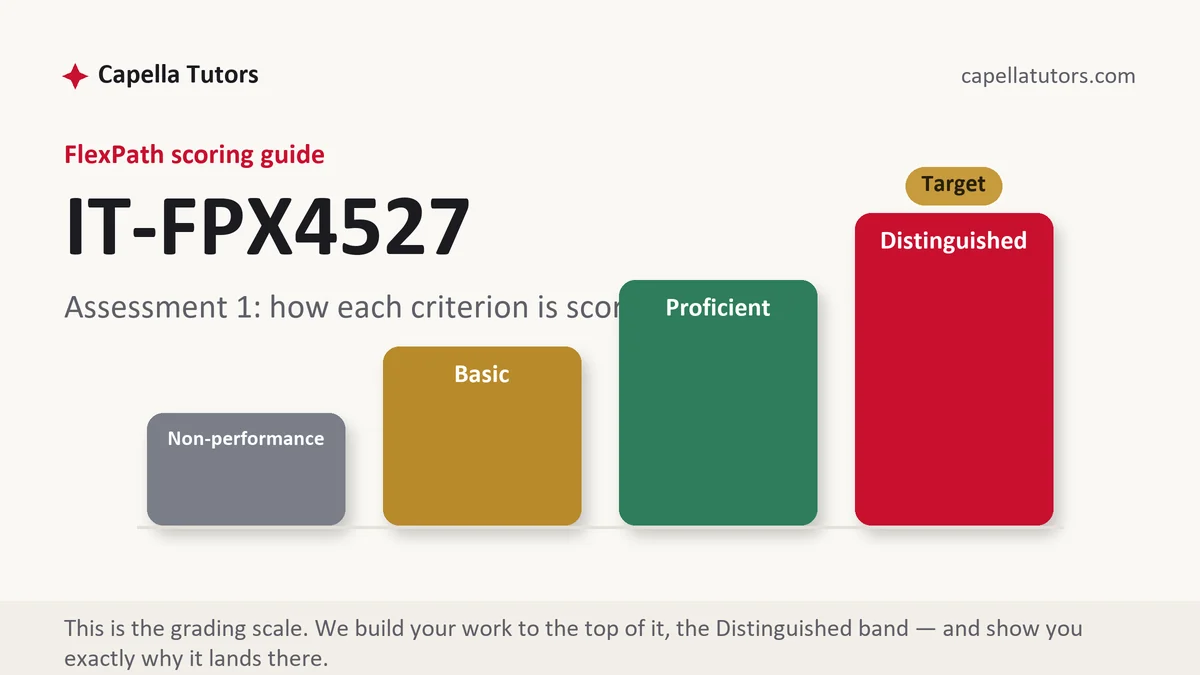
How IT FPX 4527 Assessment 1 is scored
FlexPath records a level rather than a score. Every criterion lands on one of four descriptors, and those descriptors are the design brief as well as the grading brief:
| Level | What it means on a requirements and design deliverable |
|---|---|
| Distinguished | Every class has one responsibility you can state in a sentence, the things it deliberately does not do are named, composition is chosen over inheritance for a reason tied to this design, and each requirement can be traced to the type that satisfies it. |
| Proficient | The design works and is described accurately. Responsibilities are reasonable, and none of the boundaries between them has been defended against an alternative. |
| Basic | A class list with a paragraph underneath. The types exist, the reasoning does not, and one class quietly holds the interface, the rules, and the storage all at once. |
| Non-performance | A required element is absent, most often the numbered requirements the design was supposed to satisfy or the relationships between the types. |
Almost every deduction in a development course traces back to a requirement that was implemented approximately. Twenty minutes spent turning the prompt into a numbered list in your own words, and then naming the type that answers each number, prevents the single class that ends up doing three jobs and loses the design criterion without any code being wrong.
The IT FPX 4527 Assessment 1 method, step by step
-
Convert the criteria into headings before you open an editor
Build the outline from the scoring guide, then put the top-level wording under each heading. Code written before the criteria are read tends to satisfy the prompt and miss the guide, and in a design deliverable the guide is asking for reasoning that no amount of working software supplies on its own.
-
Rewrite the prompt as numbered requirements in your own words
Decide what the program must accept, what it must produce, what it must refuse, and what it must record. Number them. That list becomes both your acceptance test and the trace the design section points back to, and anything you cannot number is something you have not understood yet.
-
Give each class one reason to exist and say what it refuses
Write a sentence per type naming its single responsibility and a second naming what it deliberately does not do. The second sentence is what evaluators reward, because it shows the boundary was placed rather than discovered, and it also stops the class quietly absorbing work later.
-
Choose between an interface and an abstract class deliberately
An interface describes what a type can do; an abstract class supplies partial machinery a subclass inherits whether it wanted it or not. Prefer composition, because a subclass is coupled to details its parent never promised to keep stable, and say in one sentence why the case in front of you is or is not an exception.
-
Decide immutability and equality before any code exists
Make a class immutable when nothing in it needs to change, which removes a whole category of concurrency defect in advance. If you override equals, override hashCode with it, since an object that compares correctly and hashes incorrectly behaves properly in a comparison and wrongly in every hash-based collection.
-
Trace each requirement to a type, then self-score
Walk the numbered list and name the class that satisfies each entry; anything unclaimed is a gap and anything claimed twice is a boundary problem. Then mark every criterion D, P, B, or N yourself and rewrite anything short of the top. Submit early, since an evaluation is allowed two business days.
A structure that maps to the criteria
These lengths are the planning targets our tutors use on a design deliverable rather than Capella requirements, so expand whichever section your own guide weights most heavily.
| Section | What it must do | Guide |
|---|---|---|
| Problem and context | The application, who uses it, and what the software has to be true about when it is finished. | ~150 words |
| Numbered requirements | What the program accepts, produces, refuses, and records, each written so a reader could test it unaided. | ~250 words |
| Types and responsibilities | Each class, its single responsibility, and the work it deliberately leaves to something else. | ~350 words |
| Relationships and layering | Which types talk to which, where the interface, logic, and storage boundaries sit, and why there. | ~300 words |
| Design decisions defended | Interface against abstract class, composition against inheritance, immutability, equality, and the release targeted. | ~300 words |
| Sources and format | Language and library documentation by version, secure coding references, current APA both ways. | as needed |
Annotated sample excerpt
An original excerpt from our writers, showing a requirement turning into types without any one of them collecting more than a single job. Learn the pattern, then apply it to your own prompt.
Requirement 4 states that a kiosk must refuse a reservation when the rider already holds an active hold, and must refuse it without revealing whether the membership number exists at all.1 Three types share that requirement and none of them shares a job. ReservationRequest carries the submitted values and nothing else, ReservationPolicy answers exactly one question, whether this rider may hold a bicycle right now, and KioskController turns the policy's answer into a line on the screen.2 Putting the policy behind an interface rather than a concrete class matters here because the parks department has already asked for a second rule covering school groups, which then arrives as a new file instead of an edit to a class that currently works.3
- 1Quotes the numbered requirement, including the part about what must not be revealed, so the design that follows is answerable to something specific.
- 2Names three types and gives each a single responsibility in one clause, which is the sentence pattern the design criterion is looking for.
- 3Defends the interface with a change the organization has actually asked for, so the choice reads as engineering rather than as a pattern applied by reflex.
The full premium sample for your exact assessment, written fresh to your scoring guide and issue, is free to request. Study it, revise it into your own voice, and submit work you understand.
The five mistakes that cost Distinguished
- One class handling input, rules, and storage. The design criterion is looking for boundaries, and a class with everything inside it offers none to point at.
- Requirements paraphrased from the prompt. A requirement written in the prompt's words has not been understood; write it so somebody could test it without asking you a question.
- Inheritance chosen because two classes look similar. A subclass is coupled to details the parent never promised to keep stable, so composition is the safer default and the choice needs a sentence.
- equals overridden with hashCode untouched. The object then compares correctly and hashes wrongly, so every hash-based collection it enters misbehaves.
- No Java release named. Available syntax and behavior differ between releases, so an unstated target makes the design unverifiable on any particular machine.
Pre-submission checklist
- Requirements appear as a numbered list written in your own words
- Each class has one stated responsibility and one stated refusal
- The interface against abstract class decision is argued in a sentence
- Composition or inheritance chosen for a reason specific to this design
- Every numbered requirement traced to exactly one type that satisfies it
- Java release named, then self-scored at the top level before submission
Design deliverable due and half sketched?
Send the prompt, the criteria, and any classes you have already drafted. The requirements come back numbered and testable, each type comes back with one responsibility and one refusal, and every design decision comes back defended against the alternative you would have been asked about. Turnaround is 24 to 48 hours.