This manual is for IT FPX 4527 Assessment 3, start to submission. The final deliverable in this course usually asks you to prove the application does what the requirements said, with tests that name what they cover, results reported honestly including failures, and coverage discussed as a limit rather than as a score. Marking is criterion by criterion against the guide that arrived with your own assessment. Below is how our tutors approach it, the structure we map to the criteria, and an excerpt with the moves called out. Want it built and tested for you? A premium original sample written to this exact assessment is returned in 24 to 48 hours, with free revision until the guide is met. Capella's catalog lists the course as IT-FPX4527, and some courserooms print IT4527; both point to this same Assessment 3.
One honesty note before the manual: Capella revises courses and scoring guides over time, so always write to the exact scoring guide attached to your assessment in the courseroom. The course identity above is verified on capella.edu; the method and structure below are our tutors' approach to it, not Capella's official rubric text.
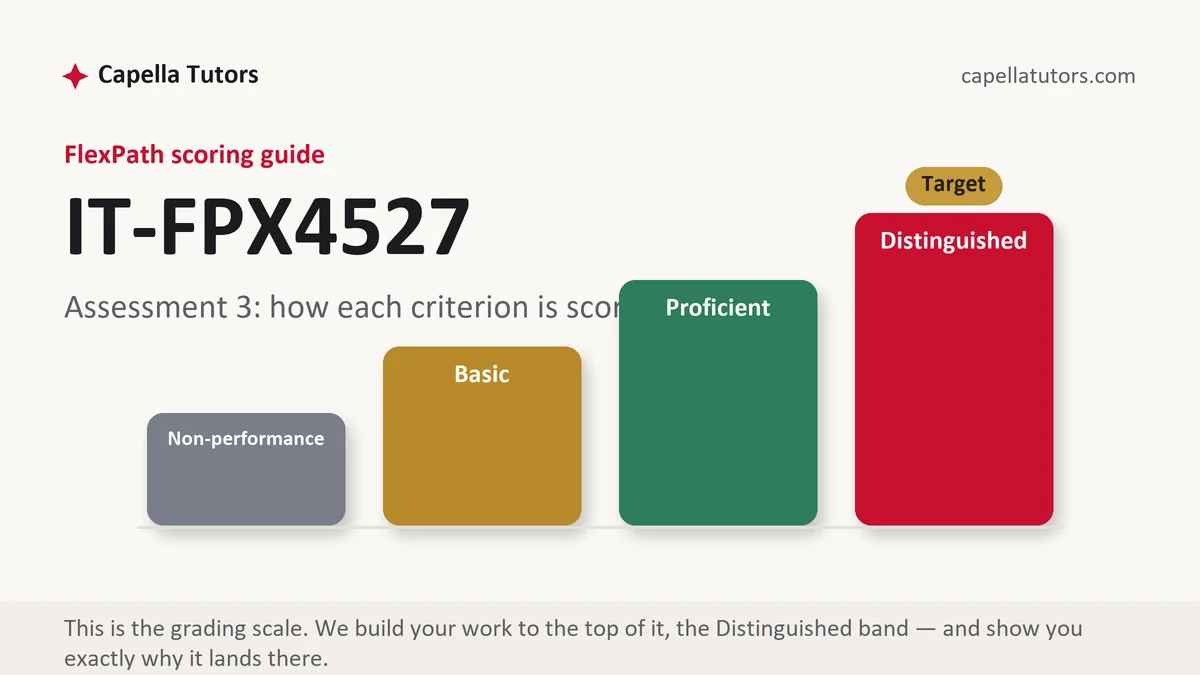
How IT FPX 4527 Assessment 3 is scored
Nothing about this resolves to a mark out of ten. Each criterion is placed at one of four levels, and the level language tells you which tests to write:
| Level | What it means on a testing deliverable |
|---|---|
| Distinguished | Every requirement has at least one test pointing at it, negative and boundary cases are tested explicitly, failures are reported rather than quietly fixed and forgotten, and coverage is discussed as a floor with its blind spots named. |
| Proficient | A working suite that passes. The requirements are broadly covered, the cases are reasonable, and nothing is said about what the tests cannot see. |
| Basic | Screenshots of a green run. Tests exist, they all exercise the same successful path, and coverage is quoted as a number that stands in for an argument. |
| Non-performance | A required element is missing, most often the negative cases or the interpretation of what the testing actually showed. |
Undergraduate work here is graded on intent rather than volume, so five well-chosen cases beat forty that all walk the same happy path. The two sentences interpreting the results usually matter more than the suite itself, because the criterion generally asks what the testing showed rather than whether testing happened.
The IT FPX 4527 Assessment 3 method, step by step
-
Put the criteria on the page, then list what must be proved
Turn each criterion into a heading, then write out every requirement the tests have to demonstrate. A suite assembled without that list tests whatever was easy to reach, and the coverage criterion is really asking whether the requirements are covered rather than whether the lines are.
-
Write each test in three visible parts
Setup, the single action being exercised, and one assertion about the result. Keeping them visibly separate makes a failure readable, and a test that performs three actions before asserting cannot tell you which of them broke when it goes red.
-
Name the method so the failure message is self-explaining
A test called testOne tells a reader nothing at three in the afternoon and less at midnight. A name that states the condition and the expected outcome means the failure line alone identifies the defect, which is the difference between a suite that helps and a suite that has to be investigated.
-
Test the cases that actually fail in practice
The empty collection, the single element, the null argument, the value one past the limit, and the input that is supposed to be rejected. Assert that the expected exception was thrown rather than hoping it was, since a negative case verified by absence of output verifies nothing.
-
Report results honestly, including anything still red
List what passed, what failed, and what you did about each failure. A suite with one documented failure and an explanation reads as engineering, while a suite that was quietly trimmed until everything passed reads exactly like what it is, and evaluators in this course look for it.
-
Interpret the coverage, then self-score
Say what the number does not include, because a suite that executes ninety percent of the lines while asserting almost nothing has measured how much code ran. Then read the draft against each criterion yourself and rewrite anything short of the top. Submit early, since faculty may take two business days.
A structure that maps to the criteria
These figures are the planning targets our tutors work to on a testing deliverable rather than Capella rules, so weight them toward whichever criterion your guide treats as heaviest.
| Section | What it must do | Guide |
|---|---|---|
| What is being verified | The requirements under test, the release and framework used, and how the suite is run. | ~150 words |
| Test design | The cases chosen, why each exists, and the mapping from each requirement to the tests that cover it. | ~300 words |
| Boundary and negative cases | Empty, single, null, one past the limit, and rejected input, each with the assertion made. | ~300 words |
| Results | Pass and fail counts, the failures themselves, and what changed in response to each one. | ~250 words |
| Coverage and limits | What the coverage figure includes, what it cannot see, and what a further round of testing would add. | ~250 words |
| Sources and format | Testing framework and language documentation by version, quality references, current APA both ways. | as needed |
Annotated sample excerpt
An original excerpt from our writers showing a negative test carrying its own explanation. Read the structure, then write the equivalent for the boundary your own requirements care about.
The test named rejectsNegativeMinutes is one line of setup, one call, and one assertion, so the name alone tells a reader what broke when it turns red.1 The setup builds a timesheet entry of minus seven minutes, which the crew leader's handheld can genuinely produce when a clock-out is corrected after the fact, the action calls the rounding method, and the assertion states that an IllegalArgumentException is thrown rather than that some value comes back.2 Three neighbours pin the rest of the boundary: zero minutes returns zero, seven minutes rounds down to zero on a fifteen-minute increment, and eight minutes rounds up to fifteen, so the halfway rule is fixed by a test rather than described in a comment.3
- 1Highlights the three-part shape and the naming, which is what makes a failure readable without opening the test body.
- 2Explains where the invalid value comes from in the real system, so the negative case is a requirement being enforced rather than an invented input.
- 3Adds the neighbouring cases that fix the boundary in both directions, which is the pattern the coverage criterion is written to reward.
The full premium sample for your exact assessment, written fresh to your scoring guide and issue, is free to request. Study it, revise it into your own voice, and submit work you understand.
The five mistakes that cost Distinguished
- Only the happy path tested. Forty passing cases that all supply valid input demonstrate that the method runs, not that it is correct.
- Coverage quoted as proof. Lines executed without meaningful assertions measure how much code ran, and the criterion asks what the tests established.
- No negative case asserted. A rejection verified by the absence of output verifies nothing; assert the exception the validation is supposed to throw.
- Failures removed instead of reported. A trimmed suite is visible to anyone who reads the requirement list, and one documented failure costs far less than a hidden gap.
- Results presented with no interpretation. The criterion usually asks what the testing showed, so two sentences of reading beat another screenshot.
Pre-submission checklist
- Every numbered requirement maps to at least one named test
- Each test has one setup, one action, and one assertion
- Empty, single-element, null, and one-past-the-limit cases all covered
- At least one test asserts that invalid input throws the expected exception
- Pass and fail counts reported with any remaining failure explained
- Coverage discussed as a limit with its blind spots named, then self-scored
Testing evidence due?
Send the requirements, the code, and the criteria. The suite comes back with a test per requirement, the boundaries pinned in both directions, at least one case asserting a rejection, and results reported honestly with the coverage argument written out. Eight specialists handle it and it returns inside 24 to 48 hours.