This manual is for IT FPX 4527 Assessment 2, start to submission. The middle deliverable in this course usually asks you to build the application and then show that it treats every value arriving from outside as untrusted, with data access parameterized, collections chosen for the access pattern, and failures handled where something can be done about them. It is scored criterion by criterion against the guide in your courseroom. What follows is how our tutors work it, a section plan the criteria can score, and an annotated excerpt. Want somebody else to build it? A premium original sample matched to this exact assessment arrives in 24 to 48 hours, revised without charge until the guide is cleared. Capella's catalog lists the course as IT-FPX4527, and some courserooms print IT4527; both point to this same Assessment 2.
One honesty note before the manual: Capella revises courses and scoring guides over time, so always write to the exact scoring guide attached to your assessment in the courseroom. The course identity above is verified on capella.edu; the method and structure below are our tutors' approach to it, not Capella's official rubric text.
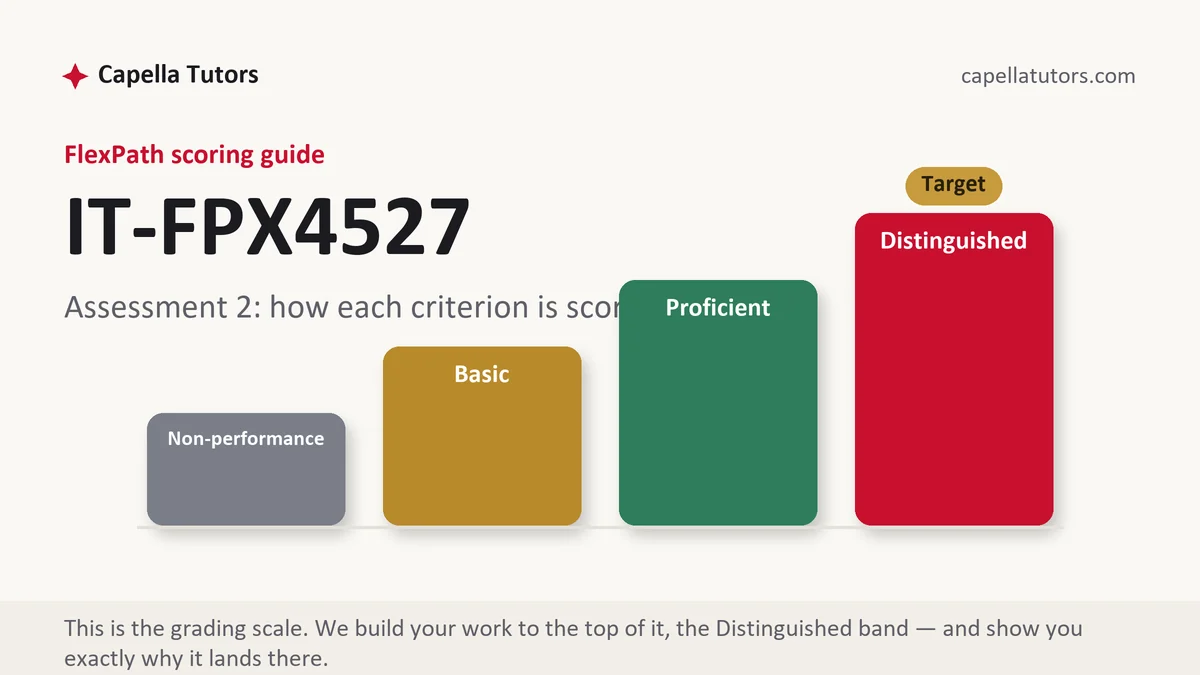
How IT FPX 4527 Assessment 2 is scored
There is no partial credit to accumulate here. Each criterion is marked at one of four levels, and the top level tells you what to build as well as what to write:
| Level | What it means on an implementation deliverable |
|---|---|
| Distinguished | Validation happens at every boundary and works by allowing what is permitted rather than filtering what is known to be bad, data access is parameterized throughout, collection choices are justified by access pattern, and every failure path either handles the problem or carries context upward. |
| Proficient | The application works and the code is clean. Input is checked, exceptions are caught, and no choice in the file is explained in terms of what it prevents. |
| Basic | Working code with a description of what it does. Validation exists in one place, a query is assembled from text somewhere, and a catch block or two are empty. |
| Non-performance | A required element is absent, most often the validation the guide asked for or a build that lets an evaluator compile the project at all. |
The difference between a paper that mentions safe coding and one that demonstrates it is a single worked example. Show one input path, name the attack it would otherwise permit, show the construct that removes the possibility rather than reducing it, and then name the case that construct does not cover. That last clause is usually where the top level of the criterion lives.
The IT FPX 4527 Assessment 2 method, step by step
-
Rebuild the criteria as headings, then fix the environment
Give each criterion a heading, then state the Java release and the build tool in the first paragraph. A long-term support release is the defensible choice for coursework, and a project whose dependencies are declared in a build file can be rebuilt by your evaluator while a folder of jar files cannot.
-
Validate by allowing, not by filtering
Every value from a user, a file, a request parameter, or another system is untrusted until something checks it. Check against the set of permitted values, lengths, and formats rather than stripping characters you consider dangerous, because a filter is a list of the attacks you happened to think of.
-
Bind every value that reaches a query
A prepared statement sends the shape of the statement and its values along separate paths, so a value can never become syntax regardless of what quotes or comment markers it contains. Concatenation cannot be made safe by cleaning the input first, and the criterion is usually written to catch exactly that reasoning.
-
Handle the identifiers binding cannot protect
Placeholders protect values, not column names or sort directions, so anything structural taken from a request has to be checked against a fixed list of permitted names before it goes near the query. Say that in the document, because it is the detail that separates a demonstration from a recital.
-
Choose collections and failure paths on purpose
An array-backed list gives constant-time indexed access and pays for insertion in the middle; a hash map gives near constant lookup while the hash distributes well; a sorted map buys ordering with logarithmic operations. Catch a failure where you can act on it, let it travel with context where you cannot, and never write an empty catch.
-
Compile on a clean machine, then self-score
Build the project somewhere that has none of your local configuration, because code that does not compile for the evaluator fails a criterion no prose recovers. Then walk the guide yourself, marking each criterion and rewriting anything below the top. Submit early, since two business days are available to your evaluator.
A structure that maps to the criteria
The lengths below are our tutors' planning figures for an implementation deliverable, not Capella rules, so weight them toward the criterion your own guide treats as heaviest.
| Section | What it must do | Guide |
|---|---|---|
| Environment and build | The Java release, the build tool, the dependency list with versions, and how to compile the project. | ~150 words |
| Implementation walk-through | The code presented as readable listings with the interpretation beside each part rather than after it. | ~350 words |
| Input handling | Every boundary where data arrives, what is permitted at each, and how the check rejects everything else. | ~300 words |
| Data access and errors | Parameterized statements, structural identifiers checked against a list, and where each exception is handled. | ~300 words |
| Data structure choices | The collection or type chosen per use, the access pattern behind it, and what it costs elsewhere. | ~200 words |
| Sources and format | Specifications and library documentation by version, secure coding references by edition, current APA. | as needed |
Annotated sample excerpt
An original excerpt from our team, written to show two defenses for two kinds of input in the space of one paragraph. Take the reasoning, then run it over your own boundaries.
The applicant search on the Fairgate Foundation intake portal takes a surname fragment and a sort column from the same request, and the two need opposite defenses.1 The surname enters the statement as a bound parameter, so the driver sends the query shape and the value along separate paths and the value can never be re-parsed as syntax, whatever quotes or comment markers it contains.2 The sort column cannot be bound at all, because placeholders protect values and not identifiers, so it is compared against a fixed set of four permitted column names and anything outside that set falls back to the default rather than being cleaned up and used.3
- 1Names both inputs and states in the first sentence that they need different treatment, which frames the paragraph as analysis rather than as a description of two lines of code.
- 2Explains why binding works mechanically, in terms of separate paths, instead of asserting that prepared statements are safer.
- 3Covers the case binding does not reach and chooses a fallback over sanitizing, which is the detail that lifts a validation criterion to the top level.
The full premium sample for your exact assessment, written fresh to your scoring guide and issue, is free to request. Study it, revise it into your own voice, and submit work you understand.
The five mistakes that cost Distinguished
- Queries built by joining strings. Concatenation lets a value rewrite the statement, and no amount of filtering afterward makes the result safe.
- Input filtered rather than allowed. Stripping known-bad characters protects against the attacks you thought of, while an allow-list protects against the rest.
- Catch blocks that throw the exception away. Swallowing a failure erases the only trace of what went wrong and keeps the defect out of your own testing.
- Resources opened and never closed. A stream or connection left open is a leak, and the language construct that closes it automatically exists to remove that mistake.
- A dependency taken without a version check. Naming the library, its version, and whether it has been superseded for a published vulnerability turns a routine choice into evidence.
Pre-submission checklist
- Java release, build tool, and every dependency version stated up front
- Each input boundary lists what is permitted rather than what is stripped
- Every value reaching a query is bound, with no concatenation anywhere
- Structural identifiers checked against a fixed list before use
- No empty catch blocks, and every propagated failure carries context
- Project compiles from a clean checkout, then self-scored before submission
Implementation due and not compiling?
Send the requirement, the criteria, the Java release your faculty expects, and whatever code exists. It comes back with validation at every boundary, bound parameters throughout, collection choices justified by access pattern, and one pass whose only job is building it on a clean machine. Delivery is 24 to 48 hours.