Hand us the prompt, the scoring guide, and whatever code you have managed to get running, and a premium original sample comes back inside 24 to 48 hours with the script commented in plain language so an evaluator who does not write code can still follow what every function does. On a program plan this one reads IT FPX 3240, Web Development and JavaScript, worth 3 program points, a core requirement in both FlexPath specializations of the BS in Information Technology, a degree built on at least 90 program points with a minimum of 27 of them earned at the 3000 level or above. In Capella's catalog the course code is written IT-FPX3240.
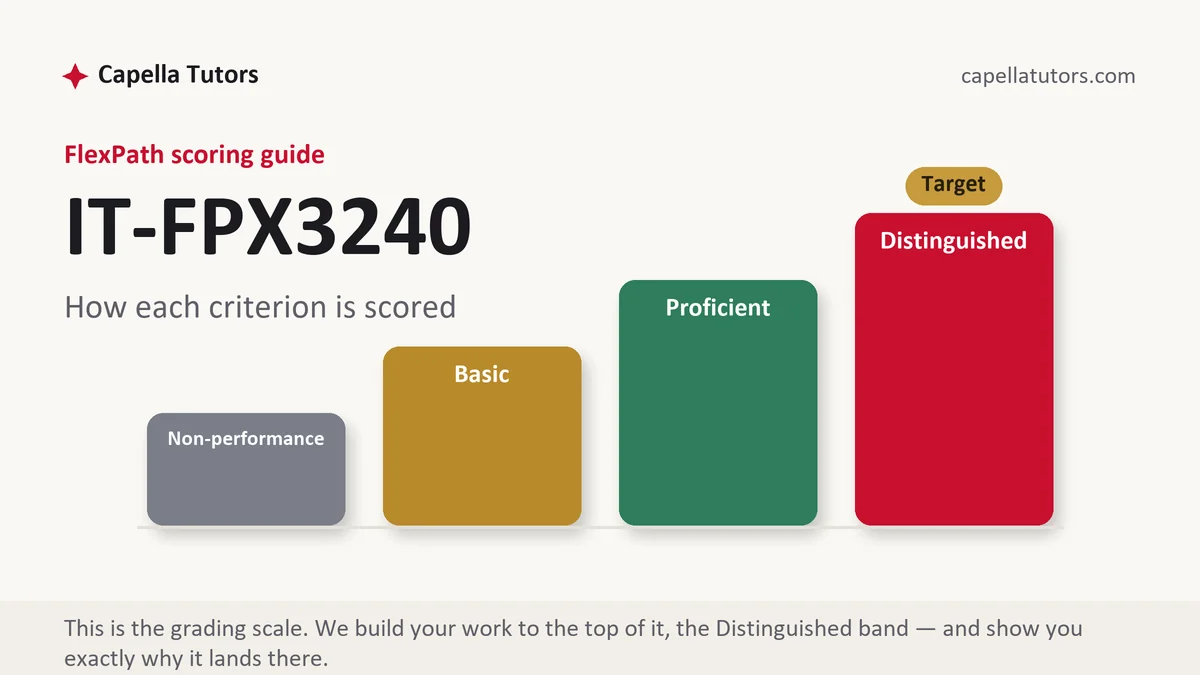
What IT FPX 3240 actually grades
Two things get scored here and only one of them is code. The first is a page that behaves: markup that carries meaning, a stylesheet that survives a narrow screen, and script that responds to what a person does. The second is a written account of how that page works, and it is the account that decides most criteria, because the person marking the row may open your folder or may read only your document. Write for the second case. A file that runs perfectly and is never explained gets scored on the paragraph you did not write.
The scripting mechanics are specific and the criteria name them. Declaring values with let and const rather than var, so a counter inside a loop does not leak into the surrounding function. Selecting elements with querySelector and querySelectorAll and knowing that the second returns a list you have to walk. Attaching behavior with addEventListener rather than an onclick attribute, which keeps behavior out of the markup and lets more than one handler exist for the same event. Reading and writing textContent instead of innerHTML when the value came from a user, since innerHTML with untrusted text is the standard way beginners introduce script injection into their own page. One pattern worth learning before your first submission is delegation: attach a single click listener to the table body rather than to each row, then check the event target inside the handler, and rows added after page load keep working while your listener count stays at one. Explaining that choice in a sentence is worth more to a criterion than another fifty lines that work.
The third strand is the standards side, and it is where undergraduate submissions lose the easiest points. Use a heading order that descends without skipping, a nav for navigation, a button for something that acts and an anchor for something that goes somewhere. Tie every label to its input with the for attribute matching the input id, because a label floating next to a field is not connected to it and a screen reader will say nothing. Give images real alternative text or an empty alt when they are decorative. Build the layout with flexible units and a media query or two rather than fixed pixel widths, and check the page at a phone width before you submit. Then say the quiet part in your write-up: validation performed in the browser is a courtesy to the person filling the form, not a security control, because anyone can disable script or send the request directly, and the server has to check the same values again.
How we help in this course
A 3240 order comes back as two things at once, a working folder and a document that explains it. The script arrives commented at the level a grader needs, the markup is validated before it leaves us, the stylesheet is organized so a reader can find the rule that produced the effect, and the document maps each criterion in your guide to the file and the lines that satisfy it. Tell us the constraints your instructor set, whether libraries are permitted, whether the data has to come from a local file, and how the work is submitted, and we will build to those constraints rather than to a generic tutorial.
Our terms on this course are the ones we run everywhere. Each deliverable inside 24 to 48 hours, aimed at the Distinguished column, and eight people touch it before you see it: a research analyst pulls your scoring guide and the reference material, a subject writer builds the page and the narrative, a scoring-guide reviewer walks the criteria one row at a time the way a Capella evaluator will, an APA and originality check reconciles citations against the reference list, and an editor reads the whole thing last. Revisions stay free until the work meets the guide, and anything faculty send back re-enters the same queue at no charge. Since faculty have two business days to evaluate a submitted attempt, sending a fixable draft early costs you less than sitting on a finished one.
The assessments, one by one
Assessment 1
The opening deliverable in Web Development and JavaScript is usually where the page gets its skeleton: elements chosen for meaning, a stylesheet that survives a phone, and a short document telling an evaluator which file and which lines answer which criterion. Read the full Assessment 1 manual.
Assessment 2
The second deliverable in this course usually moves the page from sitting still to responding: elements found in script, behavior attached with listeners, a form checked before anything is sent, and an explanation an evaluator who does not write code can still follow. Read the full Assessment 2 manual.
Assessment 3
The later work in this course usually asks the page to handle data rather than markup alone: values loaded at run time, an interface rendered from that data instead of typed by hand, failure paths handled on purpose, and a document explaining all of it to somebody who will not open your folder. Read the full Assessment 3 manual.
How to actually write IT FPX 3240: where to begin
Open the scoring guide before your editor. Copy each criterion into a blank document as a heading, paste the Distinguished wording underneath it, and then build a three-column list: criterion, the file that answers it, the line numbers inside that file. That list is your submission checklist and, lightly rewritten, it becomes the opening section of the document you hand in. Coding assessments fail on coverage more often than on skill, and the usual shape of the failure is a student who spent nine hours on the interactive feature and never noticed the criterion asking about responsive behavior.
Then practice the move this course actually rewards, which is explaining one technical decision to a reader who does not share your vocabulary. The weak version of a sentence about form handling says the JavaScript validates the form before it is submitted. The version that earns the top column says the handler listens for the submit event on the form element rather than for a click on the button, so that a person who presses Enter in the last field gets the same check as a person who reaches for the mouse; that preventDefault is called only when a check fails, so a valid form still submits normally if scripting is later removed; that the error text is written into a container marked with aria-live so assistive technology announces it instead of leaving a blind user staring at a form that refuses to move; and that the server has to repeat every one of these checks because the browser is not a trustworthy place to enforce a rule. Same feature, four checkable claims, and each one is a sentence a grader can score without reading a line of code.
Finish on delivery, which is where working submissions die. Use relative paths and lowercase file names with no spaces, keep the stylesheet and the script in their own files rather than inside the page, and open the folder from a fresh location before you submit to confirm nothing was resolving from your desktop by accident. Include the screen captures inside the document even when you also attach the folder. An evaluator who cannot open your file grades whatever is visible, and the student who assumed the code would speak for itself is the student rereading a Basic in three rows.
| Section | What goes in it | What Distinguished looks like |
|---|---|---|
| Requirement map | Each criterion beside the file and line range that answers it, plus how to run the page. | A map an evaluator can follow without hunting, with run instructions that work on a clean machine. |
| The markup | Document structure, semantic elements, heading order, labels bound to inputs, alternative text. | Elements chosen for meaning rather than appearance, and the choice defended in one line each. |
| The stylesheet | Layout method, flexible units, breakpoints, and where the rules live. | A stated layout strategy with the breakpoint justified by content rather than by device names. |
| The script | Selection, events, data handling, validation logic, and any asynchronous calls. | Behavior separated from markup, listeners rather than attributes, and each function explained in plain words. |
| Testing evidence | Browsers and widths tested, states captured, console clean, keyboard path walked. | Named browsers and versions, a failed state shown as well as a passing one, and a fix described. |
| Sources and format | Standards and documentation cited, borrowed snippets attributed, current APA both ways. | Specification cited for behavior claims, and any adapted code credited in the file and the list. |
Developing the analysis
Every build in this course contains a decision with a defensible alternative, and naming the alternative is what separates the two top columns. Storing a small amount of state in localStorage keeps the page working with no back end and loses everything when the user switches devices. Writing the interface by hand keeps the dependency count at zero and costs you more lines than a library would. Rendering rows from a JSON file loaded at run time is closer to real practice than hard-coding them and adds a failure mode when the file moves. Pick one of these, state the option you rejected, and name the criterion you rejected it on, whether that was maintainability, load time, browser support, or the simple fact that an assessment forbade the dependency. Two sentences of that reads as engineering. Announcing that you chose the best practice without saying what the runner-up was reads as a student repeating a phrase, and evaluators have seen the phrase.
Citations that survive faculty review
Three kinds of source do three separate jobs in a web development submission. Specifications carry claims about what the platform does: the HTML Living Standard maintained by WHATWG for element semantics, ECMA-262 for language behavior, and the Web Content Accessibility Guidelines published by the W3C for anything you assert about assistive technology. Documentation carries usage, and MDN Web Docs is the reference faculty in this field expect to see rather than a tutorial site, because MDN records what the standard requires and notes where engines differ. Peer-reviewed work retrieved through the Capella library carries any claim about people, which is the category students most often support with an opinion, so if you argue that a layout reduces error or improves task completion, that belongs to human-computer interaction research and not to your own impression. Two habits protect this kind of paper. Attribute adapted code twice, once in a comment directly above the block and once in the reference list, and name the version or the retrieval date for documentation, since a page describing a moving platform is a dated source. Then run current APA in both directions before the file leaves your hands.
The mistakes that land Basic instead of Distinguished
- Code that runs and is never described. The criterion is scored from your explanation, and silence scores as absence.
- A page built from generic containers. Nested divs styled to look like headings and buttons fail the semantics row every time.
- Behavior written into attributes. Inline handlers and inline styles contradict the separation the guide is checking for.
- Calling browser validation a security measure. It is an interface convenience, and the paper has to say so.
- A folder that only opens on your machine. Absolute paths and missing files turn a finished build into an unscored one.
IT FPX 3240 questions students actually ask
Can I use jQuery, React, or Bootstrap in this course?
Read the prompt, and if it is silent, ask your faculty member before you build anything. The answer is usually no for the scripting criteria and sometimes yes for layout, because most work here is written to test whether you can address the document yourself, and a framework hides the exact mechanics being graded. A page assembled in a component library can meet every functional requirement in the prompt and still score Basic on a criterion that asks you to demonstrate DOM manipulation. Where a library is allowed, load a local copy rather than a remote one so the evaluator sees the page you saw, list it in your references, and mark in the write-up which behavior is yours and which arrived with the dependency.
How do I show my JavaScript works when the submission is a document?
Capture states rather than source. Take one screen capture of the empty interface, one with a validation message visible, and one after a successful action, then caption each with the file name and the function that produced it. Underneath, quote the ten or fifteen lines that do the work and walk a reader through them in ordinary sentences, since the evaluator scoring a criterion needs the line and the requirement joined in front of them. Name the browser and the version you tested in, because behavior that differs between engines is a real finding and saying nothing about testing reads as not having tested. Attach the folder as well when the drop box allows it, and still keep the document legible on its own.
My fetch call worked in the tutorial and fails in my own file. What is wrong?
Look at the address bar before you look at the code. A page opened straight from your hard drive runs on a file origin, browsers refuse most cross-origin requests from there, and the request fails before the network is involved, which is why the console reports a security error instead of a defect in your function. Serve the folder over a local web server and the same code runs, and the editor you already have can usually do that with one extension or one command. When no local server is available, put the sample data in a JavaScript object in its own file, write the rendering function against that object, and state in your document that the data source was stubbed and which single line changes when it is live.
Build due and nothing rendering?
Send the prompt, the criteria, and the folder as it stands. You get working files and the document that explains them. The opening premium sample is free of charge.