This manual is for IT FPX 3240 Assessment 3, start to submission. The later work in this course usually asks the page to handle data rather than markup alone: values loaded at run time, an interface rendered from that data instead of typed by hand, failure paths handled on purpose, and a document explaining all of it to somebody who will not open your folder. The criteria here expect the structure, scripting, and standards work from earlier deliverables to be present at once. This page carries the method, a criterion-mapped structure, and one annotated excerpt from a model document. Out of runway? Send the brief and a premium original sample lands in 24 to 48 hours, with free revision until every row is satisfied. Capella's catalog lists the course as IT-FPX3240, and some courserooms print IT3240; both point to this same Assessment 3.
One honesty note before the manual: Capella revises courses and scoring guides over time, so always write to the exact scoring guide attached to your assessment in the courseroom. The course identity above is verified on capella.edu; the method and structure below are our tutors' approach to it, not Capella's official rubric text.
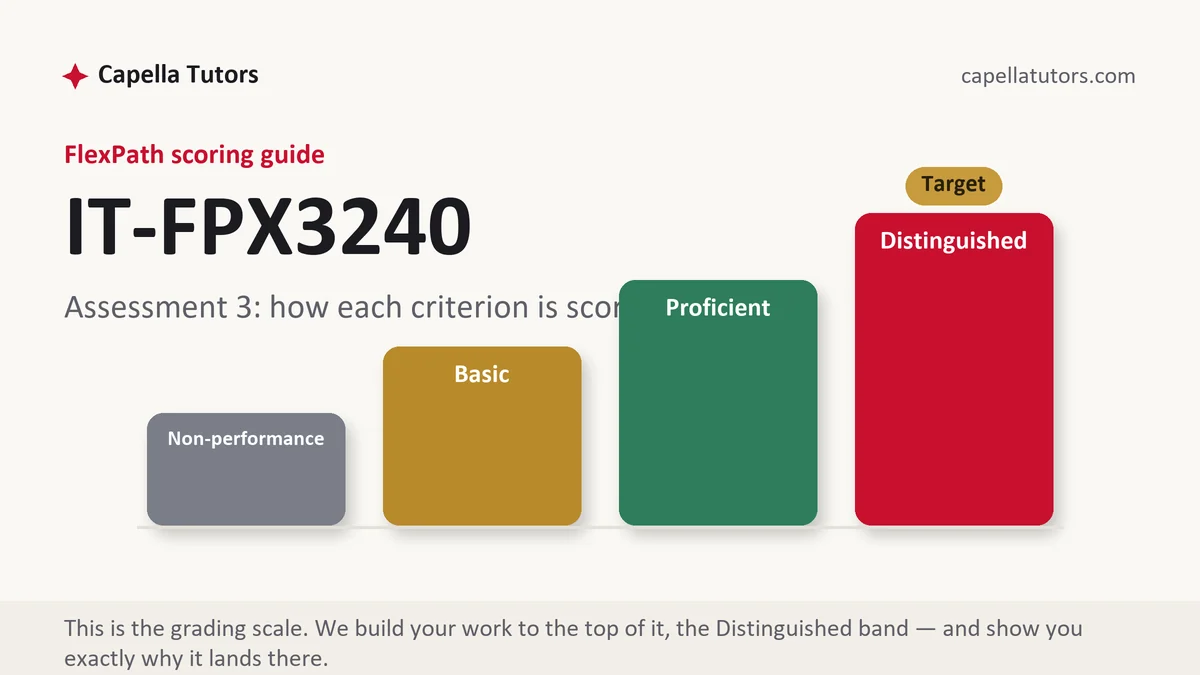
How IT FPX 3240 Assessment 3 is scored
Every criterion is marked at one of four levels and none of them is a percentage. The wording of the level you are aiming at is the instruction:
| Level | What it means on a data-handling submission |
|---|---|
| Distinguished | The interface is built from the data, the failure paths are handled and described, and the write-up names what happens when the source is empty, slow, or missing. Handling the unhappy path is the move this column is written around. |
| Proficient | Data loads, the view renders, and the requirements are met on a good day. Solid, with no account of a bad one. |
| Basic | Values typed straight into the markup with a script that decorates them. Functional, and it answers a different criterion than the one asked. |
| Non-performance | A required behavior does not run, or the page shows an empty area with no message when the source fails to load. |
Criteria on a synthesis deliverable reach backwards. Semantics, responsive behavior, label binding, and listener discipline are all still on the guide, so re-read the earlier rows rather than assuming the data work is the only thing being marked.
The IT FPX 3240 Assessment 3 method, step by step
-
Map the criteria, then decide what the data has to be
Set out the criteria as headings first, then design the shape of your data before writing any rendering code. Write one example record out in full with every field named and typed, because a field you invent halfway through the build is the field that breaks the export.
-
Choose a data problem with real shape to it
A hardware retailer holding around 1,900 stock lines across three branches gives you a record with an item code, a description, a branch, a quantity on hand, and a reorder level, which is enough for a table, a filter, a total, and an export of everything at or below its reorder point.
-
Render from the data, never around it
Write one function that takes the array and produces the rows, then call it whenever the data or the filter changes. Hard-coded rows with a script that hides some of them read as a workaround to anyone marking a criterion about dynamic content.
-
Handle the paths where nothing arrives
Three failures deserve their own code and their own paragraph: the source does not load, the source loads and holds no records, and the source is slower than the user's patience. Each gets a message in the interface rather than an empty region, and the message says what happened and what to do. A page opened from the file system rather than served will have the request refused before the network is involved, so serve the folder locally or stub the data in its own file and state which single line changes when the source goes live.
-
Build the export and prove its shape
An export is graded on the file it produces, so state the delimiter, the header row, the field order, and what happens to a description containing a comma. Open the result in a spreadsheet, capture it, and put the count of exported rows beside the count of records that met the filter. Two numbers that agree are the cheapest evidence you will find.
-
Retest the earlier criteria, then self-score and send
Walk the keyboard path again, narrow the window again, and run the validator again, because a rendering function is the easiest way to reintroduce markup problems you already fixed. Then mark every row yourself and submit early enough that a two business day evaluation still leaves you room.
A structure that maps to the criteria
Word targets our tutors plan against for the document behind a data-driven build; treat your own scoring guide as the authority on weighting.
| Section | What it must do | Guide |
|---|---|---|
| Requirement map | Criteria against files, functions, and line ranges, plus the steps to run a clean copy. | ~150 words |
| The data model | One record written out with every field named and typed, and where the source lives. | ~200 words |
| Rendering | The function that turns records into the view, and why the view is generated rather than typed. | ~300 words |
| Failure paths | What the page does when the source is missing, empty, or slow, and what the user is told. | ~250 words |
| The export | Delimiter, header row, field order, escaping, and the counts that show it is complete. | ~200 words |
| Testing and sources | Browsers and versions, states captured, validator run, and documentation cited in current APA. | ~200 words |
Annotated sample excerpt
A model excerpt from our team, written at the level the top column describes. Use it to see the moves, then produce your own version in your own voice.
When the stock file cannot be read, the table region is replaced by a short message naming the file and the branch requested, because an empty table looks identical to a branch that has sold everything.1 When the file reads successfully and holds no records at or below the reorder level, the page says so in a sentence rather than rendering an empty body, since that is a result and not an error.2 Both messages sit in the region the table occupies and are announced by the live container the filter already uses, so nothing new was added to the markup for a reader who cannot see the change.3
- 1Separates two states that look identical on screen, which is the distinction a criterion about handling data conditions is written to reward.
- 2Refuses to treat an empty result as a fault. Precision about what counts as an error is a marker of professional work.
- 3Reuses one announcement region for three purposes and says so, which shows a maintenance argument rather than only a working page.
The full premium sample for your exact assessment, written fresh to your scoring guide and issue, is free to request. Study it, revise it into your own voice, and submit work you understand.
The five mistakes that cost Distinguished
- Rows typed into the markup and filtered by script. A criterion about generating content from data cannot be satisfied by hiding half a hard-coded table.
- No message when the source fails. An empty region tells the user nothing and tells the evaluator that the unhappy path was never considered.
- A page opened from the file system and declared broken. The request is refused by the origin rule, not by your function, and the document should say which.
- An export with no escaping rule. One description containing a comma corrupts every column after it, and the write-up has to state the rule.
- Earlier criteria quietly regressed. A rendering function that emits divs undoes the semantics row you already earned in this course.
Pre-submission checklist
- One record documented field by field before any rendering code was written
- The view generated from the data by a single function that reruns on change
- Missing, empty, and slow sources each handled with a message a user can act on
- Export delimiter, header row, field order, and escaping stated and demonstrated
- Exported row count matched against the count of records that met the filter
- Keyboard path, narrow width, and validator rechecked, then self-scored D on every row
Data not loading and the deadline is close?
Send us the prompt, the criteria, and the folder in its current state. You get a documented data shape, a rendering function that handles the paths where nothing arrives, an export with its escaping rule stated, and the write-up that maps all of it to your guide inside 24 to 48 hours. Revisions stay free until it lands. First premium sample at no charge.