Tell us the role you are aiming at and send the criteria, and a premium original sample arrives inside 24 to 48 hours with the credential choice argued from counted evidence rather than from preference, dated, costed, and written to the Distinguished descriptors. The catalog lists this one as IT FPX 3180, Pathways to Certificate-Based Professional Development, an IT-FPX course held in elective and specialization-eligible standing rather than appearing on every plan, offered in FlexPath inside a BS in Information Technology that asks for at least 90 program points with a minimum of 27 of them at the 3000 level or above. Confirm the point value and where it lands on your own program evaluation before you enroll. In Capella's catalog the course code is written IT-FPX3180.
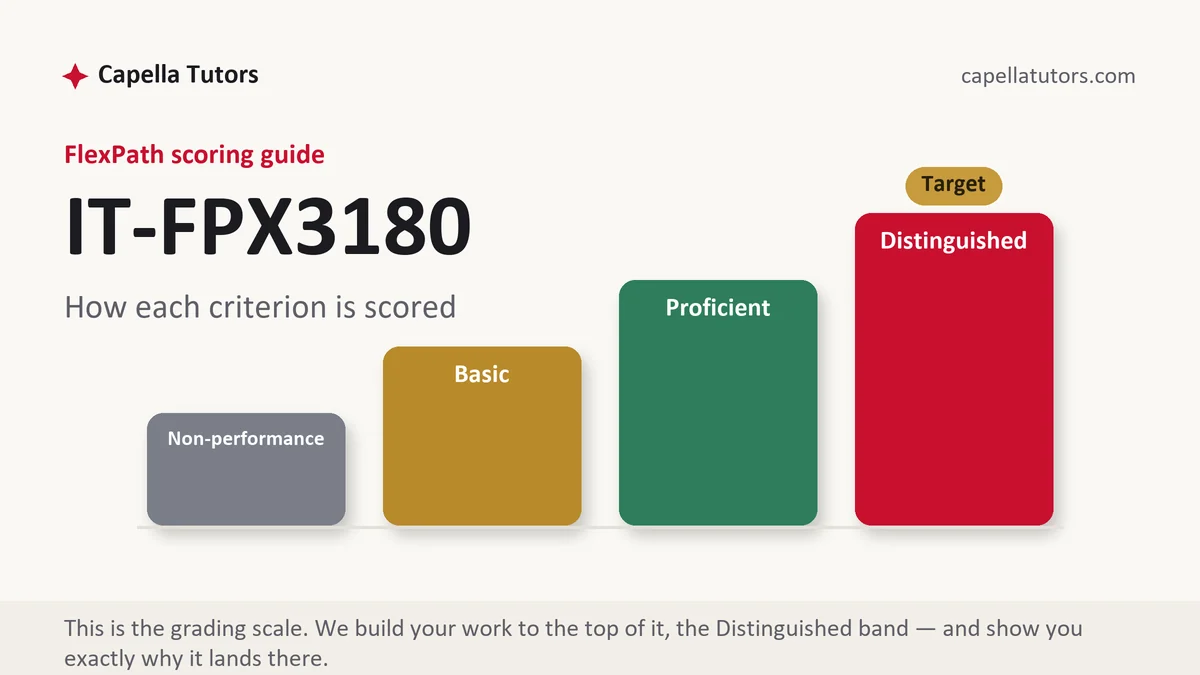
What IT FPX 3180 actually grades
You are the case study in this course, which is exactly why so many submissions underperform. Writing about your own career invites a personal essay, and a personal essay has no criteria to satisfy. The rows in the guide are looking for the same discipline any other analysis would demand: a starting position established with evidence, a target established with evidence, a gap between them named specifically, an option chosen against stated selection factors, and a plan with dates and money attached. Enthusiasm is not a finding. Wanting to advance in cybersecurity is not a goal a reader can measure. The move that lifts the whole submission is treating your professional development like a small procurement decision, where somebody else has to be able to check your reasoning.
The subject matter is the credential terrain itself, and precision here is graded. Vendor-neutral credentials test concepts that travel between employers, while vendor-specific ones certify you on a named platform and expire with it, so a plan that mixes the two should say why. Credentials also stack by level. Foundational ones sit under associate and professional tiers, some advanced credentials gate on documented work experience rather than on study alone, and the well-known information security professional credential is the standard example, since it asks for several years of cumulative paid experience across a set number of its domains and offers an associate designation to candidates who pass the examination before they have accumulated them. Structure differs too: some credentials are a single examination and others require two, some carry performance-based items rather than multiple choice, and retake rules and waiting periods vary by certifying body. State the structure of the one you pick, from the current candidate handbook, and you have satisfied a criterion most students answer from memory.
The third strand is economics, and it is the one that separates a plan from a wish. A credential costs an examination fee, study material, practice attempts, the hours you will not spend earning or resting, and a renewal obligation that arrives on a cycle and is met with continuing education activity or a further examination. Work out the cost per year of validity rather than quoting the exam fee alone, since a cheaper examination with a short cycle and an expensive renewal can outrun a dearer one that lasts. Add the employer's position, because tuition and certification reimbursement often exist and go unclaimed, and note whether a payback clause ties you to the employer for a period afterward. Grades follow the paper that names these numbers. A plan that says the examination costs a few hundred dollars is a plan that has not been priced.
How we help in this course
Work we deliver for 3180 is built out of documents rather than impressions. We pull the current objectives publication for the credentials in play, count the postings that support your target role and record the search that produced the count, build the crosswalk that runs from career goal to skill gap to credential domain to the evidence you will hold at the end, and lay the schedule out against the weeks you actually have. Tell us the role, the region, your present job, and how many study hours a week are realistic, and the plan will be one you could follow rather than one that reads well. We also keep the integrity line clean, so nothing we write claims a credential you do not hold or a role you have not worked.
Terms are the same across everything we do. Delivery inside 24 to 48 hours, written to the top descriptor, and eight sets of hands on it before yours: a research analyst gathers the scoring guide and the source documents, a subject writer produces the plan and the argument, a scoring-guide reviewer grades the draft against each criterion as a Capella evaluator would, an APA and originality pass matches every citation to the list, and an editor reads it through last. Revisions are free until the guide is met, faculty comments return to the same queue at no charge, and with two business days available for an evaluator to respond, submitting a clean draft early beats polishing one past its deadline.
The assessments, one by one
Assessment 1
Assessment 1 of IT FPX 3180, Pathways to Certificate-Based Professional Development, is usually the evidence deliverable: a starting position established with something external, a target role established the same way, and the gap between them named as specific items rather than as a feeling. Read the full Assessment 1 manual.
Assessment 2
Assessment 2 of IT FPX 3180 normally asks you to choose between credentials and defend the choice: selection factors declared before the candidates, two or three options compared on level, structure, domains and prerequisites, and the runner-up given its honest case. Read the full Assessment 2 manual.
Assessment 3
Assessment 3 of IT FPX 3180 usually closes the course on money and measurement: the full cost of holding a credential rather than the price of sitting for it, the renewal obligation that arrives on a cycle, and a definition of success that is not simply the pass. Read the full Assessment 3 manual.
How to actually write IT FPX 3180: where to begin
Start where every other course on this site starts, with the scoring guide split into headings and the Distinguished wording pasted underneath each one. Then add a discipline particular to this course, which is deciding in advance what your evidence will be for each claim about yourself. A self-assessment supported by a named framework of professional competencies, or by the requirement list from real advertisements, is evidence. A paragraph asserting that you are strong in networking and weaker in scripting is a self-report, and self-reports sit at the bottom of the evidence order. Score yourself against something external and the criterion about self-assessment stops being an opinion piece.
Then write the decision the way a hiring manager or a training budget holder would need to read it, because that reader is the model for your grader. The weak version says you plan to earn a security credential because it will help your career and open doors. The version that earns the top column says the target role is a security operations analyst, that a review of twenty-eight advertisements for that title in your metropolitan area posted within the last sixty days named one foundational security credential in twenty-two of them and a network credential in fifteen, that your gap list from the same advertisements is log analysis, incident triage, and network fundamentals, that the objectives publication for the credential you selected devotes measurable weight to two of those three and the third is covered by the neighbor credential you will take second, that the examination fee, one practice bank, and one study guide come to a stated total, that eight hours a week for eleven weeks puts the attempt inside your billing session, and that your employer reimburses on a pass with no payback clause. Every clause there is checkable, which is the whole point.
Close on renewal and on measurement, since both are criteria students skip. Say what keeps the credential alive, how many continuing education units the certifying body wants and over what period, roughly what those cost, and where they will come from, whether that is conference attendance, additional coursework, or activities the body already recognizes. Then define what success looks like beyond the pass, in terms of an interview obtained, a responsibility added, or an internal move applied for, with a date attached to each. A development plan with no measure of success is a study schedule wearing a longer title.
| Section | What goes in it | What Distinguished looks like |
|---|---|---|
| Self-assessment | Current role, experience, and skills rated against an external competency list rather than by feel. | A named framework or requirement set used as the yardstick, with the weak areas stated plainly. |
| Target role evidence | The next job title, the advertisements sampled, the region, the dates, and what they demanded. | A counted sample with the method described, so another person could repeat the search. |
| Credential comparison | Two or three candidates side by side: level, structure, domains, prerequisites, and standing. | Selection factors declared before the comparison, and the runner-up given its honest case. |
| Plan and schedule | Study hours a week, resources, milestone dates, and the intended examination window. | A schedule that fits the weeks and obligations you actually have, with slack built in for one retake. |
| Cost and renewal | Fees, materials, retake policy, reimbursement, renewal cycle, and continuing education obligations. | A total cost of ownership across the full validity period, not a single examination fee. |
| Reflection and sources | What the analysis changed about your plan, plus references in current APA. | A revision you can point to, and primary vendor documentation cited rather than summarized. |
Developing the analysis
There is a genuine argument about what certifications prove, and using it deliberately raises the analysis criterion above description. One view holds that a credential mainly signals persistence and employability to a screening system rather than demonstrating skill, which is why an applicant tracking filter can reject a capable person for lacking three letters. A second view holds that structured objectives force coverage of material practitioners would otherwise skip, so the studying itself builds the capability the badge advertises. Both are partly right and the resolution is local, which is your advantage here. Scope the claim to your own target role and region and settle it with the evidence you already collected, so if the credential appears in most advertisements for the role you want, its screening value is established for you regardless of what it proves in general. Then say what it will not do, because acknowledging that a foundational credential does not substitute for two years of ticket work is the kind of honesty the top column is written to reward.
Citations that survive faculty review
Four kinds of source hold up in a professional development plan. Certifying bodies are primary documents and belong in the reference list by name, including the objectives or candidate handbook, the fee schedule, the prerequisite statement, and the renewal policy, each cited in the version you read. Government labor data supplies the outside view, chiefly the Occupational Outlook Handbook and the wage and employment series published by the Bureau of Labor Statistics, which give occupation-level figures a training vendor's marketing page cannot. Professional associations supply competency language and ethics obligations, and the computing and information systems audit bodies publish frameworks you can score yourself against instead of inventing a scale. Peer-reviewed workforce and information systems research pulled through the Capella library carries any general claim about hiring, wage effects, or credential value, which is precisely the claim students most often support with a blog post. One rule protects this paper more than any other. Never cite a salary increase or a hiring statistic that appears on a page selling training, and never cite an examination dump site at all, since one is marketing and the other is a violation of the certifying body's own agreement. Reconcile the list against the text in current APA and date every vendor page you used.
The mistakes that land Basic instead of Distinguished
- A plan with no dates. Soon and next year are not milestones, and a schedule is the artifact being graded.
- A credential named without its current objectives. Describing a credential from reputation shows you never opened the publication.
- Salary claims lifted from a training seller. The source has an interest in the number, and evaluators know the pages.
- Renewal left out entirely. A credential you cannot maintain is a cost you have not counted.
- A reflection written as feelings. Say what changed in the plan and what evidence changed it.
IT FPX 3180 questions students actually ask
Do I have to actually sit and pass a certification exam?
Your scoring guide decides that, and it is the first thing to check rather than the thing to assume. Coursework of this kind is normally graded on the quality of the plan and the evidence behind it, meaning the gap analysis, the comparison, the schedule, and the budget, none of which require a passing score to be excellent. Where a voucher or an exam attempt is part of the requirement, the criteria will say so in words you cannot miss. Write the plan as though you intend to follow it either way, because a schedule built to be real is easier to defend than one built to look impressive, and the reflection at the end is far simpler to write when the dates were plausible.
Which certification should I choose?
Let the postings decide and show your work. Choose the job title you want next rather than the one you want eventually, collect twenty to thirty current advertisements for that title in the region you will actually work in, and count how many name each credential. A credential appearing in nineteen of thirty postings for a support analyst role beats one that appears in three, and the count is evidence a grader can check while a preference is not. Then read the exam objectives for the two leaders and pick the one whose domains overlap your gap list, not the one with the better reputation online, and record the date range and the search terms you used so the method is repeatable.
How do I cite an exam objectives document in APA?
Treat the certifying body as the author, because that is exactly what it is. The organization goes in the author position, the year of the version you read goes in the date position, the full title of the objectives or candidate handbook goes in italics with the version or exam code included, and the link to the page you retrieved it from closes the entry. Cite the edition you actually opened rather than the credential in general, since these documents are revised on a cycle and a plan built on retired objectives is a plan built on the wrong domains. Adding a retrieval date is sensible for any vendor page that changes without notice, and the same discipline applies to a fee schedule or a renewal policy you quote.
Development plan due and nothing on paper?
Send the criteria and the role you are chasing. You get the evidence, the comparison, and a schedule that fits your weeks. Nothing to pay on the first premium sample.