This manual is for IT FPX 3180 Assessment 2, start to submission. Assessment 2 of IT FPX 3180 normally asks you to choose between credentials and defend the choice: selection factors declared before the candidates, two or three options compared on level, structure, domains and prerequisites, and the runner-up given its honest case. Your scoring guide sets the requirements row by row, and the row that decides your grade is the one asking why this one rather than that one. The sequence our tutors follow comes next, with a structure matched to the criteria and an annotated sample excerpt. Prefer to hand it over? The premium original sample for this exact assessment lands within 24 to 48 hours, and revisions are free until the criteria are satisfied. Capella's catalog lists the course as IT-FPX3180, and some courserooms print IT3180; both point to this same Assessment 2.
One honesty note before the manual: Capella revises courses and scoring guides over time, so always write to the exact scoring guide attached to your assessment in the courseroom. The course identity above is verified on capella.edu; the method and structure below are our tutors' approach to it, not Capella's official rubric text.
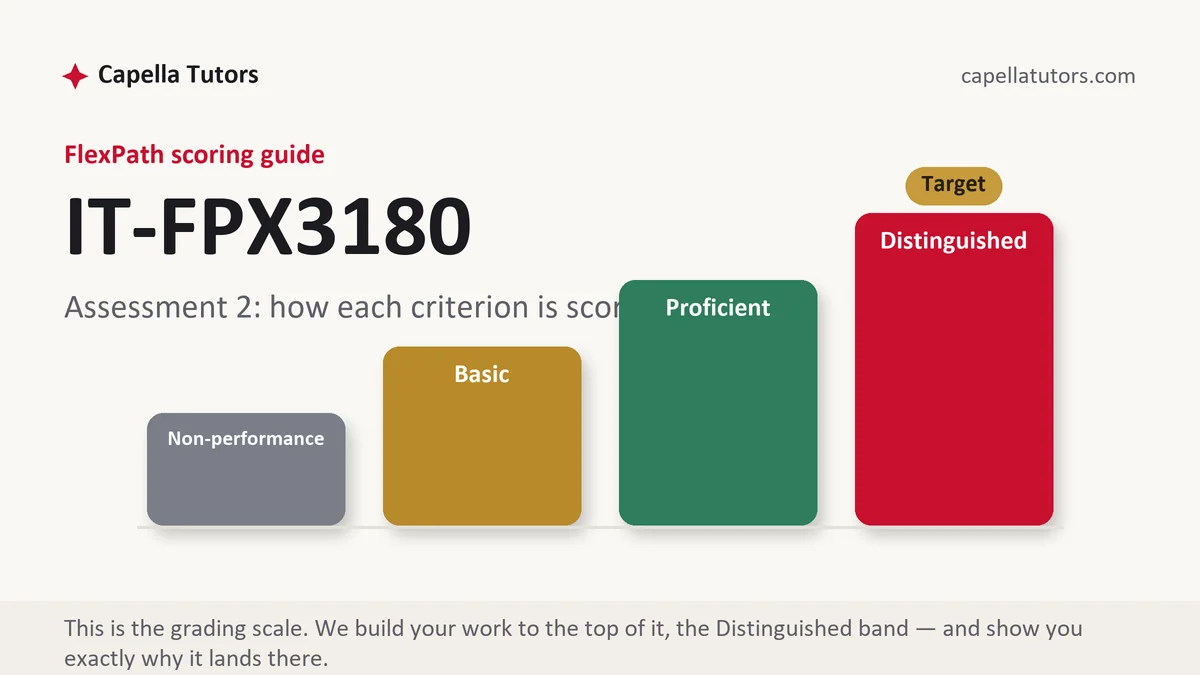
How IT FPX 3180 Assessment 2 is scored
Levels rather than marks, four of them per criterion, and their wording is the most useful outline available to you:
| Level | What it means on a credential comparison |
|---|---|
| Distinguished | The selection factors are declared before the candidates appear, each credential is described from its current objectives rather than its reputation, the rejected option is given its real case, and the paper says what the winner will not do. Naming the limit is where the top level lives. |
| Proficient | Two or three credentials compared accurately on stated factors with a defensible choice. Complete work, one admission below the column above. |
| Basic | A description of two credentials followed by a preference, with the factors implied rather than stated. The usual result on a first comparison. |
| Non-performance | A required element is absent, most often the prerequisites or the structure of one candidate. An unanswered row is scored as unanswered. |
Precision about the terrain is graded here. Vendor-neutral credentials test concepts that travel between employers while vendor-specific ones certify you on a named platform, some credentials gate on documented work experience rather than on study alone, and some are one examination while others are two.
The IT FPX 3180 Assessment 2 method, step by step
-
Declare the selection factors before you open a single objectives page
Three or four factors, each phrased so a reader could apply it themselves: how often the credential appears in postings for your target title, whether its domains cover your gap list, whether it outlives the platform it certifies, and what its renewal demands. Factors written after the winner is chosen are visible, and the analysis row is where that becomes expensive.
-
Describe each candidate from its current publication
Open the objectives or candidate handbook for the version live today and take the level, the domain weighting, the number of examinations, the item types, the prerequisites and the retake rules from there. Describing a credential from its reputation shows exactly that, because the domains rarely match what the internet remembers about them.
-
Check whether experience gates the credential
Some advanced credentials require documented paid work across a number of their domains before they will issue, and offer an associate designation to candidates who pass the examination before they have accumulated it. If that applies to a candidate you are considering, it changes your sequence rather than your ambition, and saying so is a row of its own.
-
Score every candidate against every factor
No blank cells. A credential that fails a factor gets a sentence saying how badly and why that matters here, since a comparison with an unscored column has compared nothing. Keep the winner's weaknesses in the table too, because a candidate that loses on nothing reads as a decision made before the analysis started.
-
Give the runner-up its strongest case
One paragraph arguing for the option you are not taking, built from the same objectives and the same factors. Then say what would have to be true for it to win. This is the cheapest way to demonstrate the reasoning the criterion rewards, and a weakened opposing case does more damage than none at all.
-
Say what the winner will not do, then self-score
A foundational credential does not substitute for two years of ticket work, and writing that plainly is the honesty the top column is built to reward. Scope the general argument about what certifications prove to your own role and region and settle it with your own evidence. Then grade each criterion and submit early.
A structure that maps to the criteria
Planning lengths our tutors use on a comparison of this size rather than requirements Capella publishes; expand where your guide asks more.
| Section | What it must do | Guide |
|---|---|---|
| Selection factors | Three or four factors, declared before any candidate and phrased so a reader could apply them. | ~200 words |
| Candidate profiles | Level, structure, domains, item types, prerequisites and retake rules from the current publication. | ~300 words |
| Scored against the factors | Every candidate against every factor, with the failures stated as plainly as the wins. | ~280 words |
| The runner-up's case | The best argument for the option you are rejecting, and what would make it win. | ~220 words |
| The decision | The credential chosen, the factor that decided it, and the sequence the others take. | ~200 words |
| Limits and references | What the credential will not do, plus certifying-body publications in current APA. | as needed |
Annotated sample excerpt
An original excerpt from our team showing what declared factors sound like on the page. Take the sequence and run it against your own two candidates.
Four selection factors were fixed before either credential was opened: how often each appears in advertisements for the target title, whether the published domains cover the gap list, whether the credential outlives the platform it certifies, and what the renewal cycle demands.1 On the third factor the two separate cleanly, because the vendor-neutral credential tests concepts that travel to the next employer while the vendor credential certifies competence on one provider's console and is retired whenever that provider reorganises its programme, a history the provider's own retirement notices record.2 The runner-up still has an honest case and it is a strong one: the print shop already runs everything on that provider, so the vendor credential is the one the current employer will fund this quarter, which is why the plan takes it second rather than dismissing it.3
- 1Puts four applicable factors on the page before either candidate appears. The order is the whole criterion, and it costs nothing but discipline.
- 2Separates the candidates on one factor and sources the claim to the provider's own notices rather than to an opinion about vendor credentials in general.
- 3Argues the rejected option properly and then places it in the sequence instead of discarding it. A runner-up with a real case is what stops the comparison reading as a formality.
The full premium sample for your exact assessment, written fresh to your scoring guide and issue, is free to request. Study it, revise it into your own voice, and submit work you understand.
The five mistakes that cost Distinguished
- Selection factors that appear after the winner. The sequence is visible in the prose, and a factor shaped to fit a conclusion is scored as preference rather than analysis.
- A credential profiled from its reputation. The current publication rarely matches what is remembered about it, and the mismatch tells the grader the document was never opened.
- Prerequisites left out of the comparison. An experience requirement changes the sequence entirely, so omitting it can make the whole plan unworkable.
- A rejected option given a weak case on purpose. An evaluator recognises the tactic, and it costs more than leaving the comparison at two lines would have.
- A winner that loses on nothing. Every credential fails some factor, and a candidate with no weakness reads as a decision taken before the factors were written.
Pre-submission checklist
- Three or four selection factors declared before any candidate is introduced
- Each credential profiled from its current objectives or candidate handbook
- Prerequisites and any experience requirement stated for every candidate
- Every candidate scored against every factor, including the ones it fails
- The rejected option argued at strength, with what would make it win
- One sentence stating what the chosen credential will not do for you
Credential comparison due?
Send the criteria, the target role and the credentials you are weighing. The sample returns in 24 to 48 hours with the factors declared first, both candidates profiled from their current publications, and the runner-up given its real case. We check every prerequisite and structure claim against the issuing body before the file leaves us.