This manual is for IT FPX 3180 Assessment 1, start to submission. Assessment 1 of IT FPX 3180, Pathways to Certificate-Based Professional Development, is usually the evidence deliverable: a starting position established with something external, a target role established the same way, and the gap between them named as specific items rather than as a feeling. FlexPath grades it criterion by criterion against your scoring guide, and the difficulty is that you are the case study, which invites a personal essay when the rows are asking for an analysis. Below is the method our tutors bring to it, a structure shaped by the criteria, and an annotated sample excerpt. Want it handled? You have a premium original sample for this exact assessment inside 24 to 48 hours, revised free until the guide is met in full. Capella's catalog lists the course as IT-FPX3180, and some courserooms print IT3180; both point to this same Assessment 1.
One honesty note before the manual: Capella revises courses and scoring guides over time, so always write to the exact scoring guide attached to your assessment in the courseroom. The course identity above is verified on capella.edu; the method and structure below are our tutors' approach to it, not Capella's official rubric text.
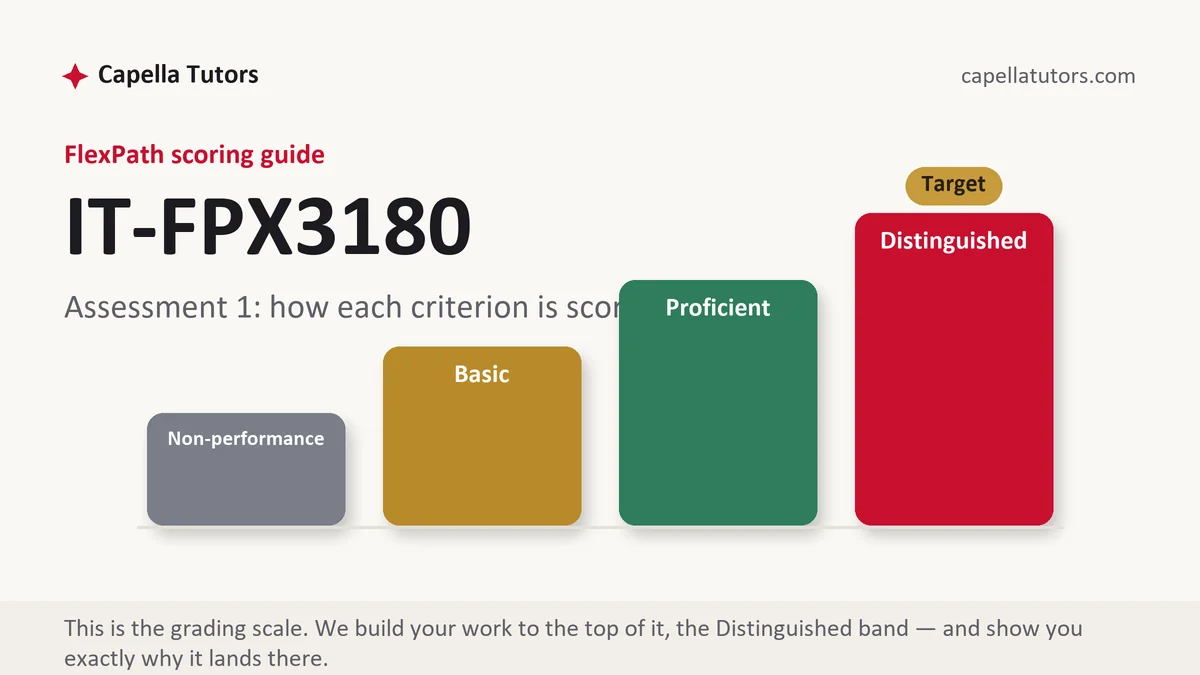
How IT FPX 3180 Assessment 1 is scored
FlexPath places each criterion at one of four levels and never converts them to a mark. The level wording is what you write to:
| Level | What it means on a self-assessment and target-role analysis |
|---|---|
| Distinguished | The self-assessment is scored against something outside your own head, the target is evidenced with a counted sample whose method a reader could repeat, and the gap includes the items no credential covers. Noticing those items is where the top level sits. |
| Proficient | A clear self-assessment and a well-evidenced target, with the gap named. Solid analysis, one observation below the column above. |
| Basic | A confident account of your strengths and ambitions with a job title attached. Sincere, unfalsifiable, and where most first submissions land. |
| Non-performance | A required element never appears, most often the evidence behind the target role. A row asking how you know cannot be answered by conviction. |
The move that lifts every row at once is treating your own development as a small procurement decision, where somebody else has to be able to check the reasoning. Enthusiasm is not a finding, and wanting to advance is not a goal a reader can measure.
The IT FPX 3180 Assessment 1 method, step by step
-
Decide what your evidence will be before you write a claim
For each statement you intend to make about yourself, name the external thing that supports it: a published competency list, a set of collected requirement statements, a documented appraisal, a credential's own objectives. Self-reports sit at the bottom of the evidence order, so a paragraph asserting a strength is worth less than a mediocre score against a real yardstick.
-
Pick the job you want next, not the one you want eventually
A plan aimed four moves ahead has no measurable gap, because everything is missing. Choose the title you could realistically hold next, in the region you will actually work in, and let that choice narrow everything else. The eventual ambition belongs in one sentence at the end rather than in the middle of the analysis.
-
Count the advertisements and record the method
Twenty to thirty current postings for that title, in that region, inside a stated date range, with the search terms written down. Then tally the requirement language instead of skimming it, so you can say how many named each credential. A count another person could repeat is evidence; an impression of what employers want is not.
-
Describe the target by its work rather than its label
Two employers mean different things by the same job title, so pull the actual duties out of the postings: which systems, which responsibilities, what the person is accountable for on a bad day. This description is what your gap will be measured against, so vagueness here propagates into every later criterion.
-
Name the gap as items, including the ones no exam covers
Turn the difference between your evidence and the target into a short list of named items. Then notice which of them no credential addresses: supervised hours, a licence, a portfolio, experience only time supplies. Recognising that one gap needs a different instrument is the analysis, and most submissions never make it.
-
Keep the integrity line clean, then self-score
Claim no credential you do not hold and no role you have not worked, and describe an in-progress credential as in progress. Then grade each criterion yourself against all four levels, fix anything below the top, and submit with the two business days an evaluator has still ahead of you.
A structure that maps to the criteria
The word targets are planning figures our tutors use for an evidence deliverable of this size, not Capella rules; expand whichever section your own guide weights.
| Section | What it must do | Guide |
|---|---|---|
| Where you are now | Current role, tenure and responsibilities, described without inflation and dated. | ~200 words |
| The yardstick | The external competency list or requirement set you are scoring yourself against, and why that one. | ~200 words |
| Self-assessment | Your skills scored against that yardstick, with the weak areas stated plainly. | ~250 words |
| Target role, evidenced | The title, the region, the date range, the sample size, the search terms, and what the postings demanded. | ~300 words |
| The gap, as items | Each missing item named, including the ones no credential addresses. | ~250 words |
| Method notes and references | How the search could be repeated, plus labor and association sources in current APA. | as needed |
Annotated sample excerpt
A passage from an original model our team wrote, at the level of evidence the top column expects. Study how each claim is anchored, then anchor your own the same way.
The present seat is desktop support in a school district, three years of it, and the target is the network technician opening the district posts most Augusts.1 Thirty-one advertisements for that title were collected inside a sixty-mile radius over the previous forty-five days, with the search terms and the date range recorded so the count can be repeated, and the requirement language was tallied rather than skimmed: a vendor-neutral networking credential appeared in 19 of the 31, a vendor switching credential in 7, and a current driving licence in 24, which is a requirement no credential addresses at all.2 Scored against that tally rather than against my own impression, the gap comes to three items, two of which sit inside the objectives of the leading credential, while the third is structured cabling and goes on the plan as supervised hours instead of as an exam.3
- 1Fixes the starting point and the next step in one sentence, both dated and both modest. A target the employer actually posts is more defensible than a title borrowed from a salary article.
- 2Gives the sample size, the radius, the window and the method, then reports the tally as counts. Every clause here is repeatable by the grader, which is what the evidence row measures.
- 3Separates the gaps a credential can close from the one it cannot, and assigns a different instrument to each. That distinction is the analysis this criterion is written to reward.
The full premium sample for your exact assessment, written fresh to your scoring guide and issue, is free to request. Study it, revise it into your own voice, and submit work you understand.
The five mistakes that cost Distinguished
- Strengths asserted with nothing behind them. An unmeasured claim about yourself is the weakest evidence in the document, and the row explicitly asks what you scored against.
- A target role four moves away. Everything is missing at that distance, so the gap cannot be measured and the analysis has nothing to work on.
- Requirement language skimmed instead of tallied. A count is checkable and an impression is not, and only one of the two survives a reader who opens the same job board.
- A region left unstated in the search. Demand for a credential differs by market, so a national impression cannot support a local plan.
- An in-progress credential written as held. The integrity problem is larger than the rubric problem, and both are avoided by one qualifying word.
Pre-submission checklist
- Current role described plainly, with tenure and responsibilities dated
- An external competency list or requirement set named as the yardstick
- Sample size, region, date range and search terms all recorded
- Requirement language tallied as counts rather than summarised
- Gap written as named items, including those no credential covers
- No credential or role claimed that you do not currently hold
Self-assessment and evidence due?
Tell us the role you are chasing, the region, and your present job. The sample comes back inside 24 to 48 hours with the postings counted and the search recorded, your skills scored against a published competency set, and the gap written as items. Revisions stay free until the guide clears, and nothing in it claims a credential you do not hold.