This manual is for IT FPX 3180 Assessment 3, start to submission. Assessment 3 of IT FPX 3180 usually closes the course on money and measurement: the full cost of holding a credential rather than the price of sitting for it, the renewal obligation that arrives on a cycle, and a definition of success that is not simply the pass. The criteria are graded individually against your scoring guide, and the row students skip most often is renewal. What follows is our tutors' working order, a structure pulled from the criteria, and an annotated sample excerpt. Would you rather delegate it? A premium original sample for this exact assessment arrives inside 24 to 48 hours, with free revision until the guide is fully met. Capella's catalog lists the course as IT-FPX3180, and some courserooms print IT3180; both point to this same Assessment 3.
One honesty note before the manual: Capella revises courses and scoring guides over time, so always write to the exact scoring guide attached to your assessment in the courseroom. The course identity above is verified on capella.edu; the method and structure below are our tutors' approach to it, not Capella's official rubric text.
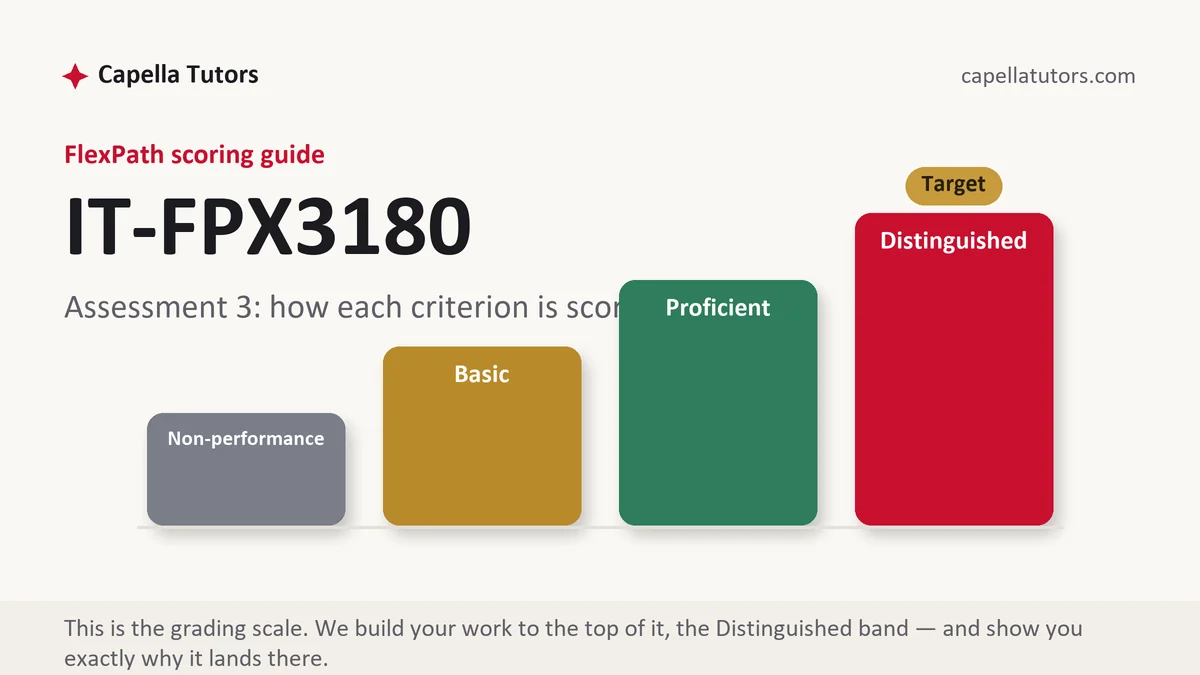
How IT FPX 3180 Assessment 3 is scored
Four levels per criterion, no percentages, and the descriptions are the specification for the numbers underneath them:
| Level | What it means on a cost, renewal and measurement plan |
|---|---|
| Distinguished | Costs are totalled across the full validity period and divided to a figure per year, the renewal obligation is quoted from the issuing body with its cycle, the employer's terms including any payback clause are written in, and success is defined with dates. The payback clause is where the top level hides. |
| Proficient | A complete budget with renewal included and measures attached. Usable planning, one term short of the column above. |
| Basic | An examination fee, a rough study estimate, and a plan to renew somehow. Where most first budgets land. |
| Non-performance | A required element never appears, most often the renewal obligation or the measure of success. The row is graded on what is written down. |
Cost per year of validity is the figure that makes two credentials comparable, because a cheap examination on a short cycle with an expensive renewal can outrun a dearer one that lasts. Quote each number from the body that publishes it and record the date you looked, since those pages change without notice.
The IT FPX 3180 Assessment 3 method, step by step
-
Total the cost of holding it, not the cost of sitting it
The examination fee is the smallest line. Add the study guide, the practice bank, one retake allowance, the continuing education the cycle requires, and the hours you will not spend earning or resting. A budget quoting only a rough figure for the examination is a budget nobody has actually built.
-
Divide by the years of validity
Once the total is assembled, divide it by the period the credential stays live to produce a figure per year. That number is what belongs beside a rival credential, and it frequently reverses a comparison made on sticker price alone. Show the division rather than only the result.
-
Quote the renewal terms from the issuing body
How many continuing education units, over what period, what activities the body already recognises, whether a further examination is an alternative, and what happens if the cycle lapses. Name where those units will come from in your own case, whether that is coursework, conference attendance or activities your employer already runs.
-
Write in the employer's terms, including the trap
Tuition and certification reimbursement often exist and go unclaimed, so check and say what your employer offers. Then check the condition: whether payment lands on a pass or on enrolment, and whether the agreement carries a payback clause tying you to the employer for a period afterwards. A benefit with a clause is a commitment, and naming it is judgment.
-
Define success beyond the pass, with dates
An interview obtained, a responsibility added, an internal posting applied for, a rate renegotiated, each with a date attached. A development plan with no measure of success is a study schedule wearing a longer title, and the measurement row is the easiest one in the course to secure once you accept that the pass is a milestone rather than an outcome.
-
Source every figure properly, then self-score
Certifying bodies for their own fees and renewal terms, government labor data for the outside view of the occupation, and peer-reviewed workforce research for any general claim about hiring or credential value. Never quote a salary figure from a page selling training, and never cite an examination dump at all. Then grade each criterion and submit early.
A structure that maps to the criteria
Targets our tutors plan a budget and measurement section of this size against, not limits set by Capella; grow whichever row your guide weights.
| Section | What it must do | Guide |
|---|---|---|
| The cost inventory | Every line: fee, materials, practice, retake allowance, and the hours committed. | ~250 words |
| Cost per year of validity | The total divided by the live period, with the division shown and the rival's figure beside it. | ~200 words |
| Renewal obligation | Units required, the cycle, recognised activities, and what a lapse costs. | ~250 words |
| Employer terms | Reimbursement, its condition, and any payback clause with its duration. | ~200 words |
| Measures of success | What changes beyond the pass, each with a date and a way of knowing it happened. | ~250 words |
| Sources and dates checked | Certifying-body pages with retrieval dates, plus labor data in current APA. | as needed |
Annotated sample excerpt
A short passage from an original model our team produced, showing what a properly priced plan reads like. Take the structure and fill it with your own figures.
The examination fee is the smallest line in this budget, which is why the plan prices three years of validity rather than one afternoon in a test centre.1 Against the fee published on the certifying body's current page, checked on 12 January, the plan adds one study guide, one practice bank, a single retake allowance and the continuing education the body requires across the cycle, then divides that total by the years the credential stays live so the figure can sit beside the other candidate's cost per year instead of beside its sticker.2 Two employer facts change the arithmetic and both are written in: reimbursement is paid on a pass rather than on enrolment, so the money leaves my own account first, and the agreement carries a twelve-month payback clause, which means leaving inside a year converts the benefit into a debt.3
- 1Opens by naming the framing error the criterion is written to catch. Pricing the holding period rather than the sitting is the decision the rest of the section depends on.
- 2Lists every line, records the date the fee was checked, and shows the division to a per-year figure. That figure is what makes two credentials genuinely comparable.
- 3Reads the reimbursement terms rather than assuming them, and names the payback clause. Noticing the condition attached to a benefit is the judgment the top column rewards.
The full premium sample for your exact assessment, written fresh to your scoring guide and issue, is free to request. Study it, revise it into your own voice, and submit work you understand.
The five mistakes that cost Distinguished
- A budget built from the examination fee alone. Materials, retakes and continuing education are the larger part, and the cost row is written about the total.
- Two credentials compared on sticker price. A short cycle with an expensive renewal beats a dearer credential on paper and loses on the yearly figure.
- Renewal mentioned without its cycle or its units. The obligation is a recurring cost, and a credential you cannot maintain is one you have not really budgeted for.
- Reimbursement assumed rather than checked. The condition matters more than the amount, and a payback clause turns a benefit into a term of employment.
- Success defined as passing the examination. The pass is the milestone, and the row asks what the credential is supposed to change afterwards.
Pre-submission checklist
- Every cost line listed, including materials, retake allowance and committed hours
- Total divided by the years of validity, with the division shown
- Renewal units, cycle and recognised activities quoted from the issuing body
- Reimbursement terms and any payback clause written in with the duration
- Success defined beyond the pass, with a date and a check for each measure
- Every figure sourced to the publishing body, with the date you retrieved it
Budget and renewal section due?
Send the criteria, the credentials in play and whatever your employer offers. The sample comes back in 24 to 48 hours with the full cost of holding the credential totalled, the per-year figure derived, the renewal cycle quoted from the issuing body, and success defined with dates. We date-check every vendor page we use, and revisions are free until the guide is met.