Give us the prompt and the scoring guide and a premium original sample returns inside 24 to 48 hours, argued to the Distinguished descriptors, with an address plan whose ranges actually tile and a diagram that agrees with the table beside it, revised free until the criteria are met. The course on paper: IT FPX 2280, Network Technology and Architecture, worth 3 program points, a core requirement in both FlexPath specializations of the BS in Information Technology. Like the rest of the 2000-level core it counts toward the 90 points the degree needs while leaving the 27-point requirement above the 3000 line for later courses to satisfy. In Capella's catalog the course code is written IT-FPX2280.
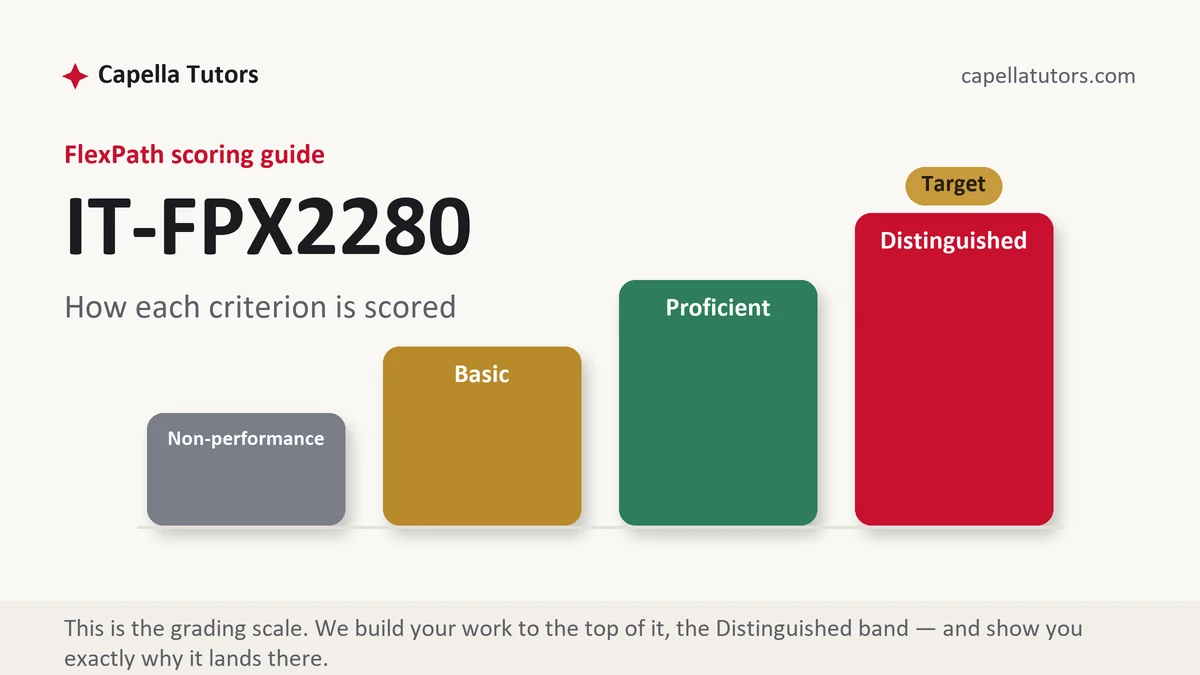
What IT FPX 2280 actually grades
Two things are being tested in every deliverable here: a design you can defend on stated requirements, and arithmetic that survives a reader with a calculator. The second one is unforgiving in a way that written courses are not. An address plan with overlapping ranges is wrong in a way an evaluator can demonstrate in fifteen seconds, so the checking is not optional and it is not something to leave until the document is otherwise finished.
The layered models earn their place by being diagnostic rather than decorative. Reciting seven layers proves nothing; using them to locate a fault proves everything. A switch forwards frames using hardware addresses and lives at the data link layer, a router forwards packets using logical addresses and lives one layer up, and knowing which of those a symptom belongs to is precisely what a troubleshooting criterion measures. A cut cable or a dead port is physical. A device in the wrong virtual segment is data link. A wrong default gateway is network. A blocked port number is transport. A name that will not resolve is an application-layer problem that every user in the building will describe as the internet being down.
Addressing is where the arithmetic gets graded. An address is thirty-two bits in four octets, and a twenty-four-bit prefix leaves eight bits for hosts, which is 256 addresses of which 254 can be assigned once the network address and the broadcast address are set aside. Borrow two more bits and you get four subnets of 64 addresses each, 62 of them assignable, with the boundaries landing at zero, 64, 128 and 192, and being able to write that sequence without hesitating is most of what the subnetting criteria want. The private ranges beginning 10, the block from 172.16, and the 192.168 space are not routed across the public internet, which is the reason address translation exists at the boundary. The newer protocol uses 128 bits and removes the scarcity that translation was invented to manage.
Two services decide whether any of the design works in practice. Address assignment hands out configuration on a lease, and a lease that expires against an unreachable server is why a machine ends up with a self-assigned address and no route anywhere. Name resolution turns names into addresses, and it fails in ways that look like everything else failing. That gives you the cleanest diagnostic in the course: if a host answers by address and not by name, the network is fine and the resolver is not, and writing that sentence into a troubleshooting answer collects a criterion on its own.
The physical layer and the wireless argument close the set, and both are about constraints rather than products. A copper Ethernet run is specified to 100 meters including the patch cords at each end, and that single number decides where the wiring closet goes in every floor plan you will ever be handed. Fiber covers the distances copper cannot and the runs between buildings. On wireless, the lower band travels further through walls and carries less, and only three of its channels avoid overlapping one another, while the higher band carries more and stops sooner. Coverage is therefore an argument about walls, channel reuse and access point placement, and a paper that answers it by specifying a more powerful router has answered a different question.
How we help in this course
Network deliverables come back with the address plan attached and checked. Send the scenario, the host counts per location and any equipment your section requires, and the sample arrives with a subnet allocation that tiles without gaps or overlaps, a table listing each subnet with its range, its usable span, its gateway and its purpose, and a diagram description keyed to that table so the two cannot disagree. Where growth is part of the requirement, the plan says how many hosts each subnet can absorb before it has to be resized.
Delivery matches the studio standard, inside 24 to 48 hours and written criterion by criterion against the guide you upload, through the eight-person pipeline with a reviewer who recalculates every boundary in the plan by hand before the file leaves. Revisions stay free until the score lands, and faculty comments return into the same cycle at no cost, which in this course usually means one arithmetic correction rather than a rewrite.
The assessments, one by one
Assessment 1
Assessment 1 of IT FPX 2280, Network Technology and Architecture, is usually the requirements and topology deliverable: device counts gathered before any diagram, a logical layout justified by those counts, and hardware chosen against constraints rather than against reputation. Read the full Assessment 1 manual.
Assessment 2
Assessment 2 of IT FPX 2280 normally turns to the arithmetic: a block of addresses, host counts per location, prefixes chosen from those counts, and ranges that tile the block with no gap and no overlap. Read the full Assessment 2 manual.
Assessment 3
Assessment 3 of IT FPX 2280 usually asks you to find a fault and prove it: a symptom described the way users describe it, tests that eliminate layers in order, and a recommendation that answers the constraint rather than the complaint. Read the full Assessment 3 manual.
How to actually write IT FPX 2280: where to begin
Start with the requirement count, not with the topology. Write down how many hosts sit at each location, add the printers, the access points, the cameras and the management interfaces that everyone forgets, then add the growth the scenario asks you to plan for, and only then choose a prefix length. Doing it the other way round, which means picking a familiar mask and hoping the hosts fit, is how a design ends up with a department that cannot grow past thirty machines. The scoring guide will name the parts it wants, typically requirements, topology, addressing, hardware, security and testing, so make each of those a heading and put nothing outside them.
Here is the contrast, worked. The Basic sentence says the network will be divided into subnets for each department. The version that scores takes the block it was given, allocates a twenty-six-bit prefix to a department of forty hosts because the next size down holds only thirty and leaves nothing spare, writes the range out as a first and last address, identifies which addresses are unusable and why, reserves the first usable one for the gateway, and finishes by saying what happens when that department reaches sixty-three machines. Same idea, and one of them is a plan.
Then read your own evidence honestly, because network captures mislead in both directions. A successful ping shows that one host reached another and that a reply came back, which says nothing about whether the application will work. A failed ping is weaker still, since blocking the protocol at a firewall or a host is ordinary practice, so an unanswered request is not proof that a machine is down and a document claiming otherwise has made an error of reasoning rather than of typing. Capture the address configuration, the reachability test, the path trace and the name lookup, and give each one a caption that says what it rules out rather than what it proves. The diagram is graded the same way: every device labeled with a name, an interface and an address or a range, a legend for the symbols, and a layout that survives being printed in black and white.
| Section | What goes in it | What Distinguished looks like |
|---|---|---|
| Requirements and host counts | Locations, users, devices, growth allowance and the services required at each site. | Counts that include infrastructure devices, with the growth assumption stated as a number. |
| Logical topology | How the segments connect, where routing happens, and where the boundary sits. | A topology justified by the requirements rather than by a familiar picture. |
| Addressing plan | Every subnet with its prefix, range, usable span, gateway and purpose. | Ranges that tile the block with no overlap and no gap, each boundary shown as arithmetic. |
| Hardware and media | Switches, routers, access points, cable categories and distances. | Media chosen against the actual run length, with the distance limit cited to a standard. |
| Security and segmentation | Segmentation, guest separation, and the controls at the boundary. | Segments justified by what traffic must not meet, with the administrative cost admitted. |
| Testing, diagram and references | The verification performed, the drawing, current APA both ways. | Captures captioned for what they exclude, and a diagram that matches the address table exactly. |
Developing the analysis
Design analysis here is a tradeoff argued in operational terms. Take segmentation. A flat network is cheaper to build and simpler for whoever inherits it, and it puts every broadcast in front of every device and lets any machine talk to any other, which is fine in a six-person office and indefensible once payment traffic, guest devices or building systems are present. Segmenting cuts the broadcast domain and separates traffic that should never meet, and it buys that with a routing device or a layer three switch, a configuration to maintain, and a support burden that lands on somebody after you leave. Decide it on stated grounds: the device count, whether traffic of different sensitivities exists on the same wire, and who administers the result. Redundancy deserves the same treatment. A second uplink from a different provider removes a single point of failure and adds a recurring monthly cost that continues whether or not the first link ever drops, and the paragraph that names that recurring cost reads as professional judgment where the paragraph recommending redundancy without pricing it reads as a slogan. Say which requirement each decision serves, and say what you gave up.
Citations that survive faculty review
Protocol claims belong to the documents that define the protocols, and those are free to read, so an undergraduate networking paper has no reason to cite a summary site. The request for comments series is the primary source, with the document on private address allocation being the one most often needed at this level, and the relevant specification for whichever protocol an argument turns on. Physical and wireless behavior comes from the institute that standardizes it, so cite the Ethernet and wireless standards by number and, for wireless, by amendment letter, because the generation matters to any claim about throughput. Cabling distance and category belong to the telecommunications industry standards rather than to a cable seller. Vendor configuration guides are the right source for how a specific device is set up, and the major manufacturers publish theirs openly. Certification objectives are a defensible source for vocabulary and for the troubleshooting sequence. Treat any speed printed on a product page as a rated maximum measured in conditions you will not have, and label it that way in the text.
The mistakes that land Basic instead of Distinguished
- Subnet ranges that overlap or leave a gap in the block. The arithmetic is checkable in seconds, and a plan that does not tile cannot be built as written.
- Usable host counts that forget the network and broadcast addresses. Two addresses in every subnet cannot be assigned, and a design sized without them is short by two at every site.
- A diagram with devices but no addresses. A picture of boxes and lines evidences neither the plan nor the reasoning behind it.
- A failed reachability test reported as a dead host. Blocking that protocol is normal practice, so the test excludes far less than the sentence claims.
- Wireless coverage argued without walls, bands or channels. Recommending stronger equipment answers a question about power when the criterion asked about placement and reuse.
IT FPX 2280 questions students actually ask
Do I have to do the subnetting by hand?
You have to show the working, which amounts to the same thing. Use a calculator to check yourself, never to produce the answer, because the criterion is written about the reasoning and a table of ranges with no derivation reads as copied. Show the host requirement, show how many bits that needs, show the resulting prefix and the block size it produces, then list the boundaries. Doing it in binary once in the document is worth the space, since it demonstrates the borrowing that every later line depends on, and it is the fastest way to convince an evaluator that the rest of the plan is yours.
What should I draw the diagram in?
Anything that exports a clean image at a readable size. Visio, draw.io, Lucidchart and even a presentation tool are all acceptable, and no rubric awards points for the software. What is graded is whether a reader can follow it: consistent symbols with a legend, every device named, every interface and address labeled, links annotated with media type where that matters, and enough white space that the labels do not collide. Export at a resolution that survives printing, check it in black and white since colour alone should never carry meaning, and make sure the drawing and the address table in your text say the same thing.
How do I test a network I am not allowed to build?
Simulate it and say so. Packet Tracer, GNS3 and a set of virtual machines on a hypervisor will all carry an undergraduate design far enough to produce real configuration output and real reachability tests, and evidence from a simulator is entirely acceptable provided the document names the tool and its version and labels the captures as simulated. What fails is presenting simulated output as production. Where even a simulator is out of reach, write the verification plan instead: the command you would run, the result that would confirm the design, and the result that would tell you which layer to look at next.
Network design due?
Send the scenario, the criteria and the host counts. The sample comes back with a plan that tiles and a diagram that matches it. First premium sample free.