This manual is for IT FPX 2280 Assessment 1, start to submission. Assessment 1 of IT FPX 2280, Network Technology and Architecture, is usually the requirements and topology deliverable: device counts gathered before any diagram, a logical layout justified by those counts, and hardware chosen against constraints rather than against reputation. FlexPath grades it criterion by criterion against your scoring guide, and a design defended on stated requirements is what separates the top two columns from the rest. The rest of this page carries our tutors' method, a structure built to the criteria, and an annotated sample excerpt. Want it handled instead? Inside 24 to 48 hours a premium original sample for this exact assessment is back with you, revised free until the criteria are met. Capella's catalog lists the course as IT-FPX2280, and some courserooms print IT2280; both point to this same Assessment 1.
One honesty note before the manual: Capella revises courses and scoring guides over time, so always write to the exact scoring guide attached to your assessment in the courseroom. The course identity above is verified on capella.edu; the method and structure below are our tutors' approach to it, not Capella's official rubric text.
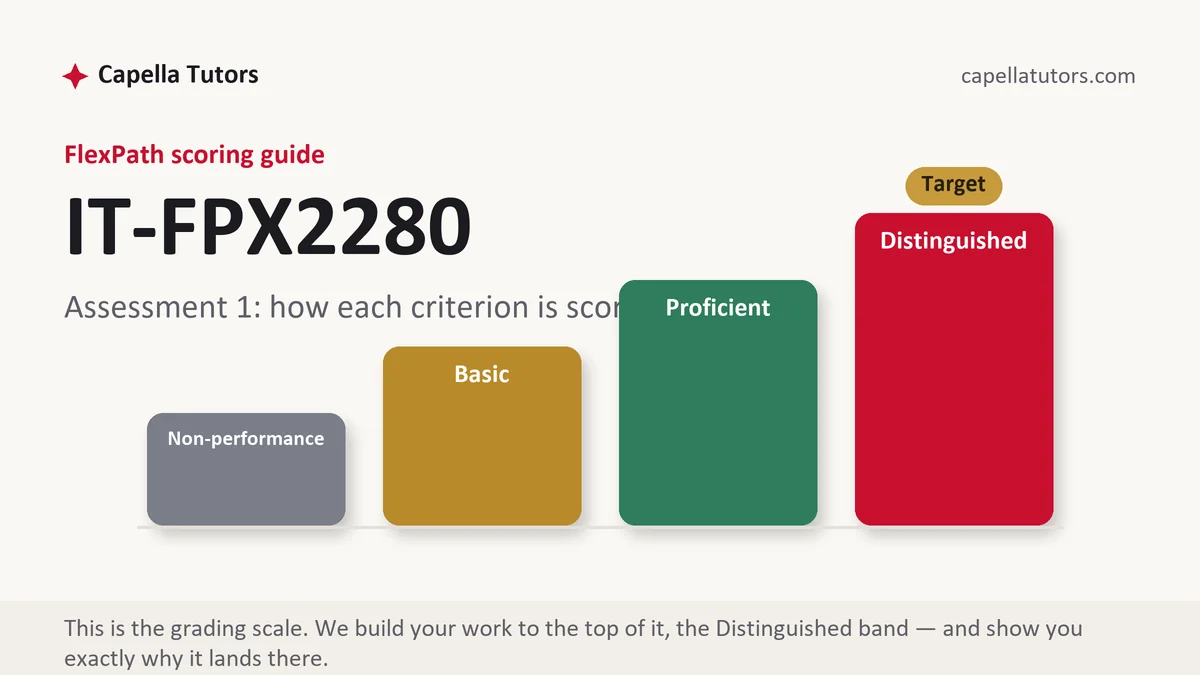
How IT FPX 2280 Assessment 1 is scored
FlexPath deals in levels, not letters. Every criterion lands on one of four, and the level wording is the brief for the section beneath it:
| Level | What it means on a requirements and topology deliverable |
|---|---|
| Distinguished | The counts include the devices everyone forgets, the growth allowance is a number, every design choice points back at a requirement, and the administrative cost of the design is admitted. The admitted cost is usually the sentence the top level was written for. |
| Proficient | Requirements gathered properly and a topology that satisfies them. Sound design work, one concession short of the column above it. |
| Basic | A familiar topology drawn first and requirements written afterwards to fit it. The commonest result on a first network design. |
| Non-performance | A required element never appears, most often the growth allowance or the infrastructure devices. An unanswered row scores at the floor regardless of the drawing. |
The layered models earn their place in this course by being diagnostic rather than decorative. A switch forwards frames by hardware address and a router forwards packets by logical address, and knowing which of those a requirement belongs to is what turns a parts list into a design.
The IT FPX 2280 Assessment 1 method, step by step
-
Count the devices before you draw a single box
Users at each location, then the printers, the access points, the cameras, the building controllers and the management interfaces that get left off every first list. Add the growth the scenario asks you to plan for as a stated number. Choosing a familiar layout and hoping the devices fit is how a design ends up unable to accept the next hire.
-
Write the requirements as sentences a client would sign
Each one testable: how many wired ports, what must never reach what, how many uplinks, who supports it on a Tuesday afternoon. Requirements phrased this way do double duty, because every later choice can point at the line that forced it and the justification criterion stops needing separate work.
-
Let the requirement select the equipment
Some requirements cannot be met by buying a larger version of what is already there. Guest devices that must not reach internal hosts need segmentation, which needs a device that can segment, and no number of ports on an unmanaged switch will do it. Say that in the paragraph rather than arriving at the managed option because it sounds more capable.
-
Decide segmentation on stated grounds
A flat network is cheaper to build and simpler for whoever inherits it, and it puts every broadcast in front of every device. Segmenting cuts the broadcast domain and separates traffic that should never meet, and it buys that with a routing device, a configuration to maintain and a support burden that lands on somebody after you leave. Decide on device count, traffic sensitivity and who administers the result.
-
Price the recurring costs, not just the boxes
A second uplink from a different provider removes a single point of failure and adds a monthly charge that continues whether or not the first link ever drops. Name that recurring figure. A paragraph recommending redundancy without pricing it reads as a slogan, and a paragraph that prices it reads as professional judgment.
-
Draw it so it survives a photocopier, then self-score
Every device named, every interface and address labeled, a legend for the symbols, links annotated with media type where that matters, and colour never carrying meaning on its own. Check the drawing against the text so the two cannot disagree. Then grade each criterion yourself and submit with two business days still available.
A structure that maps to the criteria
The word targets are planning figures our tutors use for a design document of this size, not Capella rules; expand whichever section your own guide weights.
| Section | What it must do | Guide |
|---|---|---|
| Requirements and counts | Locations, users, infrastructure devices, services and the growth allowance as a number. | ~250 words |
| Logical topology | How the segments connect, where routing happens, and where the provider boundary sits. | ~250 words |
| Hardware and media | Switches, routers, access points and cabling, each selected by a named requirement. | ~250 words |
| Segmentation decisions | What traffic must not meet, how the design keeps it apart, and what administering that costs. | ~250 words |
| Costs and redundancy | One-time and recurring figures, with any redundancy priced over the same period. | ~180 words |
| Diagram and references | The drawing, its legend, and standards or vendor documentation in current APA. | as needed |
Annotated sample excerpt
A passage from an original model our team built, pitched at the register the top column describes. Study how the requirement selects the equipment, then do the same for your own scenario.
The office runs three departments through one 24-port unmanaged switch installed in 2015, which currently leaves claims traffic, the guest access point and two building controllers sharing a single broadcast domain.1 Four requirements were written before any equipment was priced: 38 wired devices today with headroom for 12 more, guest devices that must reach the internet and no internal host, one provider uplink, and a support model where the office manager can reseat a cable and nothing further.2 Those requirements are what select a managed switch rather than a larger unmanaged one, because the guest separation requirement cannot be satisfied by any number of ports, and the paragraph has to say so plainly instead of arriving at the managed option because managed sounds better.3
- 1Describes the existing situation as a fault with a mechanism attached. One broadcast domain holding three kinds of traffic is the problem statement the whole design answers.
- 2Four requirements, all countable or testable, including the support model that most designs ignore. The headroom figure is stated as a number, which is what the growth criterion asks for.
- 3Ties the equipment choice to the one requirement that forces it, and names the reasoning explicitly. This sentence is the justification row rather than a description of the purchase.
The full premium sample for your exact assessment, written fresh to your scoring guide and issue, is free to request. Study it, revise it into your own voice, and submit work you understand.
The five mistakes that cost Distinguished
- Infrastructure devices left off the count. Access points, cameras and management interfaces consume addresses and ports, and a design sized without them is short on the day it is installed.
- A topology drawn before the requirements were written. The order shows in the prose, and a requirement reverse-engineered to fit a picture reads as decoration.
- Growth described as room to expand. The row asks for an allowance, and an allowance is a number rather than a reassurance.
- Redundancy recommended with no recurring cost attached. A second link is a monthly commitment, and omitting the figure turns judgment into a slogan.
- A diagram whose labels contradict the text. The mismatch is the fastest correction a faculty member can write, and it costs the documentation row as well as the design one.
Pre-submission checklist
- Every device counted, including printers, access points, cameras and management interfaces
- Growth allowance stated as a number rather than as an intention
- Each hardware choice traced back to the requirement that forced it
- Segmentation decided on device count, traffic sensitivity and who administers it
- Recurring costs priced over the same period as one-time purchases
- Diagram legible in black and white, with labels that match the text exactly
Network design due?
Send the scenario, the criteria and the device counts you have. The sample comes back inside 24 to 48 hours with the requirements written first, the equipment selected by those requirements, and a drawing keyed to the text. A reviewer checks every figure before the file leaves, and revisions stay free until the guide clears.