This manual is for IT FPX 2280 Assessment 3, start to submission. Assessment 3 of IT FPX 2280 usually asks you to find a fault and prove it: a symptom described the way users describe it, tests that eliminate layers in order, and a recommendation that answers the constraint rather than the complaint. The criteria are graded individually against your guide, and the rows that catch people are about what a test excludes rather than what it appears to show. Our tutors' method sits below, with a structure taken from the criteria and an annotated sample excerpt. Would you rather delegate it? A premium original sample for this exact assessment comes back inside 24 to 48 hours, revised at no cost until every criterion clears. Capella's catalog lists the course as IT-FPX2280, and some courserooms print IT2280; both point to this same Assessment 3.
One honesty note before the manual: Capella revises courses and scoring guides over time, so always write to the exact scoring guide attached to your assessment in the courseroom. The course identity above is verified on capella.edu; the method and structure below are our tutors' approach to it, not Capella's official rubric text.
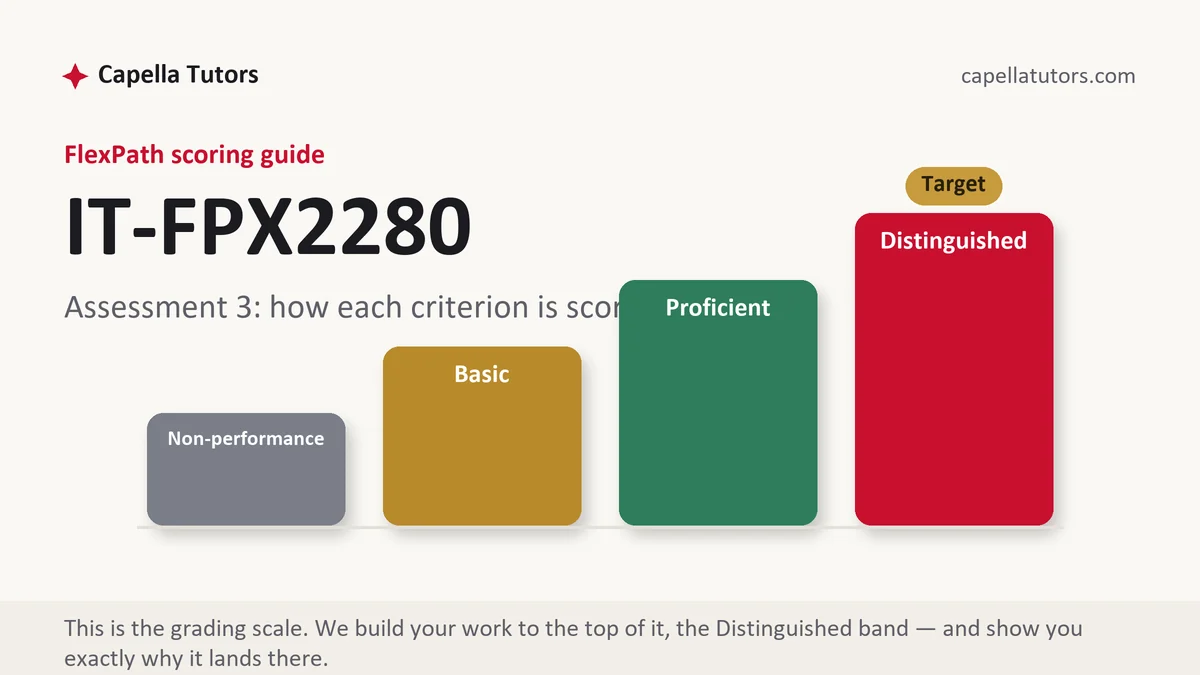
How IT FPX 2280 Assessment 3 is scored
Four levels per criterion and no percentage anywhere. The descriptions are the closest thing to written instructions you will get:
| Level | What it means on a troubleshooting and testing deliverable |
|---|---|
| Distinguished | The symptom is separated from the diagnosis, each test is captioned with what it rules out, the fault is located at a named layer, and the recommendation answers the measured constraint. Saying what a test excludes rather than what it proves is where the top level lives. |
| Proficient | The fault is found and the tests support the conclusion. Competent diagnosis, one careful caption short of the column above. |
| Basic | A guess that happened to be right, with a successful test pasted in as proof. The usual result on a first troubleshooting write-up. |
| Non-performance | A required element is missing, most often the testing evidence or the layer analysis. The row is graded on what is documented. |
Read your own evidence honestly, because network tests mislead in both directions. A successful reachability test shows one host answered another and says nothing about whether the application will work, and a failed one proves less still, since blocking that protocol at a firewall or a host is ordinary practice.
The IT FPX 2280 Assessment 3 method, step by step
-
Write the symptom in the user's words, then in yours
Users report that the internet is down, and a name that will not resolve produces exactly that sentence while the network underneath is healthy. Record the complaint verbatim, then restate it as an observation: which devices, at what times, doing what. The gap between those two sentences is often where the fault is.
-
Eliminate layers in order rather than guessing
A cut cable or a dead port is physical. A device in the wrong segment is data link. A wrong default gateway is network. A blocked port number is transport. A name that will not resolve is an application problem. Work the sequence and the write-up has a structure the criterion recognises, because the order is itself the content.
-
Use the cleanest diagnostic in the course early
If a host answers by address and not by name, the network is working and the resolver is not, which removes half the possible causes in one test. Capture both attempts side by side. Address assignment is the companion check, since a lease that expired against an unreachable server leaves a machine with a self-assigned address and no route anywhere.
-
Caption every capture with what it excludes
This is the habit that separates the top two columns. An address configuration, a reachability test, a path trace and a name lookup each rule something out, and writing that exclusion under the figure is more honest and more useful than writing what it appears to prove. A test with no stated exclusion has not narrowed anything.
-
Measure the physical constraint before recommending equipment
A copper Ethernet run is specified to 100 meters including the patch cord at each end, and that single number decides more designs than any product feature. On wireless, the lower band travels further through walls and carries less while only three of its channels avoid overlapping, so coverage is an argument about walls, channel reuse and placement rather than about power.
-
Recommend against the constraint, then self-score
Answer what you measured. A run that is too long wants fiber or a relocated closet, not a stronger access point. Where the network cannot be touched, write the verification plan instead: the command you would run, the result that would confirm the fix, and the result that would tell you which layer to look at next. Then grade each criterion and submit early.
A structure that maps to the criteria
Targets our tutors plan a troubleshooting document of this size against, not limits set by Capella; grow whichever section your guide leans on.
| Section | What it must do | Guide |
|---|---|---|
| The symptom | The complaint as reported, restated as an observation with devices, times and conditions. | ~180 words |
| Layer analysis | The candidate causes sorted by layer, and the order you chose to eliminate them in. | ~250 words |
| Tests and exclusions | Each test performed, its output, and what that output rules out. | ~300 words |
| The fault located | Where the problem actually is, at which layer, and the evidence that fixes it there. | ~200 words |
| Recommendation | The remedy that answers the measured constraint, with what it costs and what it does not solve. | ~220 words |
| Simulation notes and references | The tool and version if simulated, labeled as such, plus standards in current APA. | as needed |
Annotated sample excerpt
A short passage from an original model our team produced, showing how a test is reported by what it eliminates. Take the discipline into your own fault.
The complaint is that the four gate cameras at the far end of the lot drop off every afternoon, reported by the site manager as the internet going down, which it is not.1 A reachability test by address succeeds and a name lookup also succeeds, which rules out resolution and the address lease together and pushes the fault downward rather than upward, while the switch port serving that access point logs errors climbing steadily through the afternoon, a physical signature rather than an addressing one.2 The measurement settles it: the copper run to that access point is 118 meters including both patch cords, past the 100 meters the specification allows, so the remedy is a fiber run or a relocated wiring closet and not a more powerful access point.3
- 1Separates the reported complaint from the actual observation in one sentence. Users describe every fault as the internet being down, and saying so is the first analytical move available.
- 2Reports two tests by what they exclude rather than by what they show, then adds an observation that points at a layer. This is the paragraph that earns the diagnosis criterion.
- 3Closes on a measurement against a published limit, and rejects the intuitive fix. Answering the constraint rather than the complaint is the recommendation row in a single clause.
The full premium sample for your exact assessment, written fresh to your scoring guide and issue, is free to request. Study it, revise it into your own voice, and submit work you understand.
The five mistakes that cost Distinguished
- A failed reachability test reported as a dead host. Blocking that protocol is normal practice, so the test excludes far less than the sentence around it claims.
- Tests captioned with what they appear to prove. A capture narrows the search or it contributes nothing, and the row is written about the narrowing.
- A fix recommended before anything was measured. A guess that happens to work still leaves the diagnosis criterion empty, since the reasoning is what was being graded.
- Wireless coverage answered with more power. The criterion asks about walls, channel reuse and placement, so a stronger device answers a question nobody set.
- Simulated output presented as production. Evidence from a simulator is perfectly acceptable when it is labeled, and unacceptable when it is not.
Pre-submission checklist
- The complaint recorded as reported and restated as an observation
- Candidate causes sorted by layer, with the elimination order stated
- A name lookup and an address test captured side by side
- Every figure captioned with what the test rules out
- Physical limits measured and compared against the published specification
- Any simulator named with its version and every capture labeled as simulated
Troubleshooting write-up due?
Send the symptom, the criteria and whatever output you already have. The sample comes back in 24 to 48 hours working the layers in order, with every capture captioned for what it excludes and a recommendation aimed at the measured constraint. Revisions are free until the guide is met, and faculty comments re-enter the same queue at no charge.