This manual is for IT FPX 2280 Assessment 2, start to submission. Assessment 2 of IT FPX 2280 normally turns to the arithmetic: a block of addresses, host counts per location, prefixes chosen from those counts, and ranges that tile the block with no gap and no overlap. Your scoring guide sets the requirements row by row, and this deliverable is unforgiving in a way written work is not, because an overlapping range can be demonstrated wrong by a reader with a calculator. What follows is how our tutors work it, a structure that answers the criteria, and an annotated sample excerpt. Prefer to hand it over? The premium original sample for this exact assessment arrives within 24 to 48 hours, with revisions free until the guide is satisfied. Capella's catalog lists the course as IT-FPX2280, and some courserooms print IT2280; both point to this same Assessment 2.
One honesty note before the manual: Capella revises courses and scoring guides over time, so always write to the exact scoring guide attached to your assessment in the courseroom. The course identity above is verified on capella.edu; the method and structure below are our tutors' approach to it, not Capella's official rubric text.
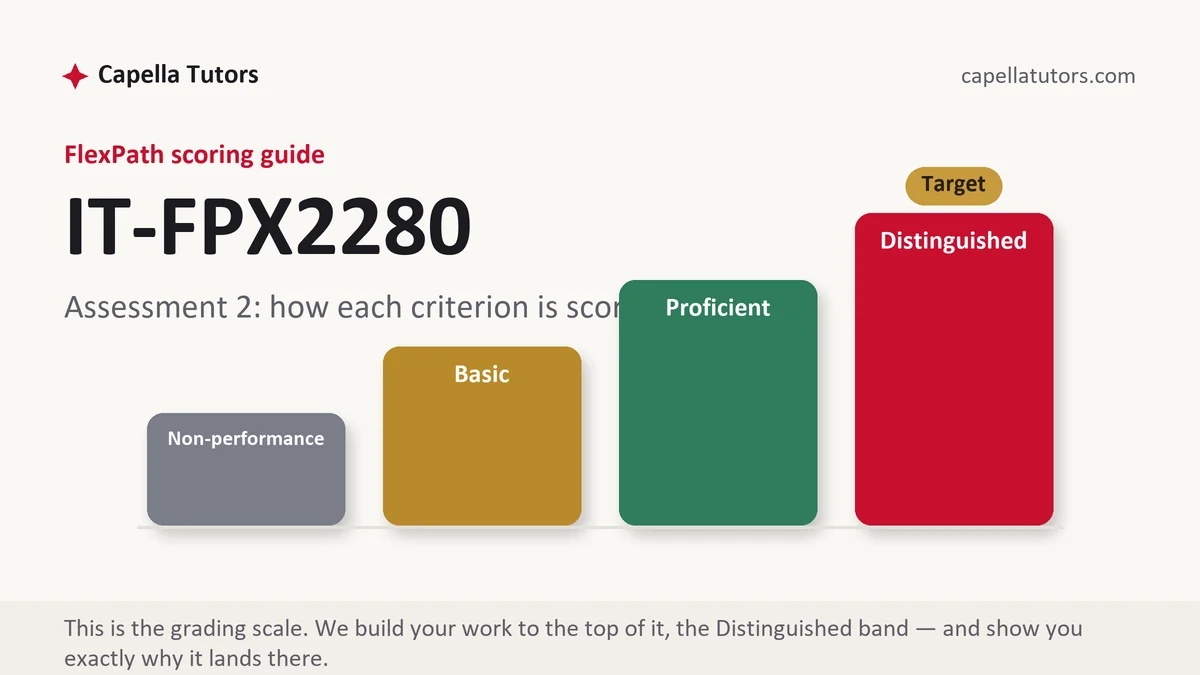
How IT FPX 2280 Assessment 2 is scored
Criteria resolve to levels here, four of them, and their wording tells you what has to appear on the page beneath each one:
| Level | What it means on an addressing plan |
|---|---|
| Distinguished | Host requirements come first, every prefix is derived rather than chosen, the ranges tile the block exactly, the unusable addresses are named, and the plan says at what device count each subnet has to be resized. The ceiling figure is where the top level sits. |
| Proficient | A correct plan with derivations shown and gateways assigned. Accurate arithmetic, one forward-looking sentence below the column above. |
| Basic | A table of ranges with no working shown, usually produced by a calculator and reproduced without reasoning. Where most first plans land. |
| Non-performance | A required element is missing, most often the derivation or the usable host count. An unanswered row scores at the floor however tidy the table looks. |
Learn one sequence and most of this deliverable follows. An address is thirty-two bits in four octets, a twenty-four-bit prefix leaves eight host bits for 256 addresses of which 254 can be assigned, and borrowing two more bits gives four subnets of 64 with boundaries at 0, 64, 128 and 192.
The IT FPX 2280 Assessment 2 method, step by step
-
Gather the host requirement per location first
Users, then every device that consumes an address, then the growth allowance stated as a figure. Only then choose a prefix. Working the other way round, which means picking a familiar mask and hoping the hosts fit, is how a department discovers it cannot grow past thirty machines a year after installation.
-
Derive each prefix from the count
Show the requirement, show how many host bits that needs, show the prefix that leaves them, then show the block size it produces. A department of forty needs the size above thirty, because the smaller option holds thirty and leaves nothing spare. Doing the borrowing in binary once in the document is worth the space, since every later line depends on it.
-
Subtract the two addresses you cannot assign
The network address at the bottom of each range and the broadcast address at the top are unusable, so a 64-address subnet assigns 62. Name them rather than only subtracting them. A design sized without that subtraction is short by two at every site, and it is the most mechanical mark on the guide to lose.
-
Tile the block with no gap and no overlap
Write every subnet as a first and last address and check the boundaries in sequence, because the next range starts where the previous one ends plus one. Overlaps are checkable in fifteen seconds and cannot be built as written. Leave the spare ranges in the table labeled as reserved rather than leaving them unexplained.
-
Reserve the gateway and state the ceiling
Assign the first usable address in each range to the gateway and say that you did. Then finish each row with the sentence most plans omit, which is how many devices that subnet can absorb before it has to be resized. That figure is what makes it a plan rather than a snapshot.
-
Recalculate everything by hand, then self-score
Use a calculator to check yourself, never to produce the answer, because the criterion is written about the reasoning and a table with no derivation reads as copied. Then make sure the diagram and the address table say the same thing, grade each criterion yourself, and submit while the evaluation window still fits.
A structure that maps to the criteria
Planning lengths our tutors work to on an addressing deliverable of this size rather than requirements published by Capella; expand where your guide asks more.
| Section | What it must do | Guide |
|---|---|---|
| Host requirements | Devices per location today, plus the growth allowance as a stated number. | ~200 words |
| Prefix derivation | For each subnet, the count, the host bits needed, the prefix, and the block size produced. | ~300 words |
| The allocation table | Every subnet with its first and last address, usable span, gateway and purpose. | ~250 words |
| Unusable addresses | The network and broadcast addresses named per range, with the assignable count. | ~150 words |
| Headroom | The device count at which each subnet must be resized, stated per row. | ~180 words |
| Diagram and references | The drawing keyed to the table, plus the standards documents in current APA. | as needed |
Annotated sample excerpt
An original excerpt from our team showing what open subnet arithmetic reads like. Take the sequence and run it against your own block.
The practice was given one 192.168.20.0/24 block for both buildings, and the counts settle the split before any mask is chosen: 40 devices in the main building including the printers and the two access points, 22 in the annex, and a growth allowance of a quarter stated as a figure rather than as a hope.1 A twenty-six-bit prefix yields four subnets of 64 addresses with boundaries at 0, 64, 128 and 192, so the main building takes .0 through .63 and the annex takes .64 through .127, leaving two ranges that tile the remainder of the block with no gap and no overlap.2 Two addresses in each range cannot be assigned, the network address at the bottom and the broadcast address at the top, which leaves 62 usable, so the gateway takes the first of those and the main building reaches its ceiling at 61 further devices rather than at 64.3
- 1Puts the counts and the growth figure before the mask, and includes the infrastructure devices in the count. Both details are rows on the guide and both are commonly skipped.
- 2Derives the prefix and then lists the boundaries in sequence, so a reader can verify that the ranges tile. Checkable arithmetic is the entire point of this criterion.
- 3Names the two unusable addresses instead of only subtracting them, reserves the gateway, and finishes on the ceiling. That last figure is what turns a table into a plan.
The full premium sample for your exact assessment, written fresh to your scoring guide and issue, is free to request. Study it, revise it into your own voice, and submit work you understand.
The five mistakes that cost Distinguished
- Ranges that overlap or leave an unexplained gap. The arithmetic is checkable in seconds, and a plan that does not tile cannot be built the way it is written.
- Usable counts that keep the network and broadcast addresses. Two addresses per subnet are unassignable, so the design is short by two at every location.
- A prefix chosen before the host count was gathered. The mask then dictates the requirement instead of answering it, which the derivation row is written to detect.
- A table of ranges with no derivation anywhere. Output from a subnet calculator is not reasoning, and the criterion asks for the reasoning.
- No headroom figure per subnet. A plan that does not say when a range runs out is a photograph of one afternoon rather than a design.
Pre-submission checklist
- Host counts gathered per location, with the growth allowance as a number
- Every prefix derived in the text from its host requirement
- Network and broadcast addresses named for each range, with the assignable count
- Ranges written as first and last address, checked to tile with no gap or overlap
- Gateway reserved and stated for every subnet
- The device ceiling for each subnet written into its row
Addressing plan due?
Send the block, the criteria and the host counts per location. The sample returns in 24 to 48 hours with each prefix derived from its requirement, the ranges tiling the block, and a table carrying gateway, usable span and purpose per subnet. A reviewer recomputes every boundary by hand before the file leaves us.