Send us the prompt with the scoring guide attached and an original premium sample comes back within 24 to 48 hours, written to the Distinguished column, with the model built before the queries and every result reported alongside the statement that produced it, plus free revisions until the criteria are cleared. The identity: IT FPX 2230, Introduction to Database Systems, worth 1.5 program points, a core course both FlexPath specializations of the BS in Information Technology require. That half-weight point value is the trap, because the workload behaves like a full course while the credit suggests otherwise, and the degree still needs 90 points overall with 27 of them at the 3000 level or above. In Capella's catalog the course code is written IT-FPX2230.
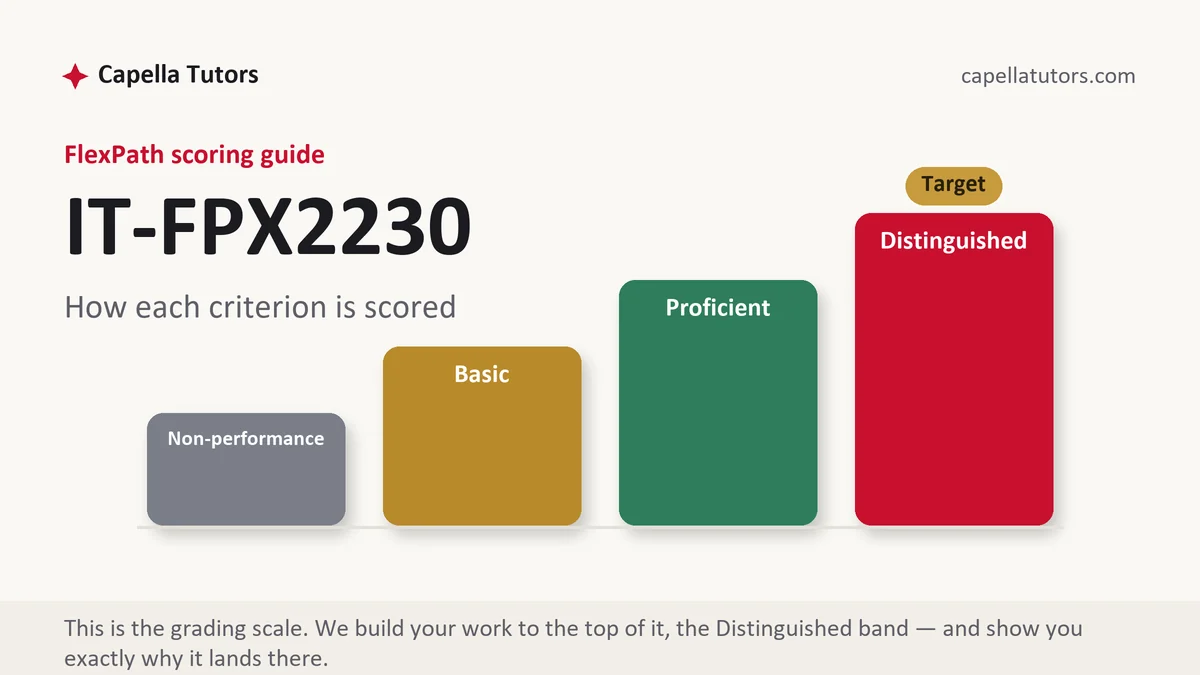
What IT FPX 2230 actually grades
The order of the criteria tells you what this course values: it grades a model before it grades a query. Learners arrive wanting to write SQL and discover that the first several criteria never mention it, because a statement written against a badly shaped set of tables cannot be repaired by rewriting the statement. Get the structure right and the queries become short. Get it wrong and every question turns into a workaround you then have to explain.
Modeling is graded on precision about relationships. Entities become tables, attributes become columns, and the relationships between them carry a cardinality that has to be stated rather than implied, which in crow's foot notation means the reader can see at a glance whether a customer must have an order or merely may have one. The relationship students consistently mishandle is many to many, which no relational database can hold directly: it resolves into a junction table carrying a foreign key to each side, and that table almost always turns out to have attributes of its own, such as the quantity and the unit price on an order line. Decide early whether keys will be natural or surrogate, decide whether table names are singular or plural, and then never change your mind mid-schema.
Normalization is where most of the writing marks live, and the forms are easier than their reputation. First normal form asks that every cell hold one value, so a column containing a comma-separated list of product codes fails immediately. Second normal form only bites when the key is composite: an order line keyed on order and product cannot store the product name, because that name depends on half the key rather than all of it. Third normal form removes the dependency between two non-key columns, the classic case being a postal code that determines a city, which means the city belongs in its own table rather than repeated beside every address. Naming the specific dependency you removed is worth more than the phrase third normal form ever is.
Then the statements have to behave, and a handful of behaviors account for most wrong answers. An inner join returns only matched rows while a left join keeps every row from the left side, and the trap that catches nearly everyone is filtering the right-hand table in the where clause, which discards the unmatched rows and silently converts the left join back into an inner one, so that condition belongs in the join clause instead. Counting all rows and counting a column give different answers whenever that column holds nulls. Grouping requires that every selected column is either grouped or aggregated. Nothing equals null, including null itself, so the test is the is-null form rather than an equals sign. Above all, a query that returns rows is not a query that returns the right rows, so predict the row count before you run it.
Integrity closes the set. Primary keys, foreign keys, not-null, unique and check constraints are the database enforcing rules that the application would otherwise have to remember, and the argument for putting them in the schema is that the schema outlives whichever program is talking to it this year. Referential actions decide what a delete does to the children of a parent row, and choosing between refusing, cascading and nulling is a design decision worth a sentence. Transactions and the four properties they guarantee belong in the paper at definition level, with an example of the classic pair of updates that has to succeed or fail together.
How we help in this course
Database drafts arrive as a complete set rather than as prose about a database. Tell us the scenario and the engine your section uses and you get the model, the diagram description, the data definition statements, the sample rows and the queries, each labeled to the criterion it answers, with the statements written in the dialect you will actually run rather than in generic pseudo-SQL that fails on the first execution.
Terms are the same across the studio: inside 24 to 48 hours, criterion by criterion against your uploaded guide, through the eight-person pipeline with a reviewer who executes every statement before delivery so nothing reaches you untested, and revisions free until the score lands. Faculty feedback re-enters that cycle at no cost, which in this course usually means a single normalization comment that is quicker to answer than to argue with.
The assessments, one by one
Assessment 1
Assessment 1 of IT FPX 2230, Introduction to Database Systems, is usually the modeling deliverable: a scenario turned into business rules, entities and attributes drawn from those rules, and a relationship with its cardinality on every line. Read the full Assessment 1 manual.
Assessment 2
Assessment 2 of IT FPX 2230 normally asks you to take a structure apart and defend the pieces: a table that breaks a normal form, the specific dependency that breaks it, the split that fixes it, and the anomaly the split prevents. Read the full Assessment 2 manual.
Assessment 3
Assessment 3 of IT FPX 2230 usually asks the database to answer questions: a set of statements written against your own schema, results reported with the row counts they returned, and the constraints shown doing their job. Read the full Assessment 3 manual.
How to actually write IT FPX 2230: where to begin
Work in the order the data does, because the scoring guide almost always follows it. Requirements first, written as business rules in short sentences a non-technical reader would confirm, since every rule becomes either a table, a column, a relationship or a constraint. Then the conceptual model, then the logical schema with keys and data types, then sample data, then the queries. Doing this backwards, which usually means starting from a query somebody wants and inventing tables to serve it, produces a schema that answers one question well and everything else badly, and the design criteria are written to catch exactly that.
Compare two versions of the same claim. The Basic sentence reports that the database has been normalized to third normal form. The version that scores names the table, states the dependency that violated the form, which might be that the city column was determined by the postal code column rather than by the primary key, shows the split into two tables, gives the key of each, and finishes by naming the anomaly the split prevents, which is an update that has to correct the same city name in nine hundred rows or leave the data inconsistent. The rubric language about justification is asking for exactly that last clause.
Be equally honest about evidence. A results grid pasted as an image proves a statement ran once and returned something, and nothing more, because the reader cannot see the statement, cannot see how many rows came back, and cannot tell whether the data was arranged to make the answer look right. Include the SQL as selectable text as well as any image, state the row count returned, show a case that should return nothing and demonstrate that it returns nothing, and caption each result with the criterion it satisfies. A query proving a negative is often stronger evidence than one proving a positive, since it demonstrates the constraint is doing work.
| Section | What goes in it | What Distinguished looks like |
|---|---|---|
| Requirements and business rules | The scenario restated as rules, each one testable by a non-technical reader. | Rules written so that each maps visibly onto a table, a relationship or a constraint. |
| The conceptual model | Entities, attributes and relationships with cardinality on every line. | Many-to-many relationships resolved into junction tables with their own attributes named. |
| The logical schema | Tables, columns, data types, primary and foreign keys, constraints. | Types chosen deliberately, with the reason a column is fixed length or nullable stated. |
| Queries and results | The statements asked for, their output, and the row counts returned. | SQL supplied as text, with a negative case shown alongside the positive one. |
| Normalization and integrity | The forms reached and the dependencies removed to reach them. | Each split justified by the anomaly it prevents rather than by naming the form. |
| Assumptions and references | What you assumed about the scenario, engine documentation, current APA both ways. | Assumptions listed openly, with vendor documentation cited to the version you installed. |
Developing the analysis
The analysis this course rewards is the denormalization argument handled honestly, because it forces you to hold two true things at once. Third normal form removes duplicated facts, which means a correction happens in one place and cannot leave the data contradicting itself. It also means a report drawing on customers, addresses, orders, order lines and products has to join five tables, and joins cost time that a flat table would not spend. The undergraduate answer is not to pick a side. Normalize the transactional design, say plainly where a controlled exception would be considered, such as a reporting table refreshed on a schedule rather than maintained live, and state the price of that exception, which is that the copy can be stale and something has to own refreshing it. Indexing follows the same logic and gets the same treatment: an index makes a lookup faster and makes every insert, update and delete on that table slower, so an index on a column nobody filters or sorts by is a cost with no return. Avoid quoting performance figures you did not measure. Naming the direction of a tradeoff scores; inventing a percentage does not.
Citations that survive faculty review
The engine you installed is the primary source for how it behaves, and dialects differ enough that the distinction matters, so cite the PostgreSQL, MySQL, Microsoft SQL Server, SQLite or Oracle documentation for the exact version rather than a general reference. Where portability is part of your argument, point at the SQL standard itself and note which behaviors your engine implements differently, since auto-incrementing keys are spelled three different ways across the common engines. The relational model has an origin worth citing directly, which is Codd's original paper, and the normal forms have a literature of their own, so attribute them there rather than to a tutorial site that reprints the definitions. Your assigned textbook is a legitimate source for the vocabulary and the modeling notation. Tutorial and question-and-answer sites are where you will learn syntax quickly, and they are not evidence for a design decision, so any statement adapted from one gets a comment in the code and a line in the reference list.
The mistakes that land Basic instead of Distinguished
- A diagram drawn with no cardinality on the relationship lines. A line without notation says two tables are connected and says nothing an evaluator can grade.
- A many-to-many relationship left unresolved in the logical design. The relational model cannot represent it directly, so the missing junction table is a structural error rather than an omission.
- Normalization asserted without naming the dependency removed. The justification criterion is written about the reasoning, and the phrase third normal form is not reasoning.
- A left join filtered in the where clause. The condition eliminates the unmatched rows the join was written to preserve, and the result is quietly wrong.
- Results supplied only as images with no statement text. The reader cannot verify a query they cannot read, and unverifiable output supports nothing.
IT FPX 2230 questions students actually ask
Which database engine should I install?
Use whichever one the prompt or the courseroom specifies, and where the choice is open pick a free engine you can install without a licensing detour and then stay on it for the whole course. PostgreSQL and MySQL both run on every desktop platform, SQLite needs no server at all and is entirely adequate for coursework of this size, and the free edition of Microsoft SQL Server suits anyone heading toward a Windows environment. State the engine and its version in the document, because syntax diverges in visible places, particularly around automatically generated keys, date handling and string functions, and a statement copied from one dialect into another is the most common reason a submitted query does not run for the evaluator.
Do I have to reach third normal form every single time?
Reach it, then justify anything you deliberately left out. The expectation at this level is a design in third normal form because that is what the criteria are written against, and a schema that stops at second normal form without comment reads as an oversight rather than as a choice. Where a genuine reason exists to keep a derived or duplicated value, and there sometimes is one, write the reason in the document, name what could now go out of step, and say what keeps it correct. A justified exception scores. An unexplained one loses the criterion that asks you to defend the design.
How do I demonstrate a query works when I only have a few rows?
Design the sample data to exercise the logic rather than to fill space. Twelve well-chosen rows beat two hundred random ones, provided they include a customer with no orders so a left join has something to prove, an order with several lines so an aggregate has something to sum, a null in a column your count is meant to skip, and a row that should fail a check constraint so you can show the constraint rejecting it. Report the row count with each result and say what you expected before you ran it. Data built to test the edges is itself evidence of understanding, and evaluators notice the difference.
Schema or query set due?
Send the scenario, the criteria and the engine you installed. The sample comes back modeled, normalized and tested. First premium sample free.