This manual is for IT FPX 2230 Assessment 2, start to submission. Assessment 2 of IT FPX 2230 normally asks you to take a structure apart and defend the pieces: a table that breaks a normal form, the specific dependency that breaks it, the split that fixes it, and the anomaly the split prevents. Your scoring guide sets the requirements row by row, and the one that decides your grade is about justification rather than about vocabulary. Below is the sequence our tutors use, a structure that mirrors the criteria, and an annotated sample excerpt. Prefer to hand it over? The premium original sample for this exact assessment is with you inside 24 to 48 hours, and revisions continue free until the guide is met. Capella's catalog lists the course as IT-FPX2230, and some courserooms print IT2230; both point to this same Assessment 2.
One honesty note before the manual: Capella revises courses and scoring guides over time, so always write to the exact scoring guide attached to your assessment in the courseroom. The course identity above is verified on capella.edu; the method and structure below are our tutors' approach to it, not Capella's official rubric text.
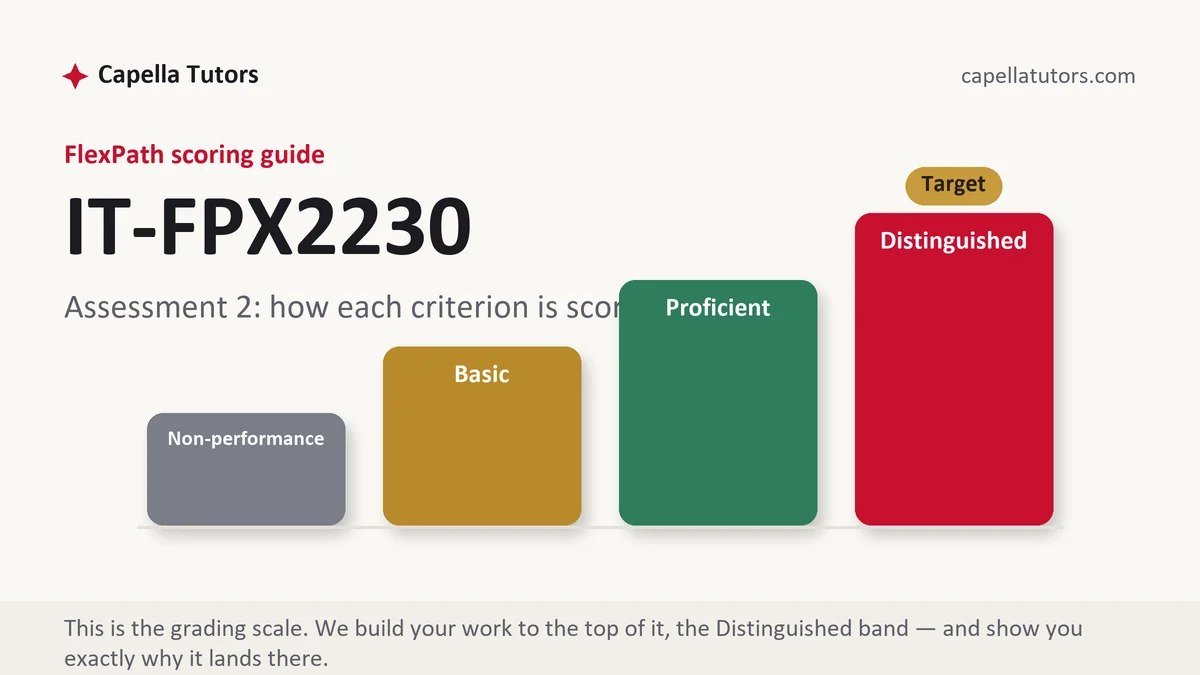
How IT FPX 2230 Assessment 2 is scored
Criteria in FlexPath resolve to levels. There are four of them, and their wording is the clearest instruction set you will be given:
| Level | What it means on a normalization deliverable |
|---|---|
| Distinguished | Each violation is named as a specific dependency, each split is justified by the anomaly it prevents, and any deliberate exception is declared with what keeps it correct. The declared exception is usually where the top level lives. |
| Proficient | Every form reached correctly with the dependencies identified. Accurate work, one justification short of the column above. |
| Basic | The phrase third normal form asserted over a schema that happens to be in it, with no dependency named. Where most first normalization write-ups land. |
| Non-performance | A required step never appears, commonly the reasoning for a split or the form the design actually reaches. An unanswered row scores at the floor. |
The forms are easier than their reputation and the marks are in the naming. One cell holding one value, no column depending on half a composite key, and no non-key column determining another: three sentences, and a write-up that points at the offending column outscores one that recites the definitions.
The IT FPX 2230 Assessment 2 method, step by step
-
Find the repeating group before anything else
A column holding a comma-separated list of values fails the first form immediately, and it is the easiest violation to demonstrate because a reader can see it. Name the column, quote one offending cell, then show the split. Starting here also tends to reveal the entity somebody was storing in a notes field.
-
Check composite keys for partial dependencies
The second form only bites where the key has more than one column. If a line is keyed on both the order and the product, then the product's name depends on half that key rather than on all of it, and it belongs in the product table. Say which half, because the criterion asks which and the answer is the analysis.
-
Hunt the dependency between two non-key columns
This is the third form and the one worth spending words on. A postal code that determines a town, a supplier code that determines a supplier name, a plot number that determines a section: in each case one non-key column decides another, and the dependent value belongs in a table of its own with its own key.
-
Justify every split by the anomaly it prevents
Naming the form is not reasoning. Write what goes wrong without the split: the update that has to correct the same value in hundreds of rows or leave the data contradicting itself, the insert that cannot happen because unrelated information is missing, the delete that quietly destroys a fact nobody meant to lose. That clause is what the justification row is written for.
-
Declare any exception you are keeping on purpose
There are real reasons to hold a derived or duplicated value, and a design that stops short of the expected form without comment reads as an oversight rather than a decision. Where you keep one, write the reason, name what can now go out of step, and say what keeps it correct and who owns doing so.
-
Show the before and after, then self-score
Give the offending table, the corrected tables, the keys of each, and a short statement of the form the design now satisfies. Supply the definition statements as text rather than as pictures so a reader can build them. Then grade each criterion yourself and upload with the evaluation window still open.
A structure that maps to the criteria
Planning lengths our tutors use on a normalization write-up of this size rather than requirements Capella publishes; expand where your guide asks for more.
| Section | What it must do | Guide |
|---|---|---|
| The starting structure | The table or spreadsheet as it exists, with sample rows that show the problem. | ~200 words |
| First form | Any repeating group or multi-valued cell, named, with the split that removes it. | ~200 words |
| Second form | Partial dependencies on composite keys, with the half of the key each one depends on stated. | ~220 words |
| Third form | Dependencies between non-key columns, each named as a specific column pair. | ~250 words |
| Anomalies prevented | For every split, the update, insert or delete problem it removes. | ~250 words |
| Exceptions and references | Anything deliberately left denormalized with its safeguard, plus sources in current APA. | as needed |
Annotated sample excerpt
An original excerpt from our team showing what a named dependency reads like on the page. Take the pattern, then apply it to the table in front of you.
The allotment register a community garden has kept since 2019 holds one row per plot and a column called Growers containing names separated by commas, which fails the first form before any other question is asked.1 Splitting that column produces a plot table, a grower table and a tenancy table between them, and the tenancy immediately acquires the start date, the end date and the plot that the register had been recording in a free-text notes field.2 The second violation is narrower: the postal code column determined the town column rather than the plot key determining it, which is a dependency between two non-key columns, so town moved into a table of its own, and the anomaly that disappears is a correction that would otherwise have to change the same town name in 118 rows or leave the register disagreeing with itself.3
- 1Points at the column by name and states the form it breaks, in one sentence. A reader can verify the claim without trusting the writer, which is what the criterion measures.
- 2Notices that resolving the repeating group uncovers an entity that was hiding in a notes field. That observation is worth more than the split itself and most write-ups miss it.
- 3Names the dependency as a specific pair of columns and finishes on the anomaly with a row count attached. The last clause is the justification the rubric language is asking for.
The full premium sample for your exact assessment, written fresh to your scoring guide and issue, is free to request. Study it, revise it into your own voice, and submit work you understand.
The five mistakes that cost Distinguished
- The form asserted with no dependency identified. A design that happens to satisfy a form has not demonstrated the reasoning the row is written about.
- A partial dependency looked for where the key is single. The second form only applies to composite keys, and hunting it elsewhere shows the definition was learned by shape rather than by meaning.
- Splits justified by tidiness. Cleaner is not an anomaly, so the reason has to name the update, insert or delete problem that disappears.
- An unexplained stop short of the expected form. Without a stated reason it reads as an oversight, and the row asking you to defend the design goes unanswered.
- Corrected tables shown only as an image. A reader cannot build a picture, and the definition statements are part of the artifact being graded.
Pre-submission checklist
- The starting structure shown with sample rows that expose the problem
- Every violation named as a specific column or column pair
- Partial dependencies stated with the half of the composite key involved
- Each split justified by the update, insert or delete anomaly it prevents
- Any deliberate exception declared with what keeps the duplicate correct
- Definition statements supplied as selectable text, not only as figures
Normalization write-up due?
Send the table, the criteria and the engine you installed. The sample returns inside 24 to 48 hours with each violation named as a column pair, each split justified by the anomaly it removes, and the corrected statements supplied as text. Faculty comments in this course are usually a single normalization note, and they re-enter our queue at no charge.