This manual is for IT FPX 2230 Assessment 3, start to submission. Assessment 3 of IT FPX 2230 usually asks the database to answer questions: a set of statements written against your own schema, results reported with the row counts they returned, and the constraints shown doing their job. The criteria are graded individually against your scoring guide, and the trap is that a query returning rows is not the same as a query returning the right rows. What follows is our tutors' approach, a structure taken straight from the criteria, and an annotated sample excerpt. Would you rather delegate it? A premium original sample for this exact assessment reaches you in 24 to 48 hours, revised at no charge until the criteria are satisfied. Capella's catalog lists the course as IT-FPX2230, and some courserooms print IT2230; both point to this same Assessment 3.
One honesty note before the manual: Capella revises courses and scoring guides over time, so always write to the exact scoring guide attached to your assessment in the courseroom. The course identity above is verified on capella.edu; the method and structure below are our tutors' approach to it, not Capella's official rubric text.
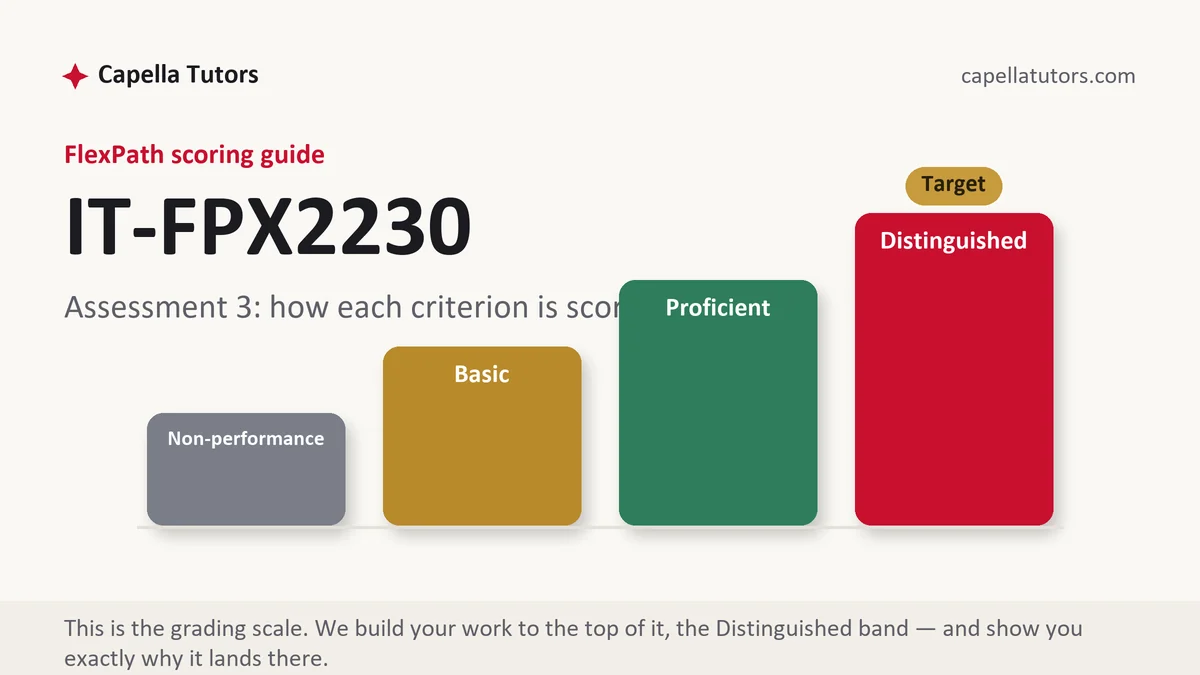
How IT FPX 2230 Assessment 3 is scored
Levels rather than percentages, four of them per criterion, and the descriptions double as a specification for what you submit:
| Level | What it means on a query and integrity deliverable |
|---|---|
| Distinguished | Statements appear as selectable text, each result carries the row count it returned, a negative case proves a constraint refusing bad data, and the paper states what the sample set does not exercise. The untested edge is where the top level sits. |
| Proficient | Correct statements, correct results, and integrity rules present and explained. Solid work, one demonstration short of the top. |
| Basic | Queries that run and results pasted as pictures, with no counts and no negative case. The usual landing spot for a first query set. |
| Non-performance | A required artifact never arrives, commonly the statement text or the constraint demonstration. The row is graded on what can be read. |
A handful of behaviours account for most wrong answers here, and they are worth memorising: nothing equals null including null itself, counting all rows and counting a column differ wherever nulls exist, and every selected column must be either grouped or aggregated. Predict the row count before you run the statement and you will catch these yourself.
The IT FPX 2230 Assessment 3 method, step by step
-
Write the question in words before writing any statement
One sentence per report, naming what must appear and, critically, what must appear even when it has no match. That second half decides whether you need an inner join or an outer one, and deciding it in English first prevents the most expensive error in the course from being written into the query at all.
-
Keep the outer join's filter in the join clause
A left join preserves every row on the left until you filter the right-hand table in the where clause, at which point the unmatched rows vanish and the statement quietly becomes an inner join. The condition belongs in the join clause. This is the single most common silent fault in a submitted query set and it never raises an error.
-
Predict the row count, then run it
Write down the number of rows you expect before executing. A mismatch is information: either the statement is wrong or your understanding of the data is, and both are worth finding before an evaluator does. Report the actual count beside every result, because a count is the cheapest evidence of correctness available.
-
Build sample data that exercises the edges
Twelve deliberate rows beat two hundred random ones. Include a parent with no children so an outer join has something to prove, a group with several members so an aggregate has something to sum, a null in a column your count is meant to skip, and a row that should violate a check constraint so the constraint can be seen refusing it.
-
Show a constraint refusing bad data
Primary keys, foreign keys, not-null, unique and check constraints are the schema enforcing rules the application would otherwise have to remember, and the argument for putting them there is that the schema outlives whichever program is talking to it. Prove one: attempt the invalid insert and paste the error the engine returns. A query proving a negative is often the strongest evidence in the document.
-
Say what you did not test, then self-score
Name the cases your sample set does not cover and the behaviour you are therefore taking on trust, plus the engine and version everything ran on, since dialects differ around generated keys, dates and string functions. Then grade each criterion yourself and submit while the two business days still fit.
A structure that maps to the criteria
Targets our tutors plan a query deliverable of this size against, not limits published by Capella; grow the sections your own guide weights.
| Section | What it must do | Guide |
|---|---|---|
| The questions, in words | Each report stated as a sentence, including what must appear even with no match. | ~180 words |
| Sample data | The rows chosen and why, including the ones planted to exercise nulls and edges. | ~180 words |
| Statements and results | Each query as selectable text with its output and the row count it returned. | ~350 words |
| The negative cases | A constraint refusing invalid data and an outer join preserving an unmatched row. | ~220 words |
| Integrity and referential actions | The constraints in place, and what a delete does to dependent rows. | ~220 words |
| Untested cases and references | What the sample set does not exercise, plus engine documentation in current APA. | as needed |
Annotated sample excerpt
A short passage from an original model our team wrote, showing how a join fault is explained rather than hidden. Take the reasoning into your own report set.
The loan desk needs one report above all others: every item still out past its due date, including the items nobody has ever borrowed, so that a count of zero is itself a meaningful answer.1 That requirement is what forces the outer join, and it is also where the statement goes quietly wrong, because putting the due-date test in the where clause discards the rows that have no matching loan and converts the left join back into an inner one, so the condition belongs in the join clause instead.2 Against the twelve-row sample set the corrected statement returns 41 rows where the first version returned 29, and the negative case carries as much weight: an item inserted with no loan history at all still appears, with a zero beside it, which is exactly what the requirement asked for.3
- 1States the requirement in a sentence that already contains the decision. Naming the rows that must survive with no match is what tells the reader an outer join is necessary.
- 2Explains the fault as a mechanism rather than as a rule to memorise, then places the fix. This is the paragraph that lifts a query criterion off Proficient.
- 3Gives both row counts and demonstrates the negative case. Two numbers and one planted row do more for the evidence criterion than a page of screenshots.
The full premium sample for your exact assessment, written fresh to your scoring guide and issue, is free to request. Study it, revise it into your own voice, and submit work you understand.
The five mistakes that cost Distinguished
- An outer join filtered in the where clause. The unmatched rows the join existed to preserve are silently discarded, and the result is wrong without any error appearing.
- Results pasted as images with no statement text. A reader cannot verify a query they cannot read, and unverifiable output supports no criterion.
- Row counts left off the results. The count is the cheapest proof of correctness in the document, and its absence leaves every result taken on trust.
- Null tested with an equals sign. Nothing equals null, so the comparison returns neither true nor false and the row simply disappears from the answer.
- Sample data generated to fill space. Two hundred random rows exercise nothing, while a planted null and a childless parent prove two criteria between them.
Pre-submission checklist
- Each report written as a sentence before any statement is drafted
- Outer-join conditions placed in the join clause, not the where clause
- Predicted and actual row counts reported for every query
- Sample rows deliberately planted for nulls, empty groups and constraint failures
- One constraint shown refusing invalid data, with the engine's error quoted
- Engine and version stated, plus the cases the sample set does not exercise
Query set due?
Send the schema, the criteria and the engine you are running. The sample comes back in 24 to 48 hours with statements in your dialect, row counts beside every result, and a constraint captured refusing bad data. Every statement is executed by a reviewer before delivery, so nothing reaches you untested, and revisions are free until the guide is met.