This manual is for IT FPX 2230 Assessment 1, start to submission. Assessment 1 of IT FPX 2230, Introduction to Database Systems, is usually the modeling deliverable: a scenario turned into business rules, entities and attributes drawn from those rules, and a relationship with its cardinality on every line. FlexPath grades it one criterion at a time against your scoring guide, and the order of the rows is the lesson, because this course grades a model before it grades a single statement. The method our tutors work to is laid out below, with a criterion-mapped structure and an annotated sample excerpt. Want it handled instead? You get a premium original sample for this exact assessment inside 24 to 48 hours, revised free until every criterion clears. Capella's catalog lists the course as IT-FPX2230, and some courserooms print IT2230; both point to this same Assessment 1.
One honesty note before the manual: Capella revises courses and scoring guides over time, so always write to the exact scoring guide attached to your assessment in the courseroom. The course identity above is verified on capella.edu; the method and structure below are our tutors' approach to it, not Capella's official rubric text.
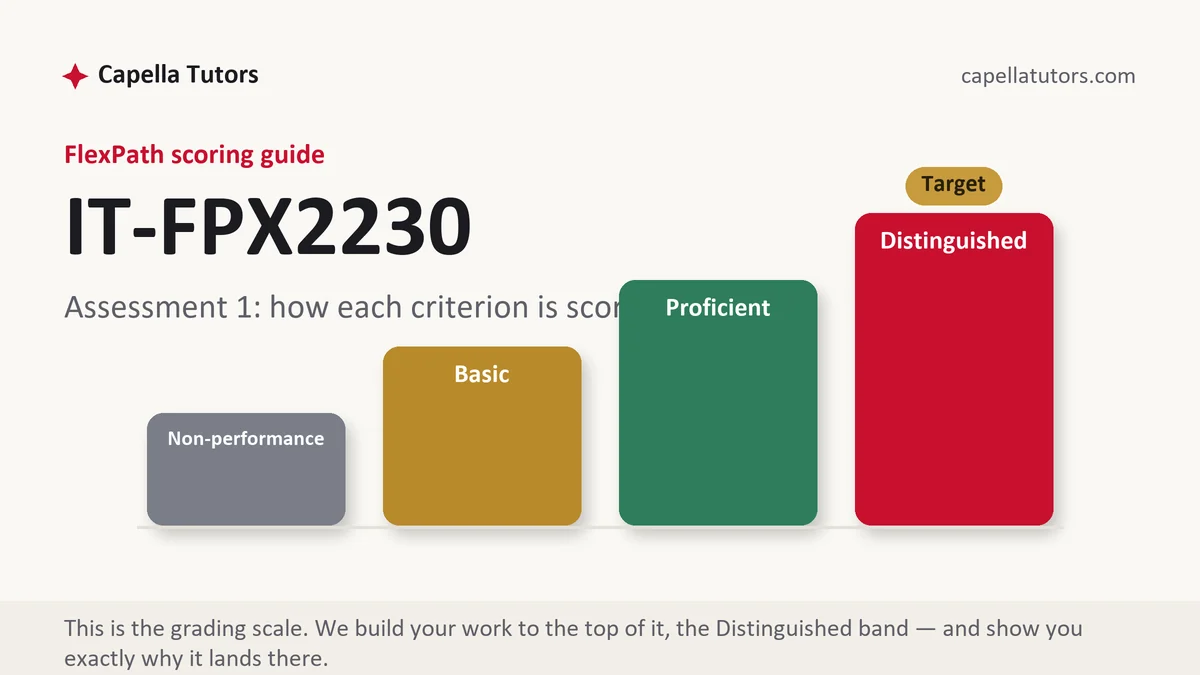
How IT FPX 2230 Assessment 1 is scored
FlexPath awards levels rather than letters. Every criterion sits at one of four, and the level wording is the brief for the work beneath it:
| Level | What it means on a conceptual data model |
|---|---|
| Distinguished | Each rule maps visibly onto a table, a relationship or a constraint, every relationship carries cardinality and optionality, many-to-many pairs are resolved with junction tables that have their own attributes named, and the assumptions are listed openly. The assumption list is where the top level usually hides. |
| Proficient | A correct model covering the scenario, with keys and relationships defined. Sound work, one deliberate disclosure below the column above it. |
| Basic | Entities and attributes identified with lines drawn between them and no notation on the lines. The commonest result on a first model. |
| Non-performance | A required element is absent, most often the cardinality or the junction table. A relationship the model cannot represent is a structural gap rather than an oversight. |
Get the structure right and later queries become short. Get it wrong and every question turns into a workaround you then have to explain, which is why the criteria spend their weight on the model long before they mention retrieval.
The IT FPX 2230 Assessment 1 method, step by step
-
Write the business rules before you draw anything
Short sentences a non-technical reader could confirm or correct, one rule per line. Every rule becomes a table, a column, a relationship or a constraint, and rules you cannot place are usually rules you have misunderstood. This list is also the evidence for the requirements criterion, so keep it in the document rather than throwing it away.
-
Decide your conventions once, then stop deciding
Natural keys or surrogate keys, singular or plural table names, and a single spelling style for columns. Choose at the start and hold it, because a schema that changes convention halfway through reads as two people's work and the design criterion notices. Say in one sentence which conventions you adopted and why.
-
Put cardinality and optionality on every line
A line without notation says two tables are connected and nothing an evaluator can grade. Decide whether each side is one or many, then decide separately whether it is mandatory or optional, because must have an order and may have an order are different rules about the same relationship and only one of them is true for your scenario.
-
Resolve every many-to-many, then look for its attributes
No relational database holds a many-to-many relationship directly, so each one becomes a junction table carrying a foreign key to each side. Then ask the question most learners skip: what belongs to the pairing itself rather than to either side. Quantity, price at the time, and the date of the association nearly always live there.
-
Choose types deliberately and say why
Fixed or variable length, the precision of a number, whether a column may be null, and what a date column is actually recording. Money belongs in a decimal type rather than in a floating point one. A sentence explaining one or two of these choices satisfies a criterion that most submissions answer by listing types with no reasoning attached.
-
List your assumptions, then self-score
Every scenario is underspecified, so write down what you assumed rather than quietly deciding it: whether a customer can exist before a transaction, whether a price is historical or current, whether a record is ever deleted. An open assumption is honest and costs nothing. Then grade each criterion yourself and submit with two business days of evaluation still ahead.
A structure that maps to the criteria
The word targets are planning figures our tutors use for a modeling deliverable of this size, not Capella rules; expand any section your own guide weights more heavily.
| Section | What it must do | Guide |
|---|---|---|
| Scenario and business rules | The situation restated as numbered rules, each one testable by a non-technical reader. | ~220 words |
| Entities and attributes | The things being recorded, what is recorded about each, and the identifier for each one. | ~250 words |
| Relationships | Every association with its cardinality and optionality, described in prose as well as drawn. | ~250 words |
| Resolved many-to-many pairs | The junction tables, their keys, and the attributes that belong to the pairing itself. | ~200 words |
| Keys, types and constraints | Primary and foreign keys, data types chosen with reasons, and the rules the database will enforce. | ~200 words |
| Assumptions and references | What you assumed about the scenario, plus engine and textbook sources in current APA. | as needed |
Annotated sample excerpt
A passage from an original model our team wrote, at the level of precision the top column describes. Study how it moves from rule to structure, then do the same with your own scenario.
Five business rules came out of a half-hour conversation with the owner of a two-bench bicycle repair shop, and each one had to become a table, a column, a relationship or a constraint.1 A customer may leave several bicycles and a bicycle belongs to exactly one customer, which is one to many, drawn optional on the bicycle side because the shop records a walk-in before anything is booked in.2 A repair ticket consumes many parts and a part appears on many tickets, which no relational database holds directly, so it resolves into a ticket line carrying a foreign key to each side plus two attributes of its own, the quantity used and the price charged on the day, because last spring's price for a chain is not this spring's.3
- 1States where the rules came from and what each one has to turn into. The requirements criterion is answered by the mapping, not by the length of the scenario summary.
- 2Handles cardinality and optionality as two separate decisions in one sentence, with the reason for the optional side given. That reason is the part most models leave out.
- 3Resolves the many-to-many and then finds the attributes belonging to the pairing. Naming why the price must live on the line rather than on the part is the reasoning the design row pays for.
The full premium sample for your exact assessment, written fresh to your scoring guide and issue, is free to request. Study it, revise it into your own voice, and submit work you understand.
The five mistakes that cost Distinguished
- Relationship lines drawn with no notation on them. A connector with nothing on it states that two tables are related and leaves the grader nothing to assess.
- A many-to-many left standing in the logical design. The model cannot be built as drawn, so the missing junction table reads as a structural error rather than a small omission.
- Optionality treated as the same question as cardinality. Must have and may have are different rules, and getting them confused misstates the scenario the rules came from.
- Attributes of the pairing pushed onto one of the sides. A price stored against the part loses every historical figure the moment it changes, which is a design fault the criterion is written to find.
- Assumptions made silently instead of listed. An undisclosed decision looks like an error to a reader, and disclosing it costs one line and secures a row.
Pre-submission checklist
- Business rules written as numbered testable sentences before any diagram
- Naming and key conventions stated once and held throughout the schema
- Cardinality and optionality both decided on every relationship
- Every many-to-many resolved, with the junction table's own attributes named
- Data types chosen with a stated reason for at least the non-obvious ones
- Assumptions listed openly in their own section before submission
Data model due?
Send the scenario, the criteria and the engine your section uses. A premium original sample comes back inside 24 to 48 hours with the rules written first, cardinality on every relationship, and the junction tables resolved. A reviewer builds the schema before the file leaves you, and revisions stay free until the guide clears.