Send the prompt and the scoring guide and a premium original sample comes back inside 24 to 48 hours, written to the Distinguished descriptors, with every term defined the first time it appears and every capture captioned to the criterion it serves. The identity of the course: IT FPX 1006, Information Technology Concepts and Practices, worth 3 program points, a core course carried by both FlexPath specializations inside Capella's BS in Information Technology. The degree asks for at least 90 program points with 27 of them sitting at the 3000 level or above, and a 1000-level course feeds the first total without touching the second, so read this one as the vocabulary every later course will assume you already have. In Capella's catalog the course code is written IT-FPX1006.
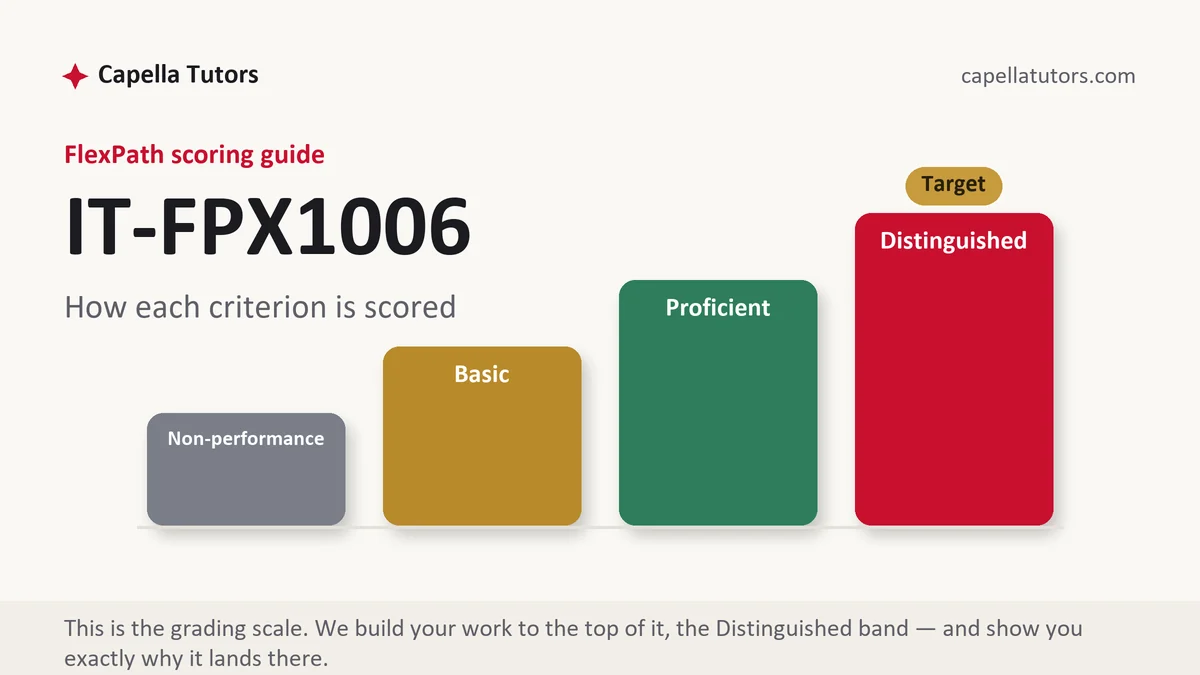
What IT FPX 1006 actually grades
Survey courses are graded on explanation rather than on how much you happen to know, and this is the survey course. The criteria want a component named correctly, its job in the system stated plainly, and the whole thing written so a reader outside the field follows it on one pass. Most of the marks lost here are lost to altitude. A learner who reprints a manufacturer's spec sheet has described nothing, and a learner who writes that a computer has parts working together has described nothing either, so aim between those two failures and stay there for the length of the document.
Precision about ordinary parts is what the early criteria reward. The processor executes instructions, and its clock speed and core count describe how many and how fast rather than how well. Memory is volatile working space that empties when power stops, storage is the non-volatile part that does not, and blurring those two words is the single most common error in a first submission. Capacity arithmetic deserves a sentence of its own, because a drive sold as 1 TB reports roughly 931 GB once Windows counts it: the manufacturer counted a terabyte as a trillion bytes and the operating system counted in powers of two. Explaining that gap in two clean sentences separates a learner who understands the machine from one who read the packaging.
The course then lifts you off your own desk and onto somebody else's hardware. Infrastructure as a service rents you the machine and leaves the operating system, the patching and the application in your hands. Platform as a service hands over a runtime and keeps the operating system to itself. Software as a service delivers the finished application and keeps everything underneath it out of view. An assessment asking you to recommend a model is really asking who you want holding each responsibility, and a recommendation that never says who applies the security updates has missed the criterion it was written against.
Security arrives at definition level and stays there. Confidentiality, integrity and availability are the three properties every control is trying to protect, and naming which one a given control serves is usually the whole of what this level asks. Authentication proves who somebody is, authorization decides what they may then do, and the two words are not interchangeable however often they get swapped in casual writing. Where a prompt asks about a safe practice, the answer being graded is a specific behavior with a reason attached, not advice to be careful.
Method is graded as well, and method has a shape. Identify the problem and reproduce it, form a theory of probable cause, test that theory, build a plan of action and carry it out, verify the fix and add something that stops a repeat, then document the whole sequence. Written work that follows those steps in order scores because the order is the content, and a learner who jumps straight to a fix has skipped the two stages that show reasoning. When a scenario hands you a broken machine, answer it as a sequence with a decision at every stage rather than as a guess that happens to land.
How we help in this course
Drafts for 1006 are written to a named audience. Tell us whether the prompt addresses a manager, a new hire or a household, and the sample comes back pitched at that reader, with each term defined at first use and no acronym left standing on its own. Where the deliverable is a comparison, the sample builds it as a table with the decision criteria stated before the options appear, because a recommendation arriving without stated criteria reads as a preference.
The terms are the studio standard. Each deliverable returns inside 24 to 48 hours, mapped criterion by criterion against the guide you upload, moved through the eight-person pipeline so a subject writer, an editor and a scoring-guide reviewer each handle it before you see a file, and revised at no charge until the guide is satisfied. Faculty comments re-enter the same cycle free, which matters in a first course where the comment is often about format rather than about content, and where a single reformat can move three criteria at once.
The assessments, one by one
Assessment 1
Assessment 1 of IT FPX 1006, Information Technology Concepts and Practices, is normally the course's first explaining deliverable: a named non-technical reader, a piece of technology described in working terms rather than in specifications, and every term defined the first time it appears. Read the full Assessment 1 manual.
Assessment 2
Assessment 2 of IT FPX 1006 normally moves the course from describing to choosing: several options on the table, the grounds declared before the options, a recommendation that names the user it suits, and the cost of that choice written out where a reader can check it. Read the full Assessment 2 manual.
Assessment 3
Assessment 3 of IT FPX 1006 usually asks for documentation somebody else could follow: a procedure written in numbered steps, evidence from a machine you actually worked on, and the reasoning carried by the prose rather than by the pictures. Read the full Assessment 3 manual.
How to actually write IT FPX 1006: where to begin
Open the scoring guide and turn every criterion into a heading before you write a sentence. In 1006 the criteria usually run in a predictable sequence: describe something, explain how it works, compare the alternatives, recommend one, and communicate all of it in a stated professional format. Each of those verbs is scored on its own, so a paragraph that describes when the criterion asked you to compare collects the description mark twice and the comparison mark not at all. The headings also settle the length question, since the guide is quietly telling you how many separate pieces of writing the deliverable contains.
The contrast that decides your grade looks like this. The Basic version says the router connects the network to the internet and moves data around. The stronger version says the router sits at the boundary of the home network, holds the single public address the provider issued, and translates the private addresses of every device behind it so that traffic coming back from the internet reaches the machine that asked for it, which is exactly why a device inside cannot be reached from outside unless the router is configured to forward that traffic. Same subject, similar length, and only one of them demonstrates understanding.
Hands-on deliverables in this course want proof that you performed the task, and the proof is where marks quietly disappear. A screenshot establishes that a window looked a certain way on some machine at some moment. It does not establish what you were trying to achieve, whether the attempt succeeded, or why the setting matters, and no criterion in a scoring guide is written so that an image alone can satisfy it. Capture the whole window rather than a crop, leave the clock and the machine name visible, number every figure, and put a caption underneath naming the criterion the image supports and stating in one sentence what the reader should conclude. Then write the argument in the paragraph above the figure and treat the picture as the exhibit. Evaluators grade the sentence.
| Section | What goes in it | What Distinguished looks like |
|---|---|---|
| Purpose and audience | The question the document answers and the reader it is written for. | An audience named in the opening, with the level of explanation held steady after that. |
| The technology described | The components or services involved, what each does, and how they connect. | Function explained rather than specifications reprinted, with every term defined at first use. |
| The comparison | The options considered and the grounds they are being judged on. | Criteria stated before the options, and each option scored against every criterion. |
| Evidence and captures | Screenshots, output, or observations from a machine you actually used. | Numbered figures, each captioned to a criterion, with the claim written in the prose above. |
| The recommendation | The option chosen, the reason, and what the choice gives up. | A named user, a stated tradeoff, and a cost expressed over the same period as its rival. |
| Format and references | Headings, professional layout, current APA both ways. | Vendor documentation cited by version, with company-reported figures labeled as such. |
Developing the analysis
Analysis at this level is a choice made on stated grounds with the cost of the choice admitted. Set the grounds first, three or four of them, score every option against all of them, then pick. A worked example: replacing storage in a five-year-old machine, a 1 TB solid-state drive and a 4 TB mechanical drive land near the same price, the solid-state drive starts the operating system in a fraction of the time and has no moving parts to fail, and the mechanical drive holds four times as much recorded video. Neither is the answer until you say who the machine belongs to. A student writing papers wants the first, a household archiving video wants the second, and the sentence naming that user is the sentence that earns the criterion. Apply the same discipline to running costs. A subscription at nine dollars a month is one hundred and eight dollars a year and three hundred and twenty-four across three, and that three-year figure is the number that belongs beside a one-time purchase price, because a comparison putting a monthly charge next to an outright price is comparing nothing at all.
Citations that survive faculty review
Three kinds of source carry an introductory technology paper. Vendor and standards documentation is the primary source for what a technology does, so use Microsoft's own documentation for a Windows feature, the manual that shipped with the hardware, and the published specification for a protocol. Neutral technical references carry definitions and method, which is where the CompTIA A+ and IT Fundamentals objectives and the textbook assigned in your section belong. Trade and research publications carry adoption figures and market claims, always with the year attached, since a statistic about cloud adoption ages faster than almost anything else you will cite. A vendor marketing page is citable for what a product claims and never for whether the claim holds, so mark those figures company-reported wherever they appear. Cite documentation for the version you actually ran, give every borrowed number a visible origin, and run the current APA check in both directions so the list and the in-text mentions agree.
The mistakes that land Basic instead of Distinguished
- An acronym used before it is expanded. The communication criterion is scored on the reader you were told to write for, and that reader does not know it.
- A capture pasted with no caption and no claim. An unlabeled image is decoration, and decoration cannot satisfy a criterion.
- Specifications copied rather than explained. A core count reprinted from a product page shows that you can read, not that you understand the part.
- A recommendation with no stated criteria. Without grounds declared in advance, the choice reads as taste and the analysis criterion drops a level.
- Memory and storage used as the same word. The volatile against non-volatile distinction is foundational, and an evaluator reads the slip as a gap rather than as a typo.
IT FPX 1006 questions students actually ask
Do I need my own equipment for this course?
Almost never. A free hypervisor running a spare operating system, the free tier of a cloud provider, and an honest description of the machine you already own will cover most hands-on prompts in a foundations course. Where a task genuinely cannot be performed, write the procedure out step by step, name the tool it would run in, and state in one line that the environment was unavailable to you. Faculty accept that. What they do not accept is a fabricated capture, and a picture borrowed from a search result is usually recognizable because the interface version does not match the one your document claims to be running.
How technical should the writing be?
The prompt names an audience, and that name sets the level for the entire document. When no audience is given, write for an intelligent adult outside the field, which means every acronym is expanded once and then used, every analogy is checked against the thing it describes, and no sentence relies on the reader already understanding the term in it. The failure mode runs in both directions. Writing too far down produces a document that explains nothing an evaluator can score, and writing too far up produces one that quietly assumes the knowledge the criterion asked you to demonstrate.
My capture shows an error message. Do I hide it?
Keep it, and build a paragraph around it. An error you documented, diagnosed and resolved evidences the troubleshooting criterion far better than a clean window that shows only an outcome. Show the error text, say what you believed the cause to be, describe the test that confirmed or eliminated that theory, then show the corrected state in a second numbered figure. Two captures and four sentences of reasoning outscore one tidy image every time, because the criterion is written about your process and not about your luck.
Foundations assessment due?
Send the prompt, the criteria and the audience it names. The sample comes back defined, captioned and ready to submit. First premium sample free.