This manual is for IT FPX 1006 Assessment 2, start to submission. Assessment 2 of IT FPX 1006 normally moves the course from describing to choosing: several options on the table, the grounds declared before the options, a recommendation that names the user it suits, and the cost of that choice written out where a reader can check it. Each criterion is graded on its own against your scoring guide, and the comparison row is where a table becomes an argument or stays a list. What follows is our tutors' method for it, a structure taken from the criteria, and an annotated sample excerpt. Prefer to hand it over? A premium original sample for this exact assessment comes back in 24 to 48 hours with revisions free until it lands. Capella's catalog lists the course as IT-FPX1006, and some courserooms print IT1006; both point to this same Assessment 2.
One honesty note before the manual: Capella revises courses and scoring guides over time, so always write to the exact scoring guide attached to your assessment in the courseroom. The course identity above is verified on capella.edu; the method and structure below are our tutors' approach to it, not Capella's official rubric text.
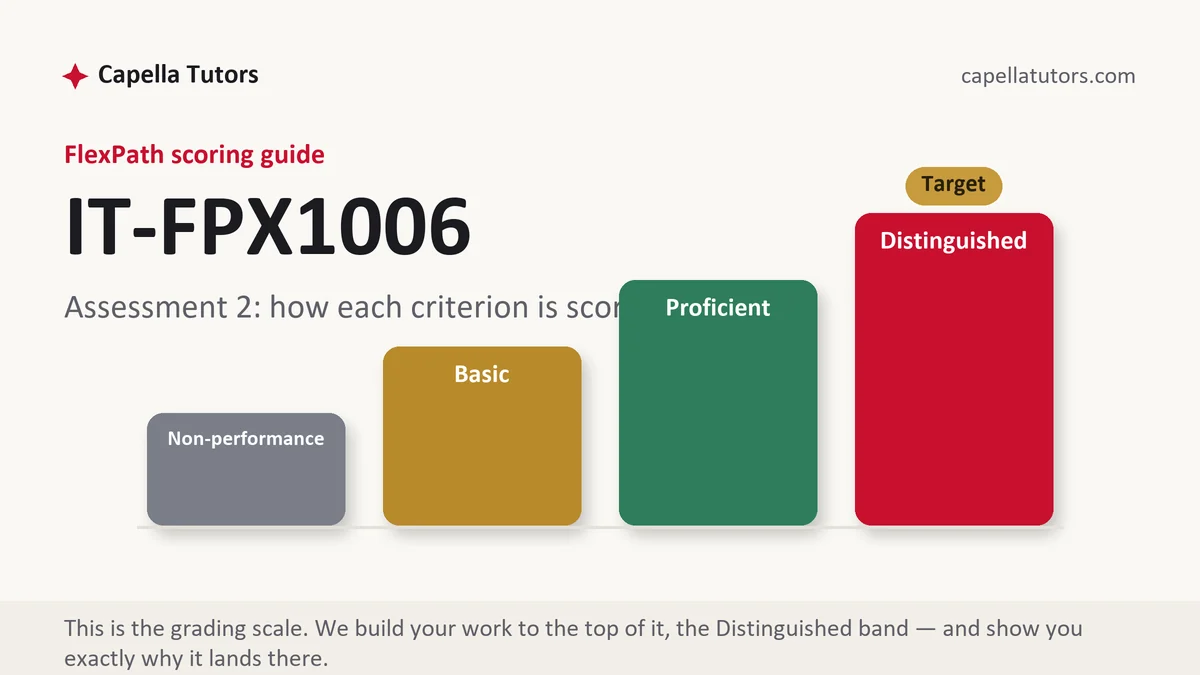
How IT FPX 1006 Assessment 2 is scored
Nothing in FlexPath resolves to a letter. Each criterion is placed at one of four levels, and reading those levels as instructions is the whole technique:
| Level | What it means on a comparison that ends in a recommendation |
|---|---|
| Distinguished | The grounds are set before the options, every option is scored against every ground, the choice names its user, and the paragraph admits what the choice gives up. The concession is usually the sentence the top level was written for. |
| Proficient | The options are compared fairly and the recommendation follows from the comparison. Complete work, one honest sentence away from the column above it. |
| Basic | A feature list with a preference attached to the end. Everything present, nothing weighed, which is the most common landing spot for a first comparison. |
| Non-performance | One of the required elements never appears, usually the stated criteria or the cost. An empty row is scored as empty however good the surrounding prose is. |
Read the comparison row as the spine of the deliverable rather than as one item among several. When the grounds are declared first, the recommendation row nearly writes itself and the communication row improves as a side effect, because a document with stated criteria has an order the reader can follow.
The IT FPX 1006 Assessment 2 method, step by step
-
Count the criteria, then count the options
The guide is quietly telling you how many separate pieces of writing the deliverable holds, and how many things you are expected to weigh. Two options compared on four grounds is eight paragraphs of judgment, not one. Build that grid on paper before you look at anything for sale, because the grid is the deliverable and the prose is its presentation.
-
Declare the grounds before you price anything
Three or four grounds, written as questions a reader could answer yes or no to, and written down before the first product appears. Grounds invented after the winner is chosen are visible from a long way off, and an evaluator who spots them reads the whole analysis as a preference dressed up in a table.
-
Score every option against every ground
No gaps in the grid. An option that loses on a ground still gets a sentence explaining how badly and why that matters, since a comparison where one column is blank has compared nothing. Keep the winner's weaknesses in the table too, because leaving them out is what makes a recommendation read as sales copy.
-
Put every cost on the same clock
A monthly charge and a one-time price cannot be set side by side until they cover the same period. Multiply the subscription out to three years, add whatever the outright purchase will need in that time, and show the arithmetic in the text. A comparison that leaves a monthly figure next to a purchase price has compared two different things.
-
Name the user, then name what the choice sacrifices
Neither option is the answer until you say whose machine it is. A volunteer who needs the desk working in twenty minutes and an archivist who needs four terabytes want opposite things, and the sentence naming that person is the sentence the recommendation row pays for. Follow it immediately with the tradeoff you accepted.
-
Read the table against the prose one last time
Every number in the paragraphs has to match the number in the grid, and every ground in the grid has to appear in the discussion. Mismatches are the fastest correction a faculty member can write, and they cost the communication row as well as the analysis one. Then self-score each criterion and submit with days to spare.
A structure that maps to the criteria
Targets our tutors plan a comparison of this size against, not requirements from Capella; expand wherever your own guide asks for more.
| Section | What it must do | Guide |
|---|---|---|
| Situation and reader | The decision that has to be made, who has to make it, and the constraints they are working inside. | ~150 words |
| The grounds for judging | Three or four decision criteria, written before the options and phrased so a reader can test them. | ~150 words |
| Option by option | Each candidate scored against every ground, with the losses stated as plainly as the wins. | ~350 words |
| Costs on a common period | Purchase, subscription and running costs converted to the same span, with the arithmetic shown. | ~200 words |
| Recommendation and tradeoff | The option chosen, the user it fits, and what that user is giving up by taking it. | ~200 words |
| Evidence, format and references | Any capture or quote you produced, numbered and captioned, plus current APA both ways. | as needed |
Annotated sample excerpt
An original excerpt from our team showing how a comparison sounds when the grounds arrive first. Study the sequence, then rebuild it around your own scenario.
The ticket desk at a 240-seat community theater runs one computer for four hours before each performance, staffed by a rota of volunteers who need the seating chart open and the card reader working and nothing else at all.1 Four grounds were fixed before any product was priced: whether the machine is usable within ten minutes of a volunteer arriving, whether a mid-sale power cut loses the transaction, whether the box office manager can support it without calling a technician, and what it costs across three years rather than on the day.2 On the fourth ground the refurbished desktop with a solid-state drive and a small battery backup is a single payment of 470 dollars, while the hosted terminal at 22 dollars a month is 264 a year and 792 across the same three years.3
- 1Establishes the user and the working conditions in one sentence, so every later judgment has something concrete to be judged against rather than an imagined average buyer.
- 2Four grounds, all testable, all written before a single price appears. This is the sentence that moves the analysis row, and it costs nothing but sequence.
- 3Converts a monthly charge into the same period as an outright purchase and shows the multiplication. The reader can check the arithmetic, which is exactly why the number persuades.
The full premium sample for your exact assessment, written fresh to your scoring guide and issue, is free to request. Study it, revise it into your own voice, and submit work you understand.
The five mistakes that cost Distinguished
- Grounds written after the winner was picked. The order is visible in the prose, and a criterion invented to fit a conclusion reads as taste rather than as analysis.
- A monthly price set beside a one-time price. Until both cover the same span the two figures are not comparable, and the cost row is scored on whether they were made so.
- A grid with an empty cell. An option left unscored on one ground has not been compared, and the criterion asks for the comparison rather than for the shortlist.
- A winner with no admitted weakness. Every option costs something, and a recommendation that sacrifices nothing reads as promotion instead of judgment.
- A recommendation that never names its user. The same hardware is right for one person and wrong for another, so the choice is undefendable until the person is on the page.
Pre-submission checklist
- Decision grounds appear in the document before the first option is introduced
- Every option scored against every ground, including the grounds it fails
- All costs converted to one common period with the arithmetic visible in the text
- The recommendation names a specific user and the tradeoff that user accepts
- Numbers in the prose match the numbers in the table exactly
- Each criterion self-scored at one of the four levels before the file is uploaded
Comparison and recommendation due?
Send the scenario, the criteria and any options your prompt fixes for you. The sample returns inside 24 to 48 hours with the grounds declared first, the grid filled in completely, and the costs worked to a common period. Revisions stay free until the guide is met, and faculty comments come back into the same queue at no charge.