This manual is for IT FPX 1006 Assessment 1, start to submission. Assessment 1 of IT FPX 1006, Information Technology Concepts and Practices, is normally the course's first explaining deliverable: a named non-technical reader, a piece of technology described in working terms rather than in specifications, and every term defined the first time it appears. It is graded the FlexPath way, one criterion at a time against a scoring guide, and the communication row counts here as heavily as the content rows do. Below is the method our tutors use on it, a structure taken from the criteria, and an annotated sample excerpt. Want it handled instead? Inside 24 to 48 hours a premium original sample for this exact assessment comes back to you, revised free until the guide is satisfied. Capella's catalog lists the course as IT-FPX1006, and some courserooms print IT1006; both point to this same Assessment 1.
One honesty note before the manual: Capella revises courses and scoring guides over time, so always write to the exact scoring guide attached to your assessment in the courseroom. The course identity above is verified on capella.edu; the method and structure below are our tutors' approach to it, not Capella's official rubric text.
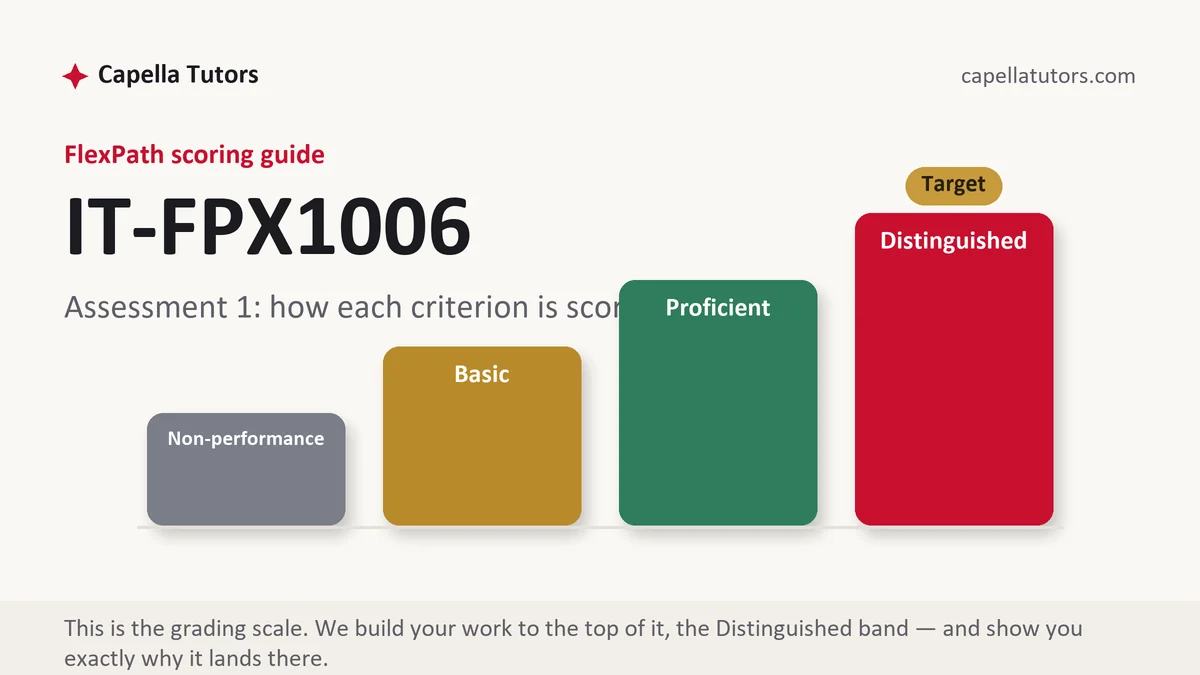
How IT FPX 1006 Assessment 1 is scored
FlexPath issues no letter grades. Every criterion on your guide lands on one of four levels, and the wording of those levels is the brief you are writing to:
| Level | What it means on an explainer written for a stated reader |
|---|---|
| Distinguished | The reader is named early and held for the whole document, each component's job is explained in working terms, and the writing says plainly what the explanation leaves out. That extra move is written into the criterion somewhere; find the sentence and answer it. |
| Proficient | Everything is described correctly and completely for the reader named. Accurate, and one deliberate move short of the top of the column. |
| Basic | A specification sheet in paragraph form, or the opposite failure, a description so general that it would fit any machine ever built. Both land in the same place. |
| Non-performance | A required element is absent rather than thin, most often the audience or the definition of a term the criterion told you to define. Missing scores lower than weak. |
The habit this deliverable builds pays out for the rest of the degree. A learner who can hold one reader in view across eight paragraphs writes usable documentation in a database course and a defensible recommendation in a networking one, because those are the same skill wearing different vocabulary.
The IT FPX 1006 Assessment 1 method, step by step
-
Read the guide for its verbs first
Describe, explain, compare and recommend are four separate tasks and usually four separate rows. A paragraph that describes where the criterion asked you to compare collects the description mark twice and the comparison mark not at all. Copy each criterion into your outline as a heading, park its top level description underneath, and write nothing that does not sit under one of them.
-
Name the reader in the opening, then hold the level
The prompt usually names an audience, and that name sets the altitude for every paragraph after it. Where no audience is given, write for an intelligent adult outside the field. Then check yourself halfway down: if a sentence assumes the reader already understands the term inside it, you have drifted upward, and drifting is what the communication criterion is built to catch.
-
Explain the job before you touch the specification
A component earns its paragraph by what it does in the system, not by what its label says. The processor executes instructions and its core count describes how many at once rather than how well. Memory is the working space that empties when power stops and storage is the part that does not. Get those two words apart and half the early criteria are already answered.
-
Expand every acronym once, then use it
First mention gets the words and the letters, every later mention gets the letters alone. Do the same for any noun the reader would have to look up, including the ones that feel obvious to you now. This is the cheapest row on the guide to secure and the most common one to lose, because a writer who knows the field stops seeing the jargon in their own draft.
-
Put the arithmetic on the page
Where a number decides something, show the number. A drive sold as 1 TB reports roughly 931 GB once the operating system counts it, because the manufacturer counted in trillions and the system counted in powers of two, and two clean sentences explaining that gap separate a learner who understands the machine from one who read the box.
-
Self-score every criterion before you upload
Read the draft once per criterion, not once overall, and mark each row honestly at the level you believe it earns. Any row below the top gets one more pass. Then upload with time in hand, since an evaluator has two business days to respond and a late-week submission can idle across the weekend.
A structure that maps to the criteria
The word targets below are planning numbers our tutors use for a first explainer of this size, not Capella rules; stretch any row your own guide asks more of.
| Section | What it must do | Guide |
|---|---|---|
| Purpose and reader | State the question the document answers and the person it is written for, inside the first two sentences. | ~120 words |
| The technology explained | Each component or service named, the job it does, and how it hands off to the next one in the chain. | ~300 words |
| The options side by side | The alternatives under consideration and the grounds they will be judged on, grounds written first. | ~250 words |
| Evidence you produced | Settings, output or observations from a machine you actually used, numbered and captioned to a criterion. | ~150 words |
| The recommendation | The option chosen, the reader it suits, and what choosing it gives up. | ~200 words |
| Format and references | Headings, a professional layout, and current APA matched in both directions. | as needed |
Annotated sample excerpt
One paragraph from an original model our team wrote, pitched at the register the top column describes. Treat it as study material: take the moves, then write your own version.
This document is written for the office manager of a two-partner accounting practice, who has asked a plain question: should the shared client folder stay on the tower in the back room or move to a hosted service.1 The practice runs eleven staff, one file server bought six years ago, and nobody whose actual job is patching it, and that missing role decides most of what follows.2 Three service models are on the table and they differ in one respect that matters to this reader, which is who applies the security updates: rent the bare machine and the duty stays in the back room, rent the runtime and it moves halfway out, rent the finished application and it leaves the building entirely.3
- 1Names the reader and the actual question in a single sentence. No definition of information technology, no paragraph about the modern office before the work starts.
- 2Supplies the constraint that will carry the recommendation. A head count and a missing role outrank any adjective available, and the specificity is what lifts a criterion off Proficient.
- 3Frames three service models by one decision the reader can hold. The criterion asks for explanation, and a stated dividing line explains where a definition only labels.
The full premium sample for your exact assessment, written fresh to your scoring guide and issue, is free to request. Study it, revise it into your own voice, and submit work you understand.
The five mistakes that cost Distinguished
- An acronym that arrives before its expansion. The communication row is graded against the reader the prompt named, and that reader has not met the letters yet.
- A product page paraphrased where a function was asked for. A clock speed reprinted from a listing shows that you can read a listing, which is not the thing being measured.
- Volatile and non-volatile storage carrying the same word. One empties when the power stops and one does not, and an evaluator reads that slip as a gap rather than as a typing error.
- A choice announced before its grounds are declared. Criteria that appear after the decision read as a defence of something already settled, and the analysis row drops a level.
- An image dropped in with no number and no caption. An unlabeled capture is decoration, and decoration cannot satisfy a row that was written about your reasoning.
Pre-submission checklist
- Every criterion on the guide owns a clearly labeled section of its own
- The reader is named in the opening paragraph and the level of explanation never shifts
- Each acronym expanded once at first use, then used in short form after that
- Comparison grounds stated before the options appear, with every option scored against all of them
- Figures numbered and captioned to a criterion, with the claim written in the prose above
- Self-scored row by row against all four levels, anything below the top given one more pass
First explainer due?
Send the prompt, the criteria and the reader it names. A premium original sample comes back inside 24 to 48 hours, defined at first use and captioned to the guide, with free revisions until the criteria clear. Eight people handle it before you do, including a reviewer who grades the draft the way your evaluator will.