Upload the prompt along with your scoring guide and an original premium sample returns within 24 to 48 hours, drafted against the Distinguished language of your own rubric and reviewed by a second reader first. On the transcript it appears as HUM FPX 1150, Cultural Understanding in a Global World, a 3-point course sitting among the Humanities options on Capella's FlexPath general education menu. Students need 22.5 points from that menu at minimum, and at least 2 of those points out of each of its four categories. Nobody is assigned this course; it is one of several humanities options a student may choose. In Capella's catalog the course code is written HUM-FPX1150.
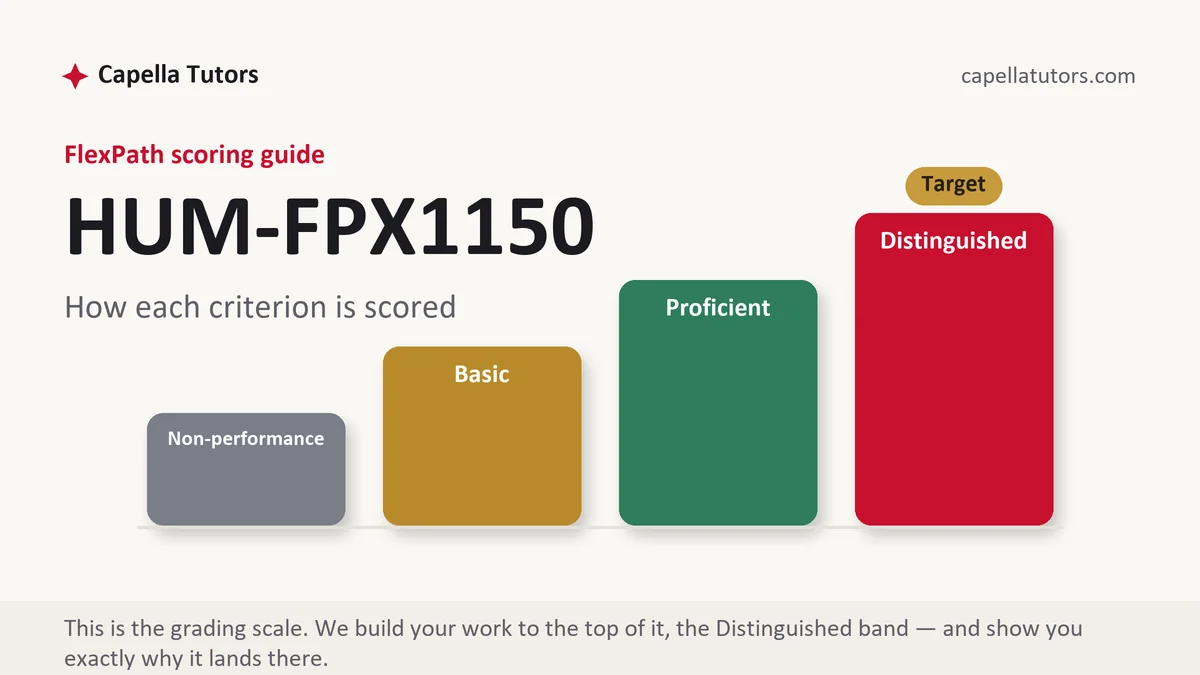
What HUM FPX 1150 actually grades
This course grades whether you can describe a culture that is not yours without reducing it to a list of holidays. In current courserooms the assessments analyze cultural artifacts: one artifact in its historical and artistic context, a comparative analysis and reflection, a comparison of how two cultures portray heroes, and a creative piece on making and interpreting an artifact. A response that reports customs has reported customs. The column above it treats a practice as something people do for reasons, situates it in a time and a place, and resists the pull toward describing it as either exotic or secretly identical to home.
The frameworks are named in the criteria and they have to be attributed and bounded. Hofstede's dimensions of national culture came out of employee surveys inside a single multinational corporation in the late 1960s and early 1970s, which is why a paper treating a power distance score as a fact about every person in a country has misused it, and saying so is worth a criterion on its own. Hall's distinction between high-context and low-context communication came from anthropological fieldwork and describes how much meaning sits in the situation rather than in the words. Bennett's developmental model describes movement from denial and defense through minimization toward acceptance and adaptation, and it describes a person rather than a nation. Use one properly rather than three loosely, name where it came from, and say what it cannot account for.
Artifacts make up the third strand. Many prompts hand you a cultural object, a film, a photograph, a song, a building, a meal, a festival, and ask for analysis rather than description. Analysis means four questions answered in order: who made this, for whom, under what conditions, and what does it assume its audience already knows. A wedding song recorded for a diaspora audience in 1994 is doing different work from the same melody sung at a village ceremony, and that difference is the paper. The failure mode has a name in the literature, the single story, the habit of letting one account stand in for a whole population, a phrase the novelist Chimamanda Ngozi Adichie gave the idea, and the cheapest protection against it is writing about a specific community in a specific place rather than about a country.
How we help in this course
Our 1150 drafts are built around one community and one artifact rather than a survey of a continent. Tell us the culture, the object, or the encounter your prompt names, plus anything about your own background you want reflected in the self-assessment section, and the sample arrives with a framework attributed to its author, applied to specifics, and qualified where the framework does not reach. Sources come from anthropology, area studies, and the community's own writers and media rather than from travel writing, which is where most of the citation marks in this course get lost.
The commercial terms do not change from course to course. You get the draft inside 24 to 48 hours, written toward Distinguished, after it has passed through eight sets of hands: scoring-guide research, subject drafting, a row-by-row review against your rubric, an APA and originality reconciliation in both directions, and a final edit for sense and structure. Revisions are included until the guide is met, and if your evaluator asks for changes those go back through the same people at no charge.
The assessments, one by one
Assessment 1: Cultural Artifact Analysis
An opening assessment in a course on cultural understanding usually hands you something cultural to look at closely: an object, a film, a song, a building, a meal, a ceremony. Read the full Assessment 1 manual.
Assessment 2: Comparative Analysis and Reflection
A middle assessment in this course usually moves from looking at one thing to holding two things side by side. Read the full Assessment 2 manual.
Assessment 3: Heroic Qualities Analysis
Compare how two cultural artifacts from different cultures portray a hero, their similarities and differences, and what they show about each culture's values. Read the full Assessment 3 manual.
How to actually write HUM FPX 1150: where to begin
Begin with the scoring guide and a decision about scale. Copy the criteria out as headings, write the Distinguished sentence under each, then narrow your subject until it fits underneath them. A paper about Japan cannot be written well in the length you have. A paper about how three generations of one Japanese American family in Los Angeles handled New Year observances can be, and it will satisfy the same rows with room to spare. Scale is the single decision that separates a strong submission in this course from a competent one.
Then separate observation from interpretation on the page. Write what you can see first, in sentences another observer would agree with, and only then say what you think it means. The difference is visible to an evaluator: a sentence saying that guests removed their shoes at the entrance and left them pointing outward is an observation, and a sentence saying this marks a boundary between public and private space is an interpretation that now has something underneath it. Papers that interpret first read as opinion, and opinion is not what the criteria measure.
Then write the self-assessment as evidence rather than as confession. A reflection row is not asking how the experience made you feel. It is asking what your own background made obvious and what it made invisible, which is a claim you support the way you support any other. Name a specific expectation you carried in, say where it came from, say what contradicted it, and say what you now think instead. Two sentences of that outperform a page of goodwill, because goodwill cannot be checked and the criterion needs something it can grade.
| Section | What goes in it | What Distinguished looks like |
|---|---|---|
| The subject | The community, practice, or artifact, located in a place and a period, with your access to it stated. | A subject narrow enough to describe accurately, and a clear account of how you know about it. |
| Observation | What is actually there, recorded before it is explained, in detail another observer could confirm. | Description that stands on its own, free of evaluative adjectives. |
| Framework | The concept applied, its author, the study or fieldwork it came from, and its limits. | A framework attributed and bounded, with a sentence on what it does not explain here. |
| Interpretation | What the observation means in context, and the alternative reading you considered. | An interpretation the evidence supports, with a rival reading acknowledged and answered. |
| Self-location | Your own cultural position, and the specific expectations it created before you looked. | A named assumption, its origin, and what changed it, rather than a general statement of openness. |
| Sources and format | Anthropology and area scholarship, primary voices from the community, current APA. | Writers from inside the culture cited alongside outside scholarship, all dated and traceable. |
Developing the synthesis
Synthesis here means holding two accounts of the same practice together when they do not agree, which happens constantly in this material because insiders and outsiders describe the same thing differently. An ethnographer writing about a ritual is describing a system; a participant writing about the same ritual is often describing an obligation, a pleasure, or a family argument. Neither account is the true one, and the criterion is not asking you to choose. It is asking you to explain why two vantage points produce different descriptions and what each one is positioned to notice. Cultural relativism and ethnocentrism are the terms the course gives you for the endpoints, and both get used badly. Ethnocentrism is not merely preferring your own food, it is using your own culture as the measuring instrument without noticing that you have. Relativism as a method means suspending judgment long enough to understand; relativism as a conclusion means never judging anything, which collapses the moment a prompt raises a human rights question. State which one you are using and why.
Citations that survive faculty review
The citation problem in this course is that the internet is full of writing about cultures and almost none of it is scholarship. Peer-reviewed anthropology, sociology, and area studies work, retrieved through the Capella library and databases such as JSTOR or Academic Search, carries any general claim you make about a practice, a value, or a pattern. Primary voices from inside the community, meaning novels, memoirs, interviews, journalism produced there, and material published in its own language where you can read it, carry the specifics and keep the paper from becoming a description of people rather than a conversation with them. Institutional and statistical material carries scale and provenance: UNESCO for heritage designations, the Census Bureau or Pew for demographic and religious survey data, museum documentation for objects. Travel blogs, listicles about doing business in a country, and generic cultural profile sites are what a Basic reference list is made of, and they are the sources that most reliably repeat a stereotype.
The mistakes that land Basic instead of Distinguished
- Treating a nation as a culture. A country of many languages, regions, and classes cannot hold one set of values, and asserting otherwise is the error this course exists to correct.
- A framework used without its limits. Hofstede applied to an individual is a category error, and evaluators here look for it specifically.
- Interpretation with no observation under it. A claim about meaning that skipped the description has nothing to be checked against.
- Reflection written as reassurance. A paragraph saying the experience was eye-opening reports a mood and answers no row.
- Sources from outside only. Writing about a community without one voice from within it is visible in the reference list before the reader reaches page one.
HUM FPX 1150 questions students actually ask
What counts as a culture I am allowed to write about?
Almost any group with shared practices, an internal vocabulary, and boundaries its members recognize, which is a much wider category than nationality. A religious congregation, a profession, an immigrant community in one city, a Deaf community, a regional community, and a workplace with strong norms all qualify, and the smaller ones usually produce better papers because you can be accurate about them. What the criteria actually require is not exoticism but difference from your own position and enough access to describe the group honestly. If you choose a group you belong to, say so, and account for what membership lets you see and what it stops you noticing.
How do I write about my own background without it becoming a memoir?
Keep every personal passage tied to a claim the paper is making. A memoir moves chronologically and rewards detail for its own sake; a cultural analysis uses one incident to establish one point and then returns to the argument. A useful discipline is to write the personal material last, once the framework and observation sections are finished, so each anecdote has a job before it goes in. Keep it to a paragraph, name the specific belief the story illustrates, and cut anything the paper would survive losing. Faculty here read a great deal of well-written autobiography that answers no criterion.
Is Hofstede still acceptable to cite?
Yes, with the qualification attached. The dimensions remain the most cited framework in cross-cultural work and your criteria may name them directly, so declining to use the model is not the answer. What matters is the framing: the original data came from employees of one corporation, collected decades ago and aggregated to the national level, so the scores describe population averages rather than individuals or their behavior in a particular room. Say that in a sentence, apply the dimension to a pattern rather than to a person, and pair it with something more recent or more local. The critique is part of the scholarship, and showing you know it usually earns more than the application itself.
Cultural analysis due?
Send the prompt, the rubric, and the community or artifact you have chosen. We will bring the framework, the sources from inside and outside, and the observation the reading rests on. The first sample you request comes without an invoice.