This manual is for HUM FPX 1150 Assessment 3, start to submission. The Heroic Qualities Analysis asks you to examine two artifacts from different cultures that portray a hero, such as a myth, film, statue or story, evaluate the heroic qualities each presents, compare their similarities and differences, and draw takeaways about what each culture values. The grade turns on comparison tied to culture. Describing two heroes scores lower than explaining why their heroism differs and what that reveals. Below is the method our tutors use, a structure that maps to the criteria, and an annotated sample excerpt. Prefer to hand it off? A premium original sample for this exact assessment comes back in 24 to 48 hours, revised free until it meets the guide. Capella's catalog lists the course as HUM-FPX1150, and some courserooms print HUM1150; both point to this same Assessment 3. In current courserooms this assessment typically appears as "Heroic Qualities Analysis".
One honesty note before the manual: Capella revises courses and scoring guides over time, so always write to the exact scoring guide attached to your assessment in the courseroom. The course identity above is verified on capella.edu; the method and structure below are our tutors' approach to it, not Capella's official rubric text.
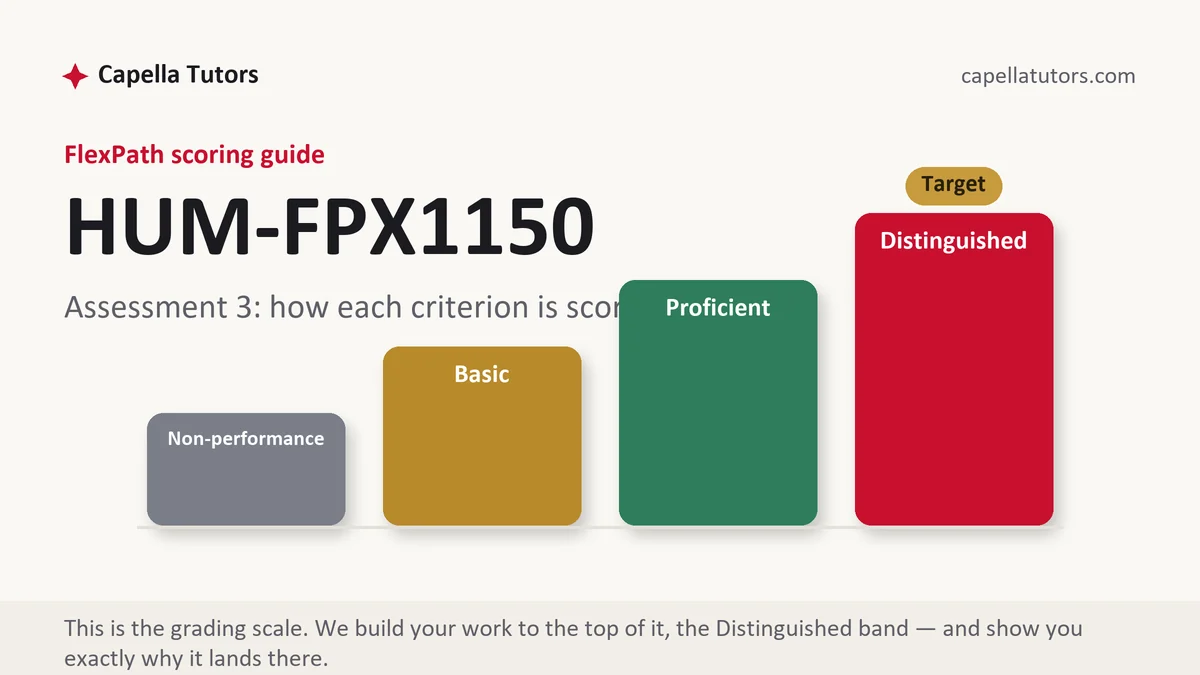
How HUM FPX 1150 Assessment 3 is scored
FlexPath does not use letter grades. Each criterion in the scoring guide lands on one of four levels, and the level descriptions are the real writing brief:
| Level | What it means on a heroic qualities analysis |
|---|---|
| Distinguished | Both artifacts are described with their cultural context, heroic qualities are analyzed with evidence from the works, similarities and differences are explained, and takeaways connect to cultural values. |
| Proficient | Both artifacts and the comparison are accurate, but cultural context is thin. |
| Basic | The paper describes two heroes with little comparison. |
| Non-performance | An artifact, the comparison or the takeaways are missing. |
Choose artifacts from clearly different cultures with enough written context to support analysis.
The HUM FPX 1150 Assessment 3 method, step by step
-
Choose the artifacts
Two portrayals of heroes from different cultures.
-
Give context
When, where and by whom each was made, and for what audience.
-
Identify heroic qualities
Courage, sacrifice, wisdom, loyalty, with examples from each work.
-
Compare
Shared qualities and differences.
-
Explain the differences
Connect them to each culture's values.
-
Draw takeaways
What the comparison teaches about heroism and culture.
A structure that maps to the criteria
Word counts are planning targets our tutors use, not Capella rules; follow the length and format your scoring guide states.
| Section | What it must do | Guide |
|---|---|---|
| Introduction | The question of heroism and the two artifacts. | ~75 words |
| Evaluation of chosen artifacts | Each artifact in context with its heroic qualities. | ~200 words |
| Similarities and differences | The comparison. | ~150 words |
| Takeaways | What it shows about culture. | ~100 words |
| References | Current APA. | as needed |
Annotated sample excerpt
An original model excerpt from our team, written to show the register that reaches the top of the guide. Learn the moves, then write your own version.
Both Achilles in the Iliad and Mulan in the Chinese ballad are celebrated warriors, but they fight for different reasons: Achilles seeks personal glory that will outlive him, while Mulan takes her father's place to protect her family.1 That difference reflects the values each tradition placed at the center of a good life, individual honor in the Greek epic and duty to family in the Chinese ballad.2 Their shared courage shows what both cultures admired; their different motives show what each believed courage was for.3
- 1Compares the heroes on a specific point.
- 2Connects the difference to cultural values.
- 3Summarizes the comparison into an insight.
The full premium sample for your exact assessment, written fresh to your scoring guide and topic, is free to request. Study it, revise it into your own voice, and submit work you understand.
The five mistakes that cost Distinguished
- Description only. Compare and explain.
- No cultural context. Place each artifact in its culture.
- Claims without examples. Point to the works.
- Similar cultures. Choose clearly different traditions.
- No takeaways. Say what the comparison shows.
Pre-submission checklist
- Two artifacts from different cultures
- Cultural context for each
- Heroic qualities with examples
- Similarities and differences explained
- Takeaways about cultural values
- Current APA references
Want the heroic qualities analysis written?
Send the scoring guide and any materials from your courseroom. Our team returns a premium original heroic qualities analysis in 24 to 48 hours, revised free until it meets the guide.