This manual is for HUM FPX 1150 Assessment 1, start to submission. An opening assessment in a course on cultural understanding usually hands you something cultural to look at closely: an object, a film, a song, a building, a meal, a ceremony. The assessment usually asks for analysis rather than description, which means the paper has to say who made the thing, for whom, under what conditions, and what it assumes its audience already knows. Handing it over is also possible, and a premium original sample reading your object for maker and audience returns inside 24 to 48 hours, revised free until the criteria clear. Capella's catalog lists the course as HUM-FPX1150, and some courserooms print HUM1150; both point to this same Assessment 1.
One honesty note before the manual: Capella revises courses and scoring guides over time, so always write to the exact scoring guide attached to your assessment in the courseroom. The course identity above is verified on capella.edu; the method and structure below are our tutors' approach to it, not Capella's official rubric text.
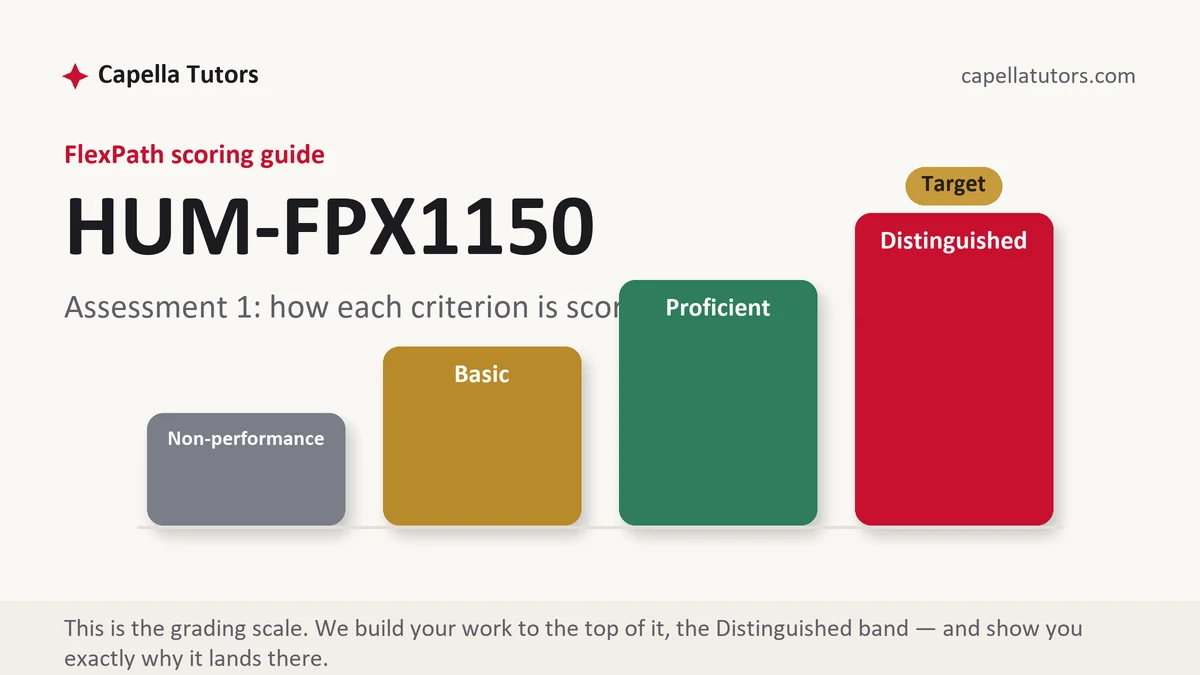
How HUM FPX 1150 Assessment 1 is scored
A FlexPath transcript records no letter grades. Each criterion on your guide lands on one of four levels, and the level language tells you what to write:
| Level | What it means on an artifact analysis |
|---|---|
| Distinguished | The object located in a place, a period and a set of conditions, with the rival reading acknowledged and answered, and the writer's own access to it stated. |
| Proficient | The object described accurately and interpreted in context. Careful work, one level short of the top. |
| Basic | A description of what the object looks like and does, with meaning asserted rather than shown. Where most first attempts at an artifact paper land. |
| Non-performance | A required element absent, most often the interpretation or the context. |
A country is not a culture, and an object is the easiest way to prove you know the difference. One thing, made by identifiable people at an identifiable time for an identifiable audience, gives every criterion something specific to grade, and it is far harder to write a stereotype about a single object than about a nation.
The HUM FPX 1150 Assessment 1 method, step by step
-
Make the criteria the outline, then narrow the object
Copy each criterion out as a heading with its top-column sentence underneath. Then shrink your subject until it fits under those headings. One object, one workshop, one occasion. Scale is the single decision that separates a strong paper here from a competent one.
-
Describe before you interpret, in sentences another observer would accept
Write what is actually there first: materials, size, colors, where it was placed, who handled it. No evaluative adjectives. Only then say what you think it means. A paper that reaches for meaning before recording anything reads as taste, and taste is not on the scale.
-
Answer the four questions in order
Who made this, for whom, under what conditions, and what does it assume its audience already knows. The fourth question is the one that produces analysis, because it forces you to name the shared knowledge the object relies on and therefore the community it belongs to.
-
Attribute the framework, then bound it
Name the concept, the person who developed it, and the fieldwork or study it came from, then say what it does not explain about your object. Geertz's argument that description has to include the web of meaning that makes an act intelligible is useful here, and it also has limits worth stating. A framework applied without its limits is the error evaluators look for first.
-
Set one rival reading against your own
Somebody who knows the object well would read it differently, and the criterion at the top of the scale usually pays for saying so. State the alternative in terms its holder would accept, then answer it from what you observed rather than by repeating your own reading more firmly.
-
Source it from inside as well as outside, then self-score
Anthropology and area scholarship carry the general claims, and writers, journalists and makers from the community carry the specifics. A reference list with no voice from inside the culture is visible before the reader reaches your first page. Then grade yourself against every row and submit early enough to absorb a two-business-day review.
A structure that maps to the criteria
Word counts are our tutors' planning targets for an artifact analysis, not Capella rules; wherever your scoring guide asks for more, write more.
| Section | What it must do | Guide |
|---|---|---|
| The object and your access | What it is, where and when it was made, and how you came to know about it. | ~140 words |
| Description | What is physically there, recorded before it is explained, in detail another observer could confirm. | ~230 words |
| Maker, audience, conditions | Who produced it, for whom, under what economic and social circumstances, and what it assumes. | ~300 words |
| Framework applied | The concept, its author, the work it came from, and the part of your object it does not reach. | ~250 words |
| Interpretation and the rival reading | What the object means in context, the alternative reading, and your answer to it. | ~230 words |
| Sources and format | Area scholarship alongside voices from inside the community, all dated, in current APA both ways. | as needed |
Annotated sample excerpt
A model excerpt from our team, showing how description turns into analysis without the seam showing. Study the moves in it, then run them on whatever object your own prompt handed you.
The coffin is roughly two meters long, built of soft wood and finished in enamel paint, and it has been carved as a fishing boat with a name lettered along the hull.1 It was made to order in a workshop in the Greater Accra region by a carpenter who took a commission from a family, which places it inside a cash economy and a trade with apprentices, prices and competitors, rather than inside a timeless custom; the boat is not decorative, it identifies what the man did for a living, and the lettering assumes a mourning crowd who can read the name and know the vessel.2 A reading that treats the object as an expression of a national attitude toward death would miss all of that, because the practice belongs to particular Ga families in particular neighborhoods and was contested inside the community by clergy who objected to the expense, which is a disagreement no account of a country could contain.3
- 1Pure description, in measurements and materials, with no meaning claimed yet. An evaluator can check every clause, which is what makes the interpretation that follows credible.
- 2Puts the maker, the commission and the economy on the page, then names the shared knowledge the lettering depends on. Answering the fourth question is what turns description into analysis.
- 3States the rival reading, refuses it with a specific, and reports a disagreement inside the community. Internal dispute is the strongest available evidence that a culture is not one thing.
The full premium sample for your exact assessment, written fresh to your scoring guide and issue, is free to request. Study it, revise it into your own voice, and submit work you understand.
The five mistakes that cost Distinguished
- A nation treated as a culture. A country of many languages, regions and classes cannot hold one set of values, and asserting it is the error this course exists to correct.
- Interpretation with no description under it. A claim about meaning that skipped the observation has nothing an evaluator can check it against.
- A framework used without its author or its limits. The concept belongs to somebody, came from somewhere, and does not reach everything, and all three facts belong in the paper.
- Only outside sources. Writing about a community with no voice from within it shows in the reference list before the argument begins.
- Evaluative adjectives in the description. Exotic, simple and vibrant are judgments wearing the clothes of observation, and they cost the row that asked for description.
Pre-submission checklist
- Every criterion on the guide has a section of its own
- Description is written separately from interpretation and free of evaluative adjectives
- Maker, audience, conditions and assumed knowledge are all answered
- The framework is attributed to its author and bounded in a sentence
- One rival reading is stated fairly and answered from the evidence
- At least one source from inside the community, APA matched both ways
Artifact analysis due and the object will not open up?
Send the prompt, the criteria and the object, film or practice you have chosen. Eight people handle the file, including a research analyst who finds the area scholarship and the voices from inside the community. Back in 24 to 48 hours, written to the Distinguished column, revised free until the guide is met.