This manual is for HUM FPX 1150 Assessment 2, start to submission. A middle assessment in this course usually moves from looking at one thing to holding two things side by side. The assessment usually asks you to compare a practice across settings, or to compare two accounts of the same practice, and to explain the difference with a framework rather than with a preference. Your scoring guide decides which framework and how much of your own position belongs in it. Or let us build it: a premium original sample describing both of your settings at equal depth arrives inside 24 to 48 hours, with unlimited free revision. Capella's catalog lists the course as HUM-FPX1150, and some courserooms print HUM1150; both point to this same Assessment 2.
One honesty note before the manual: Capella revises courses and scoring guides over time, so always write to the exact scoring guide attached to your assessment in the courseroom. The course identity above is verified on capella.edu; the method and structure below are our tutors' approach to it, not Capella's official rubric text.
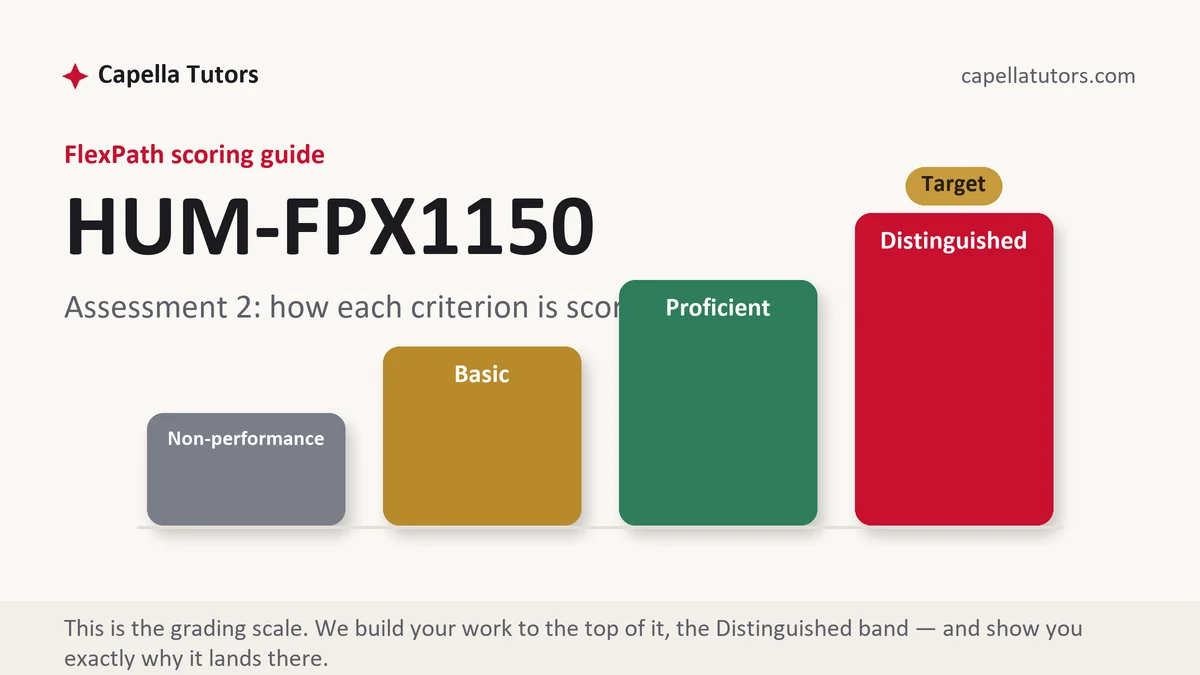
How HUM FPX 1150 Assessment 2 is scored
Criteria are graded one at a time, at one of four levels, and the wording of the level is the specification:
| Level | What it means on a cultural comparison |
|---|---|
| Distinguished | Two settings described in their own terms, the difference explained by something in the situation, and the framework's reach stated honestly. The extra step is inside the criterion; find it and make it. |
| Proficient | Both settings described accurately and compared fairly with a named concept. Sound work, one level below the top. |
| Basic | Two descriptions placed beside each other with the comparison left to the reader. The classic middle-column comparison. |
| Non-performance | A required element absent, usually the framework or the second setting in any real detail. |
A comparison that concludes the two settings are basically the same has collapsed the assignment, and one that concludes they are opposites has usually stopped looking. What the top column rewards is a difference explained by a condition, because a condition can be checked and an impression cannot.
The HUM FPX 1150 Assessment 2 method, step by step
-
Build headings from the criteria, then choose comparable units
Compare like with like: one occasion against one occasion, one household against one household. A festival in a country set against a festival in a workplace is not a comparison, it is a category error, and the row that asks for analysis will read it as one.
-
Write both settings from the inside before you compare them
Describe each one as the people in it would recognize, with the same level of detail on both sides. Unequal description is the commonest structural fault here, because the familiar setting gets specifics and the unfamiliar one gets generalities, and the imbalance is visible immediately.
-
Name the concept and say where it came from
Hall's distinction between high-context and low-context communication came out of anthropological fieldwork and describes how much meaning sits in the situation rather than in the words. Attribute it, apply it to a specific exchange, and say what it cannot account for in your case.
-
Explain the difference with a condition rather than a character trait
Ask what is different about the circumstances: who is present, how long people have known each other, what the setting is for, who is paying, what has to be finished by five o'clock. A difference explained by a condition is analysis. A difference explained by what people are like is a stereotype with a citation attached.
-
Write the self-location as evidence, not confession
A reflection row is not asking how the experience felt. Name one expectation you carried in, say where it came from, say what contradicted it, and say what you now think instead. Two sentences of that outperform a page of goodwill, because goodwill cannot be checked.
-
Check the sourcing, then self-score
General claims need peer-reviewed scholarship, specifics need voices from inside, and figures need an institution. Travel writing and country business-etiquette pages are what a Basic reference list is built from. Then place your own level on each row and leave the review window room to work.
A structure that maps to the criteria
Planning targets our tutors use for a comparison of this kind, not Capella requirements; your scoring guide decides where the words go.
| Section | What it must do | Guide |
|---|---|---|
| What is being compared | The two occasions, households or accounts, matched for scale, with your access to each stated. | ~150 words |
| Setting one, described | What happens, in order, with the participants and the conditions named, and no evaluation yet. | ~230 words |
| Setting two, described | The same practice in the other setting, at the same level of detail, in its own terms. | ~230 words |
| The framework and the difference | The concept, its author, and the condition in the situation that produces the difference between the two. | ~300 words |
| Self-location | The specific expectation you brought, its origin, what contradicted it, and what you think now. | ~200 words |
| Sources and format | Scholarship for general claims, insider voices for specifics, institutions for figures, current APA. | as needed |
Annotated sample excerpt
A model excerpt from our team, showing how a comparison paragraph earns its conclusion. Learn the moves, then rebuild them around the two settings your own criteria name.
In the office version the invitation arrived by email, gave a start and end time, and explained in two sentences what Diwali commemorates; at the family gathering the following weekend nobody explained anything, and the person who arrived without sweets was noticed without a word being said about it.1 Hall would call the second exchange the more highly contextual one, meaning that most of the message was carried by the situation rather than by the words, and the useful part of that framing is that it describes an exchange rather than a people.2 The condition producing the difference is not that one group communicates indirectly and the other does not, it is that the family had thirty years of shared practice to draw on and the office had a room booked until two, so the office had to say out loud what the family could leave in the room.3
- 1Two matched observations, same length, same level of detail, with the second one carrying an unspoken sanction. Equal specificity on both sides is what makes a comparison fair.
- 2Attributes the concept, applies it to the exchange rather than to a population, and states the limit of the framing in the same sentence. That limit is worth a criterion by itself.
- 3Replaces a claim about what people are like with a claim about circumstances, and names both circumstances. Explaining a difference by a condition is the move the top column is describing.
The full premium sample for your exact assessment, written fresh to your scoring guide and issue, is free to request. Study it, revise it into your own voice, and submit work you understand.
The five mistakes that cost Distinguished
- Unequal description. Specifics on the familiar side and generalities on the other, and the imbalance is visible before the analysis starts.
- A framework applied to a person. A dimension or a category describes a pattern or an exchange, and reading it onto an individual is the error evaluators here hunt for.
- Difference explained by temperament. What people are like cannot be checked, and the criterion is asking for something that can.
- Reflection written to reassure the reader. A closing note about how much the encounter taught you records a feeling and satisfies nothing on the guide.
- Etiquette sites doing the work of scholarship. Country profile pages repeat stereotypes efficiently, and they are the sources most likely to put one in your paper.
Pre-submission checklist
- The two settings are matched for scale and described at equal length
- No evaluative language sits inside either description
- The framework is attributed, applied to an exchange, and bounded
- The difference is explained by a named condition in the situation
- The self-location names one expectation, its origin, and what changed it
- Insider and scholarly sources both present, APA matched in both directions
Comparison due and the two halves will not balance?
Send the criteria and the practice, community or pair of accounts you are working with. We bring the framework attributed to its author, sources from inside and outside, and the observation the reading rests on. Delivered in 24 to 48 hours, written to the top column, revised free until it clears.