Give us the prompt, the scoring guide and the era or topic you have been pointed at, and a premium original sample returns inside 24 to 48 hours, written to the Distinguished descriptors with every document identified by date, collection and repository. The listing reads HIS FPX 1150, U.S. History: How the Past Informs the Present, worth 3 points, one of the Social Science choices on the FlexPath general education menu, where the requirement is 22.5 points or more with a minimum of 2 points taken in each of the four categories. Undergraduates from every bachelor's program pass through it, which is why it teaches the handling of evidence rather than a survey of names and dates. In Capella's catalog the course code is written HIS-FPX1150.
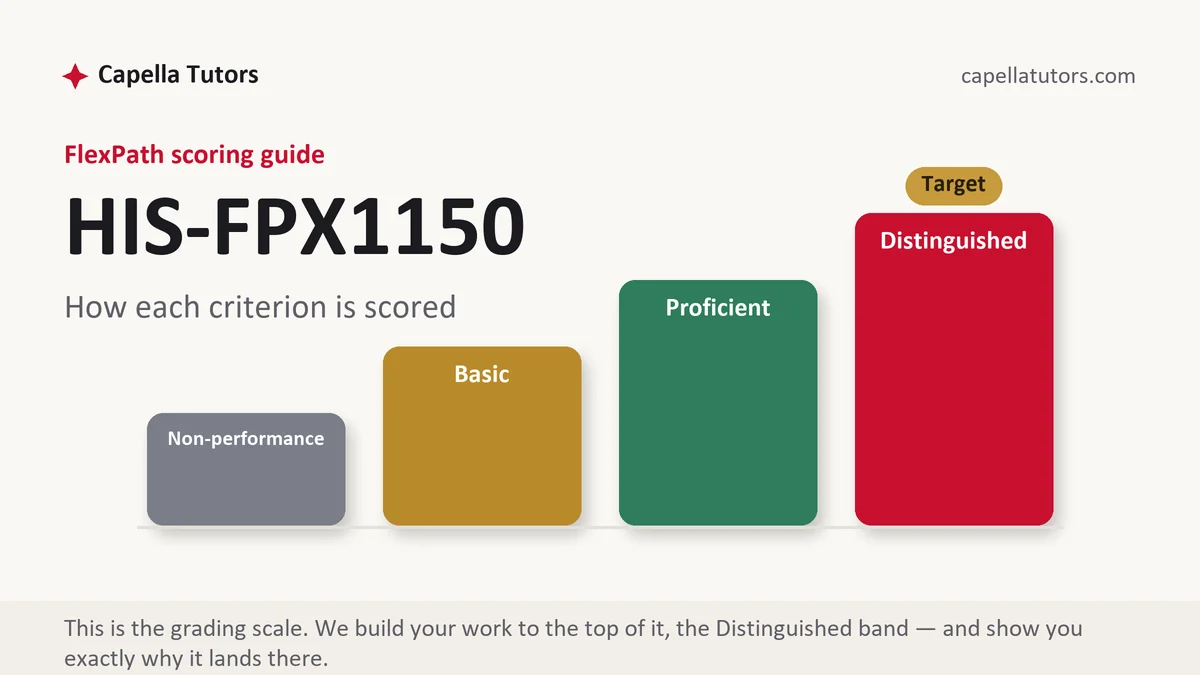
What HIS FPX 1150 actually grades
This course does not reward recall, and students who studied for it like a timeline are the ones most surprised by their first score. What the criteria examine is whether you treat a document as something made by a particular person for a particular reason at a particular moment. Every source gets the same interrogation. Who produced it, when, for whom, and what were they trying to accomplish by producing it? A speech is excellent evidence of what a politician wanted an audience to believe and poor evidence of what happened in the room beforehand. Answer those questions on the page and half the rubric is already satisfied.
Primary and secondary sources do different jobs and the distinction is graded more finely than the textbook definition suggests, because it depends on the question rather than on the age of the object. A 1975 oral history describing a strike in 1937 is a secondary account of the strike and a primary source for how the strike was remembered nearly forty years later, and the sentence that says so is worth a level on its own. Corroboration is the companion skill. One document is a claim, and two independent documents that agree, produced by people with different reasons to write, are the beginning of a fact.
Context is the third graded strand and the one most drafts thin out. Placing an event means saying what was ordinary at the time, what was contested, and what the people involved could not yet know. Causation follows the same discipline. Anything worth writing about had several causes working at different speeds, and the job is to sort them into long-running conditions, shorter-term pressures, and the immediate trigger, then admit which the evidence supports weakly. Contingency is the counterweight, since almost nothing was inevitable, and a paper that shows the moment a different decision was available is doing the analysis this course is built around.
The title tells you where the whole thing lands. The connection to the present has to be traced rather than announced. That means a mechanism, usually a law, an institution, a migration, a technology or a boundary drawn on a map, followed forward with dates attached, and it means saying what changed along the way rather than implying that the past simply persists. History does not repeat, and the sentence claiming it does is the sentence an evaluator underlines.
How we help in this course
Drafts for 1150 are built on documents you can open. Tell us the period, the question, and any sources your courseroom has assigned, and the sample quotes from identified material, with the date and the holding institution named in the sentence, so nothing rests on a paraphrase of a paraphrase. Where historians disagree about the topic, the draft says so and names them, because acknowledging an argument you did not settle is a mark of the top column rather than a weakness in it.
The terms are the same ones we offer on every course. A premium original sample inside 24 to 48 hours, aimed squarely at the Distinguished descriptors in your own guide, then reviewed by eight people, one pass for subject accuracy and factual dates and a second for APA, originality and language. Revisions continue free until the criteria clear, and faculty comments come back into that cycle at no charge. FlexPath gives faculty two business days to look at an attempt, and the review passes exist so that window is spent on your next deliverable rather than on a correction.
The assessments, one by one
Assessment 1: Evaluating Historical Sources
An opening assessment in a history course usually hands you documents rather than a topic, and grades how you handle them. Read the full Assessment 1 manual.
Assessment 2: Historical Analysis
Judge the credibility of your sources, analyze the impacts of a historical event or development in U.S. history. Read the full Assessment 2 manual.
Assessment 3: Lesson from History
Choose a historical issue, pose a research question and sub-questions, evaluate sources, explain causes and long-term impacts. Read the full Assessment 3 manual.
How to actually write HIS FPX 1150: where to begin
Start from the scoring guide and let its rows become headings, then choose a question with a place and a span of years inside it. The Great Depression is not a question. What the collapse of a single county's bank did to farm tenancy between 1930 and 1936 is one, and it is answerable, which the first is not. Narrow topics are also easier to source, since a national subject sends you to summaries while a local one sends you to documents.
Then write each analytical paragraph in a fixed order, because the order is what makes the evidence visible. Make the claim. Present the source with its provenance, meaning who wrote it, when, and to whom. Quote or describe the specific passage that carries your point. Interpret it, saying what it shows and how you know. Then bound it, saying what this document cannot establish on its own. Four of those paragraphs, each anchored to a different piece of evidence, outrank eight paragraphs of confident narration every time.
Here is the contrast, using material this course often reaches for. A Basic paragraph writes that Social Security was created in 1935 and that it still supports retirees today. The paragraph that scores names the statute, notes that its old-age insurance provisions initially left out agricultural and domestic workers, identifies who was in those occupations at the time, follows the mechanism forward through the amendments that extended coverage in the decades after, and then states the limit: that a gap in early coverage is one influence among several on later retirement security, and that the evidence establishes the exclusion far more firmly than it establishes any single downstream consequence. Same subject, same length, and only the second one is doing history. Historians differ over how much weight that exclusion should carry, and saying which reading you find persuasive, with a reason, is the move that finishes the paragraph.
| Section | What goes in it | What Distinguished looks like |
|---|---|---|
| The question and period | The place, the years covered, and the question the paper will answer. | A span narrow enough to source, with the question stated before any narration begins. |
| Primary evidence | Documents from the period, each with author, date, audience and repository. | Provenance given for every source, and each one used for what it can actually show. |
| Secondary literature | What historians have argued, including where they disagree with one another. | A disagreement named and taken a position on, with the reason given. |
| Context | Conditions, pressures and the trigger, plus what contemporaries could not know. | Causes separated by time scale, and at least one alternative outcome shown as possible. |
| The line to the present | The institution or rule traced forward, with the dates of each change along the way. | A mechanism with links rather than a resemblance, and the changes since acknowledged. |
| References | Current APA, primary sources cited with collection details, every entry matched. | A reference list where the primary and secondary material are both visibly present. |
Developing the synthesis
Synthesis in history is mostly historiography, which is the plainer idea that accounts of the past change as new evidence surfaces and new questions get asked. Two respected historians can read the same decade and disagree, and the disagreement is usually traceable to what each one counted as evidence, whether that was federal policy files, local court records, wage ledgers or letters home. Put two readings beside each other and explain the difference that way, since a comparison written in terms of sources is analysis while a comparison written in terms of tone is opinion. Then commit. Say which account you find more persuasive for your question and why, and name the evidence that would change your mind. Where a source you are relying on has been challenged, report the challenge rather than hoping your evaluator has not read it.
Citations that survive faculty review
Four kinds of material belong in this reference list. Documents from the period are the foundation, and they are cited with enough detail to be found again, meaning the item, its date, the collection and the archive or digital repository holding it. Scholarly secondary work is next, meaning peer-reviewed articles in journals such as the Journal of American History and the American Historical Review, reached through the Capella library, together with university press books, which in this field carry more weight than journal articles do in the sciences. Government and institutional records make up the third kind, including statutes, census returns, agency reports and congressional material, cited to the body that produced them. Reference works are the fourth and they are for orientation only, so an encyclopedia entry can send you toward a source and should never be the source, and popular history sites and documentary recaps sit in the same category. Then confirm every date in the prose against the document rather than against memory, because a wrong year is the one error here that a reader notices immediately.
The mistakes that land Basic instead of Distinguished
- Present standards applied without saying so. A verdict delivered before the explanation replaces analysis with commentary, and the criteria can see the substitution.
- One cause for a large event. Monocausal accounts read as summaries, and the sorting of causes by time scale is the graded skill.
- A quotation with no provenance. Who wrote it, when, and for whom decides what the quotation is evidence of, and without those the quote proves nothing.
- Americans treated as one actor. A country of millions did not think anything, and naming the region, the party, the union or the agency is always sharper.
- A connection to the present asserted by resemblance. Two situations that look alike are not linked until you can show what carried the influence from one to the other.
HIS FPX 1150 questions students actually ask
Do I actually need primary sources, and where are the free ones?
Read the criteria, because some assessments require them and some only reward them, but a paper with at least one document from the period almost always reads better than a paper built entirely out of other people's summaries. The free collections are excellent. The National Archives holds federal records including statutes, agency correspondence and photographs. The Library of Congress digital collections cover manuscripts, maps, posters and recordings, and its Chronicling America project puts digitized historic newspapers in front of you with search. State historical societies and university special collections publish finding aids that tell you what exists before you ask for it. Cite the document, its date, the collection and the repository, so a reader can reach the same page you read.
How do I connect a past event to the present without overclaiming?
Trace a mechanism and keep the chain short. A defensible line runs from a decision, through the institution that carried it out, to an arrangement that still operates, with a date on every link. What breaks the argument is the leap: two facts a century apart joined by the word therefore, with nothing in between to show how one produced the other. Say what else was working on the outcome, since anything that lasts eighty years has been touched by many hands. Then state the limit outright, that the past shaped the range of options rather than determining the result, which is both the honest version and the one the top column describes.
Is it unfair to judge people in the past by present standards?
Judgment is allowed, and history without any is bloodless, but the explanation has to come first and it has to be built from what the people involved knew and faced. Presentism is the error of skipping that step and assessing a decision by information nobody had. The way through is to establish the alternatives available at the time, including the ones contemporaries argued for out loud, since almost every practice we now condemn had critics in its own decade and citing them is far stronger than announcing your own verdict. Explain the choice, show the road not taken, then judge if the assessment invites it, and make clear which sentences are the evidence and which are yours.
History paper due this week?
Send the criteria and the period you were assigned. The draft comes back with documents quoted, dated and traced to the archive that holds them. First premium sample free.