This manual is for HIS FPX 1150 Assessment 2, start to submission. Historical Analysis asks you to analyze an event or development in U.S. history using credible sources: you assess the credibility of the sources you use, explain the impacts of the event on people and institutions at the time and afterward, and show critical thinking about cause, consequence and perspective. The grade turns on analysis of impact. Narrating what happened scores lower than explaining what changed because of it, for whom, and how we know. Below is the method our tutors use, a structure that maps to the criteria, and an annotated sample excerpt. Prefer to hand it off? A premium original sample for this exact assessment comes back in 24 to 48 hours, revised free until it meets the guide. Capella's catalog lists the course as HIS-FPX1150, and some courserooms print HIS1150; both point to this same Assessment 2. In current courserooms this assessment typically appears as "Historical Analysis".
One honesty note before the manual: Capella revises courses and scoring guides over time, so always write to the exact scoring guide attached to your assessment in the courseroom. The course identity above is verified on capella.edu; the method and structure below are our tutors' approach to it, not Capella's official rubric text.
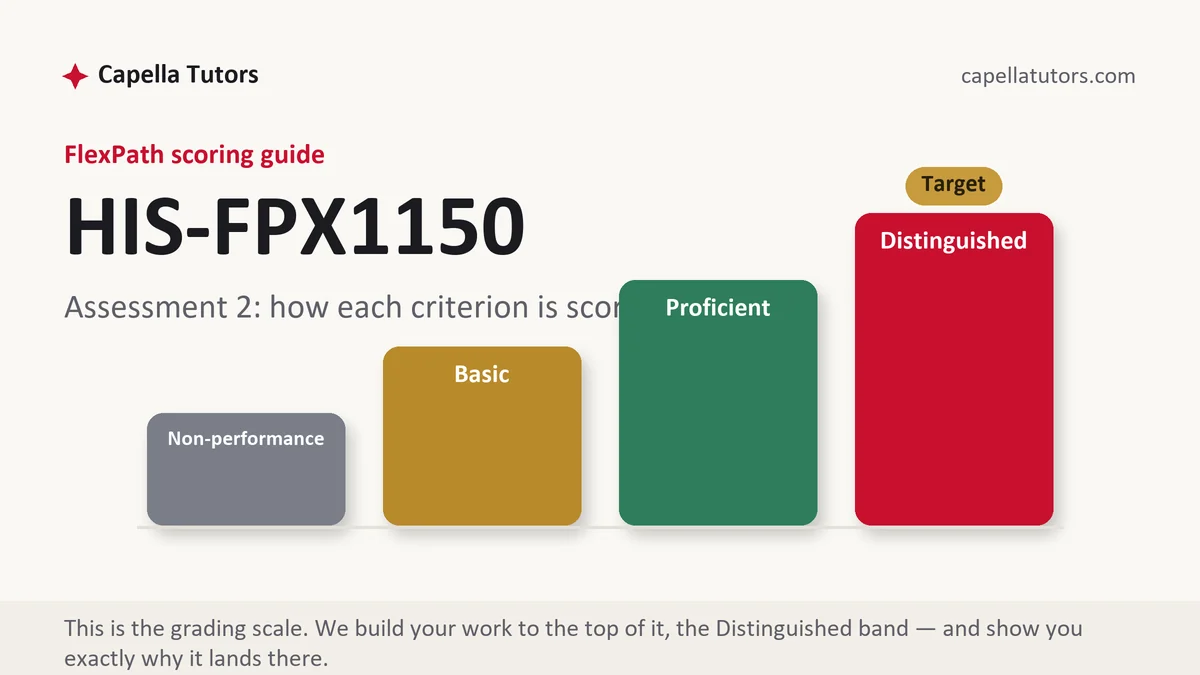
How HIS FPX 1150 Assessment 2 is scored
FlexPath does not use letter grades. Each criterion in the scoring guide lands on one of four levels, and the level descriptions are the real writing brief:
| Level | What it means on a historical analysis |
|---|---|
| Distinguished | Sources are evaluated for credibility, impacts are analyzed with evidence and dates, multiple perspectives are considered, and conclusions show critical thinking about cause and consequence. |
| Proficient | Sources and impacts are covered accurately, but the analysis leans on narrative. |
| Basic | The paper retells the event with little analysis or source evaluation. |
| Non-performance | The source evaluation or the impact analysis is missing. |
Check the format your courseroom requires; some versions ask for a presentation with notes rather than a paper.
The HIS FPX 1150 Assessment 2 method, step by step
-
Choose the event
A defined event or development with good sources, such as the New Deal or the Civil Rights Act.
-
Evaluate your sources
Who created each, when, why, and how reliable it is.
-
Analyze immediate impacts
What changed for people and institutions at the time.
-
Analyze long-term impacts
Effects that carry into later decades, with dates.
-
Consider perspectives
How different groups experienced the event.
-
Show critical thinking
Weigh causes and consequences, and note what the sources cannot tell you.
A structure that maps to the criteria
Word counts are planning targets our tutors use, not Capella rules; follow the length and format your scoring guide states.
| Section | What it must do | Guide |
|---|---|---|
| Introduction | The event and your focus. | ~75 words |
| Credibility of sources | Evaluation of each source. | ~125 words |
| Impacts of the event | Immediate and long-term effects with evidence. | ~250 words |
| Critical thinking | Perspectives, causes and limits. | ~125 words |
| Conclusion and references | Close, then current APA. | ~75 words |
Annotated sample excerpt
An original model excerpt from our team, written to show the register that reaches the top of the guide. Learn the moves, then write your own version.
The Social Security Act of 1935 changed old age in the United States within a generation: before it, poverty rates among older Americans were far higher than among working-age adults, and by the 1970s that gap had largely closed.1 Its impact was uneven at first, because the original law excluded agricultural and domestic workers, occupations that employed a large share of Black workers at the time, so the benefits reached them years later.2 Reading the law's text alongside later amendments shows how a program can expand its reach over time, which is the lesson that connects it to debates over coverage today.3
- 1States a long-term impact with a comparison over time.
- 2Adds a perspective showing uneven effects.
- 3Draws a reasoned connection from the evidence.
The full premium sample for your exact assessment, written fresh to your scoring guide and topic, is free to request. Study it, revise it into your own voice, and submit work you understand.
The five mistakes that cost Distinguished
- Narrative instead of analysis. Explain what changed and why.
- Unevaluated sources. Judge credibility.
- One perspective. Consider how different groups were affected.
- No dates. Anchor impacts in time.
- Overclaiming. Note what the sources cannot show.
Pre-submission checklist
- Defined event
- Sources evaluated for credibility
- Immediate and long-term impacts
- Multiple perspectives
- Critical thinking about cause and limits
- Current APA references
Want the historical analysis written?
Send the scoring guide and any materials from your courseroom. Our team returns a premium original historical analysis in 24 to 48 hours, revised free until it meets the guide.