This manual is for HIS FPX 1150 Assessment 1, start to submission. An opening assessment in a history course usually hands you documents rather than a topic, and grades how you handle them. The assessment usually asks you to identify what each source is, who made it and why, and then to say what it can and cannot establish. Recall is not what earns the marks here. Handing it over is an option, and a premium original sample quoting documents with their repositories named returns inside 24 to 48 hours, revised at no charge until it clears. Capella's catalog lists the course as HIS-FPX1150, and some courserooms print HIS1150; both point to this same Assessment 1.
One honesty note before the manual: Capella revises courses and scoring guides over time, so always write to the exact scoring guide attached to your assessment in the courseroom. The course identity above is verified on capella.edu; the method and structure below are our tutors' approach to it, not Capella's official rubric text.
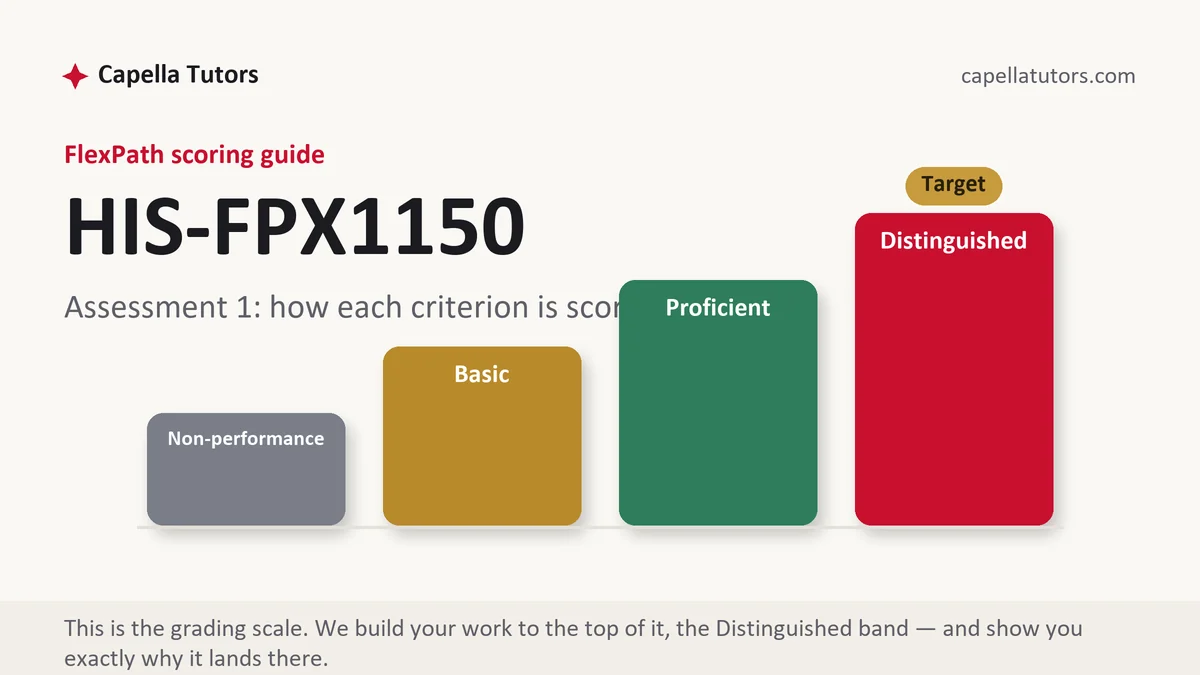
How HIS FPX 1150 Assessment 1 is scored
No letter grade is awarded in FlexPath. Each criterion lands on one of four levels, and the level wording is your brief:
| Level | What it means on a primary source analysis |
|---|---|
| Distinguished | Provenance given for every source, each one used for what it can actually show, and the limit of the document stated in the paper rather than left to the reader. |
| Proficient | Sources correctly identified and interpreted in context. Careful work, one level below the top. |
| Basic | Documents quoted for their content with the author, date and audience left out. Where most first attempts at source work land. |
| Non-performance | A required element absent, most often the provenance or the context. |
Every source gets the same interrogation: who produced it, when, for whom, and what were they trying to accomplish by producing it. A speech is excellent evidence of what a politician wanted an audience to believe and poor evidence of what happened in the room beforehand, and writing that distinction down satisfies a large part of the guide.
The HIS FPX 1150 Assessment 1 method, step by step
-
Make the criteria into headings, then narrow to a place and a span
A decade is not a question. A single city between two named years is one, and it is answerable. Narrow topics are also easier to source, because a national subject sends you to summaries while a local one sends you to documents.
-
Identify what each document is before you use it
Write the author, the date, the intended audience and the purpose in the sentence that introduces the source. A document with no provenance proves nothing, and the criterion asking you to analyze evidence is asking for exactly these four facts.
-
Decide what each source is primary for
The distinction depends on the question rather than on the age of the object. An account recorded forty years after an event is a secondary account of the event and a primary source for how it was remembered later, and the sentence that says so is worth a level on its own.
-
Write each paragraph in a fixed order
Make the claim. Present the source with its provenance. Bring in the exact line or detail that does the work for you. Read it, stating what it establishes and what makes you confident of that. Then bound it, saying what this document cannot establish alone. Four such paragraphs outrank eight of confident narration.
-
Corroborate, and say when you cannot
One document is a claim, and two independent documents produced by people with different reasons to write are the beginning of a fact. Where you have only one, say so plainly, because an acknowledged gap is treated far better than an unnoticed one.
-
Verify every date, then self-score
Check each date in the prose against the document rather than against memory, since a wrong year is the error a reader notices immediately. Then read the guide row by row, mark your own levels, and submit early, because faculty have up to two business days on an attempt.
A structure that maps to the criteria
Word counts are our tutors' planning targets for a source analysis, not Capella rules; wherever your scoring guide asks for more, expand it.
| Section | What it must do | Guide |
|---|---|---|
| The question, placed | The city or region, the years covered, and the question the paper will answer. | ~140 words |
| The documents identified | Each source with its author, date, audience, purpose and the repository holding it. | ~250 words |
| What each one can show | The claim each document supports, and what it is primary or secondary evidence for. | ~300 words |
| Corroboration | Where two independent sources agree, where they do not, and what follows from the difference. | ~250 words |
| Limits | What the surviving evidence cannot establish, stated before the conclusion rather than after. | ~200 words |
| References | Current APA, primary sources cited with collection and repository, every entry matched. | as needed |
Annotated sample excerpt
A model excerpt from our team, showing provenance doing the arguing rather than sitting in front of it. Read it for the moves, then run them on the documents your own prompt supplies.
The proclamation was issued by the mayor in October 1918, printed as a broadside for posting in shop windows, and it ordered theaters, schools and lodge halls closed while explicitly exempting streetcars and factories.1 Read for what it is, the document is strong evidence of what the city government was willing to require of some businesses and not of others, and weak evidence of whether anybody complied, because a posted order records an intention rather than a result.2 An oral history recorded in 1963 describes the same weeks and cannot corroborate the order at all, since it is a secondary account of 1918 and a primary source for how the closure was remembered forty-five years later; the two documents agree that the halls shut, and only the ledger of a single theater, dated week by week, shows for how long.3
- 1Author, date, format, audience and content in one sentence, with the exemption noted because the exemption is the finding. Provenance is not preamble here, it is the argument.
- 2States what the document is good evidence of and what it is not, in the same sentence. Naming the limit of a source is what an analysis criterion pays for.
- 3Handles the later account correctly, explains what it is primary for, and then identifies the third document that actually settles the question. Distinguishing memory from record is the top-column move.
The full premium sample for your exact assessment, written fresh to your scoring guide and issue, is free to request. Study it, revise it into your own voice, and submit work you understand.
The five mistakes that cost Distinguished
- A quotation carrying no provenance. Who wrote it, when and for whom decides what the quotation is evidence of, and without those it proves nothing.
- An order treated as an outcome. A posted requirement records an intention, and compliance needs a separate document.
- A later recollection used as contemporary evidence. Memory is a source about remembering, and treating it as a record of the event confuses the two.
- One document doing the work of a fact. A single source is a claim until something produced independently agrees with it.
- Dates checked against memory. A wrong year is the error a reader spots first, and it costs credibility across the whole paper.
Pre-submission checklist
- Each criterion has a labeled section
- Every source carries author, date, audience, purpose and repository
- What each source is primary or secondary for is stated explicitly
- Corroboration is attempted, and its absence is admitted where it fails
- The limits of the evidence appear before the conclusion
- Every date verified against the document, APA matched both ways
Source analysis due this week?
Send the criteria, the period you were assigned and any documents your courseroom supplied. The draft quotes identified material with the date and the holding institution in the sentence, so nothing rests on a paraphrase of a paraphrase. Back within 24 to 48 hours, and reworked free for as long as any criterion remains short.