This manual is for HIS FPX 1150 Assessment 3, start to submission. Lesson from History asks you to draw a practical lesson from U.S. history: you choose a historical issue, such as a social movement or reform, frame a primary research question and sub-questions, evaluate the credibility of your sources, explain the causes and long-term impacts, and relate the challenges and strategies of the past to a current issue in an organization. The grade turns on the connection to the present. A lesson announced in the last paragraph scores lower than one traced through specific strategies that an organization could use today. Below is the method our tutors use, a structure that maps to the criteria, and an annotated sample excerpt. Prefer to hand it off? A premium original sample for this exact assessment comes back in 24 to 48 hours, revised free until it meets the guide. Capella's catalog lists the course as HIS-FPX1150, and some courserooms print HIS1150; both point to this same Assessment 3. In current courserooms this assessment typically appears as "Lesson from History".
One honesty note before the manual: Capella revises courses and scoring guides over time, so always write to the exact scoring guide attached to your assessment in the courseroom. The course identity above is verified on capella.edu; the method and structure below are our tutors' approach to it, not Capella's official rubric text.
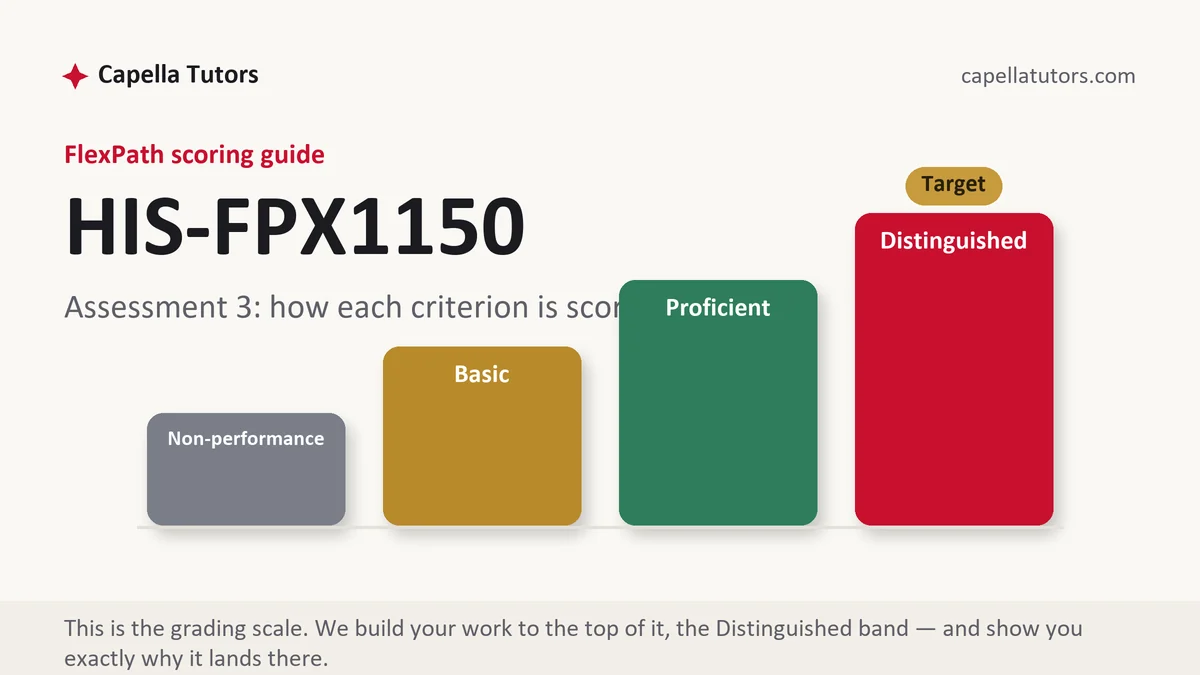
How HIS FPX 1150 Assessment 3 is scored
FlexPath does not use letter grades. Each criterion in the scoring guide lands on one of four levels, and the level descriptions are the real writing brief:
| Level | What it means on a lesson from history |
|---|---|
| Distinguished | The research question is focused, sources are evaluated, causes and impacts are explained with evidence, and past challenges and strategies are connected specifically to a current organizational issue. |
| Proficient | All parts are present, but the connection to the present is general. |
| Basic | The paper describes a historical issue with a brief lesson at the end. |
| Non-performance | The research question, the source evaluation or the present-day connection is missing. |
Many versions ask for a presentation with speaker notes; check the format in your courseroom.
The HIS FPX 1150 Assessment 3 method, step by step
-
Choose the issue
A movement or reform with documented strategies, such as women's suffrage or labor organizing.
-
Frame the research question
One primary question and two or three sub-questions.
-
Evaluate sources
Credibility, bias and usefulness of each.
-
Explain causes and impacts
Why the issue arose and what it changed over time.
-
Identify the strategies
What people did to overcome the challenges.
-
Relate to a current organizational issue
How those strategies apply to a problem in a workplace today.
A structure that maps to the criteria
Word counts are planning targets our tutors use, not Capella rules; follow the length and format your scoring guide states.
| Section | What it must do | Guide |
|---|---|---|
| Introduction | The issue and why it matters. | ~75 words |
| Research question and sub-questions | The questions guiding the work. | ~75 words |
| Credibility of resources | Source evaluation. | ~100 words |
| Causes and long-term impacts | Explained with evidence. | ~200 words |
| Relating past to present | Strategies applied to a current organizational issue. | ~175 words |
| Conclusion and references | Close, then current APA. | ~75 words |
Annotated sample excerpt
An original model excerpt from our team, written to show the register that reaches the top of the guide. Learn the moves, then write your own version.
Suffrage campaigners learned that persuasion worked best when it was organized locally and sustained over years, through state-by-state campaigns that built support before the national amendment.1 An organization trying to close a pay gap today faces a similar challenge of shifting established practice, and the same strategy applies: start with departments willing to publish pay bands, measure the result, and use that evidence to extend the policy.2 The historical lesson is not that change is inevitable, but that incremental wins with visible results build the case for broader change.3
- 1Identifies a specific historical strategy.
- 2Applies it to a concrete current issue.
- 3States the lesson precisely.
The full premium sample for your exact assessment, written fresh to your scoring guide and topic, is free to request. Study it, revise it into your own voice, and submit work you understand.
The five mistakes that cost Distinguished
- A lesson tacked on at the end. Trace the connection through specific strategies.
- A broad question. Focus the research question.
- Unevaluated sources. Judge credibility.
- Causes skipped. Explain why the issue arose.
- Vague present-day issue. Name a specific organizational problem.
Pre-submission checklist
- Focused research question and sub-questions
- Sources evaluated
- Causes and long-term impacts
- Historical strategies identified
- Specific connection to a current organizational issue
- Current APA references
Want the lesson from history paper written?
Send the scoring guide and any materials from your courseroom. Our team returns a premium original lesson from history paper in 24 to 48 hours, revised free until it meets the guide.