This manual is for HIM FPX 2660 Assessment 1, start to submission. Assessment 1 of HIM FPX 2660, Ethics and Compliance in Healthcare Data Management, is where two questions get pulled apart for the first time: whether an action was permitted, and whether it was defensible. The assessment usually asks you to analyze a scenario involving protected health information and say what happened and what should happen now, and your scoring guide decides whether the answer arrives as a case analysis, a memo or a presentation. Announcing a verdict without the analysis behind it is the Basic answer. Below is the method our tutors use for this deliverable, a structure built from the criteria, and an annotated sample excerpt. Prefer to hand it off? A premium original sample for this exact assessment comes back in 24 to 48 hours, revised free until it meets the guide. Capella's catalog lists the course as HIM-FPX2660, and some courserooms print HIM2660; both point to this same Assessment 1.
One honesty note before the manual: Capella revises courses and scoring guides over time, so always write to the exact scoring guide attached to your assessment in the courseroom. The course identity above is verified on capella.edu; the method and structure below are our tutors' approach to it, not Capella's official rubric text.
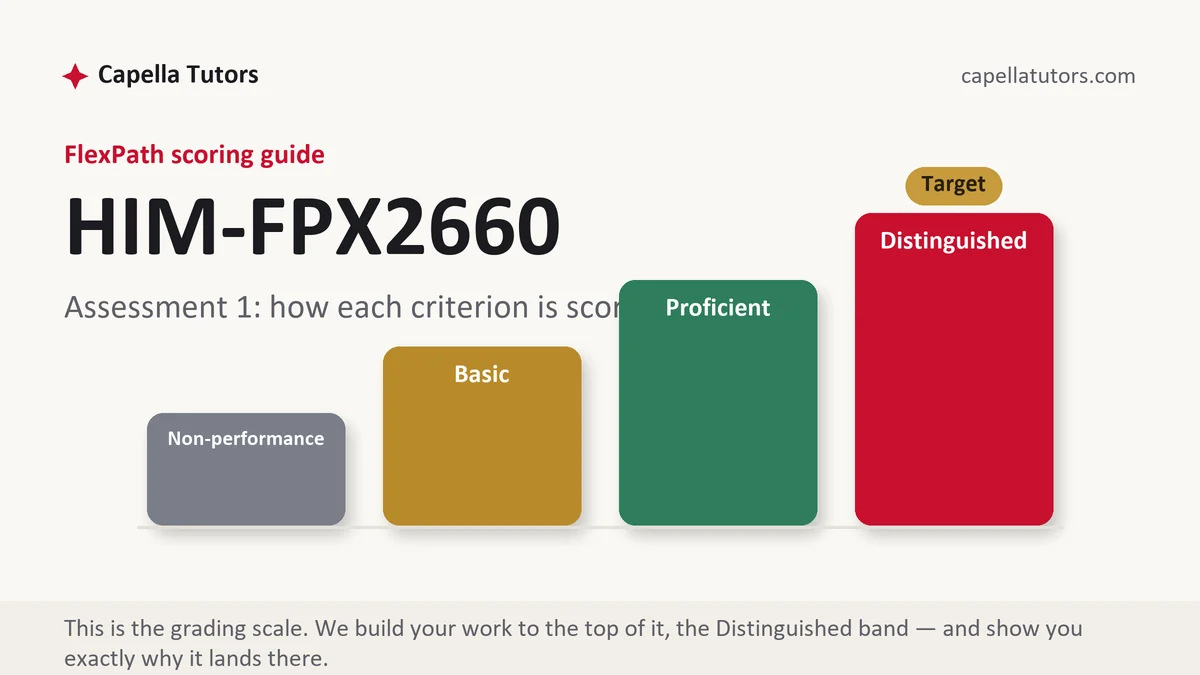
How HIM FPX 2660 Assessment 1 is scored
FlexPath grades each criterion on its own against four written levels, and on a privacy case the levels separate by how much reasoning is visible on the page:
| Level | What it means on a privacy case analysis |
|---|---|
| Distinguished | Facts are separated from assumptions, the governing requirement is cited precisely, each element of it is tested against these facts in its own sentence, the ethical question is answered as a separate question, and the response names what the organization gives up. |
| Proficient | The right rule found and applied correctly, with the ethical section written alongside the legal one rather than as its own analysis. |
| Basic | An accurate summary of privacy law followed by a conclusion about the case, with nothing connecting the two. |
| Non-performance | A required element is missing, most often the documented assessment, or the conclusion rests on no authority at all. |
The sample runs on a hospital's monthly audit log review, which shows that a registration clerk opened the record of a high school athlete whose collapse at a game had been in the local paper, twice, on days when she had no registration activity for him. Nothing was copied and nothing was sent, which is why the case is worth writing about: the analysis has to survive without a dramatic outcome to lean on.
The HIM FPX 2660 Assessment 1 method, step by step
-
Make each criterion a heading before you form an opinion
A case analysis written as one continuous argument almost always leaves a row unanswered, and rows are what get marked. Put the criteria in order in your outline, then read the scenario a second time with the headings in front of you.
-
Write the facts, and label what you had to assume
List who acted, in what role, what information was reached, through which system, when the organization learned of it, and what the log actually shows. Then mark every gap as an assumption in the open.
-
Name the requirement precisely enough to be checked
Access is not authorized by employment, it is authorized by the job, so the minimum necessary standard and the organization's own role-based access design are the provisions in play, not privacy law in general.
-
Run the assessment instead of announcing the answer
Where the facts suggest an impermissible use, work the four factors in writing: what information was involved and how identifying it is, who used or received it, whether it was actually viewed rather than merely available, and how far the risk was reduced afterwards. A defensible conclusion of low probability still has to be recorded to count, and skipping the record is a common way to lose an easy criterion.
-
Ask the ethical question as a second question
Once the legal answer is on the page, ask whether the patient would recognize this use of their record as something they agreed to. Name the professional obligation you are relying on, usually from the AHIMA Code of Ethics, and say what following it costs the organization, because an ethics section that admits no cost reads as decoration.
-
Close with a response that has parts, then self-score
Sanction applied from the written policy rather than invented for this case, a workflow or access correction, a monitoring step with a named owner and a date, and notification where the analysis requires it. Then mark yourself criterion by criterion and rewrite anything below the top level before submitting, allowing for a two business day evaluation.
A structure that maps to the criteria
The lengths below are our tutors' planning targets for a case of this size rather than Capella rules, and your scoring guide decides the sections and the format.
| Section | What it must do | Guide |
|---|---|---|
| The facts | Who acted, in what role, what was reached, through what system, and when it was discovered, with assumptions labeled. | ~200 words |
| The governing requirement | The provision at issue, cited to the regulation rather than to a summary, with the close candidates ruled out. | ~250 words |
| Application | Each element of the requirement tested against these facts, one element per sentence, reaching a stated conclusion. | ~325 words |
| The ethical question | What the professional obligation asks once the legal answer exists, named from the code and weighed against its cost. | ~250 words |
| Response | Sanction, access or workflow correction, monitoring with an owner and a date, and notification if it is required. | ~275 words |
| References | The regulation, federal guidance, the professional code, current APA in the text and in the list. | as needed |
Annotated sample excerpt
A model excerpt from our team, written to show application behaving like application. Read it for the order of the moves, then build yours from the scenario you were given.
The clerk holds a legitimate role and used a legitimate credential, so the question is not whether she could reach the record but whether this reach served a permitted purpose, and on the facts recorded in the log it served none: no registration event, no scheduled encounter and no assigned task connects her to this patient on either date.1 Because the access exceeded what her job required, it fails the minimum necessary standard and is impermissible, which triggers the presumption that has to be rebutted rather than assumed away.2 Working the factors, the information is directly identifying and clinically sensitive, the person who viewed it is a workforce member subject to the organization's policies, the log establishes that the record was opened rather than merely accessible, and mitigation is limited to a signed attestation that nothing was retained or repeated, which is a statement rather than a verification.3
- 1Separates capability from authority in the first clause, which is the distinction the criterion is built on, then grounds it in what the log does and does not show.
- 2States the conclusion as the start of an obligation rather than the end of the paragraph. Naming the presumption is what keeps the next section from looking optional.
- 3Each factor gets its own clause and the weakest one is named as weak.
The full premium sample for your exact assessment, written fresh to your scoring guide and issue, is free to request. Study it, revise it into your own voice, and submit work you understand.
The five mistakes that cost Distinguished
- The verdict without the working. Reaching the right conclusion with no documented four-factor reasoning fails the criterion that was asking for the reasoning.
- Authority confused with access. Holding a valid login is not permission, and a paper that treats the two as one has no basis for the rest of its analysis.
- Ethics written as adjectives. Calling the conduct unprofessional without naming the obligation it breached is a mood, not an argument.
- Facts the scenario never gave. Inventing what the clerk intended, then analyzing the invention, is the fastest route to a confident wrong answer.
- Real identifiers in a privacy paper. Pasting an actual log extract or chart entry into an assessment about confidentiality is the one error no evaluator can look past.
Pre-submission checklist
- Facts listed separately from inferences, with every assumption labeled
- The specific provision named and cited, not a single acronym standing in for the law
- Each element of the rule tested against these facts in its own sentence
- The four-factor assessment written out and reaching a stated conclusion
- The ethical question answered separately, obligation named, cost acknowledged
- Response with sanction, correction, monitoring owner and date, APA reconciled both ways
Privacy case open on the desk?
Send the scenario and the guide, and say which criterion is not moving. Inside 24 to 48 hours you get the fact list, the rule analysis with every element tested, the ethics section with an obligation attached, and a response plan that names owners. A reviewer marks it against your criteria before it reaches you, and revisions stay free.