This manual is for HIM FPX 2660 Assessment 3, start to submission. Assessment 3 of HIM FPX 2660, Ethics and Compliance in Healthcare Data Management, is the one that asks what an organization does with what its own monitoring found. The assessment usually asks you to evaluate a compliance program or an audit result and recommend corrective action, and your scoring guide decides whether the answer arrives as a report, a plan, a set of recommendations or a presentation with speaker notes. Recommending more training and stopping there is the safest way to land in the middle of the guide. Below is the method our tutors use for this deliverable, a structure built from the criteria, and an annotated sample excerpt. Prefer to hand it off? A premium original sample for this exact assessment comes back in 24 to 48 hours, revised free until it meets the guide. Capella's catalog lists the course as HIM-FPX2660, and some courserooms print HIM2660; both point to this same Assessment 3.
One honesty note before the manual: Capella revises courses and scoring guides over time, so always write to the exact scoring guide attached to your assessment in the courseroom. The course identity above is verified on capella.edu; the method and structure below are our tutors' approach to it, not Capella's official rubric text.
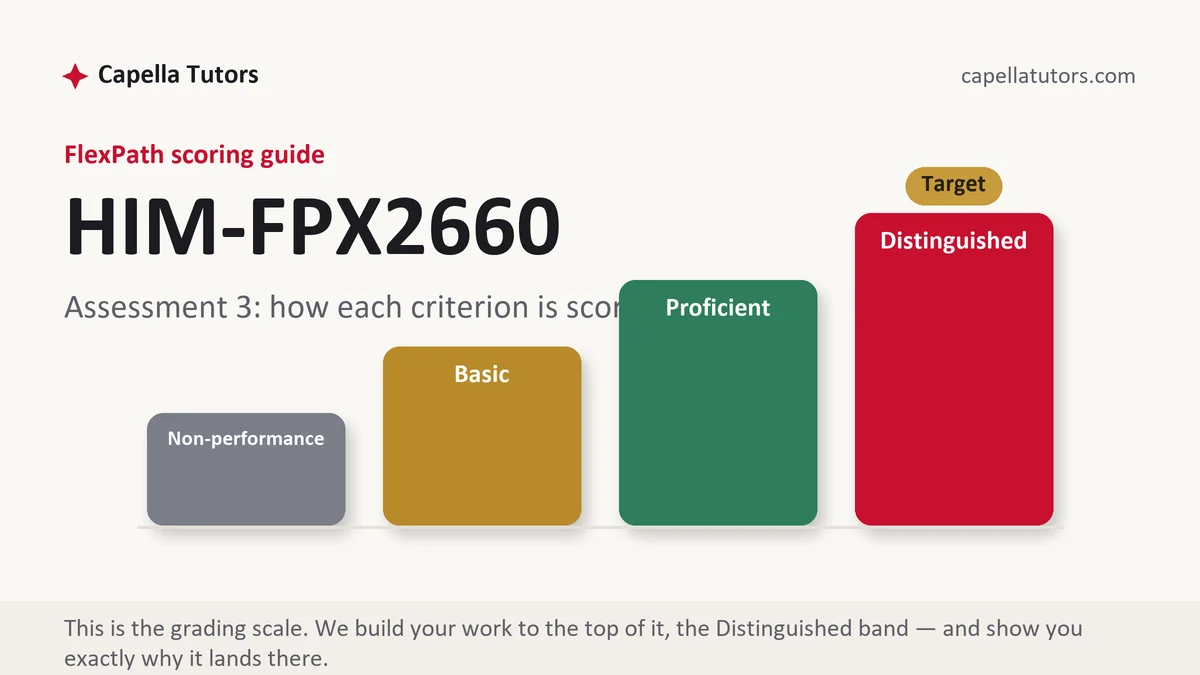
How HIM FPX 2660 Assessment 3 is scored
Four written levels, one judgment per criterion, and on a monitoring and corrective action deliverable the top level is earned by causes rather than by conclusions:
| Level | What it means on an audit and corrective action report |
|---|---|
| Distinguished | The finding is reported with its sample and its window, the cause is traced to something in the workflow rather than to a person's character, the response has parts with owners and dates, and the paper states what would count as the fix having failed. |
| Proficient | The finding is described accurately and a reasonable response follows, with the cause assumed rather than investigated. |
| Basic | A summary of the audit result and a general call for education, correct in every particular and impossible to manage. |
| Non-performance | A required component of the compliance program is never addressed, or the recommendation contradicts the organization's own written policy. |
The sample runs on an internal coding accuracy audit at a four-site primary care group. A quarterly review of 150 records shows that office visit levels have shifted upward since a new documentation template went live, with the template pre-populating history and examination detail the visit did not involve. Nobody set out to overstate anything, which is what makes it worth writing about: the compliance question is about a control and the ethics question is about who fixes it.
The HIM FPX 2660 Assessment 3 method, step by step
-
Turn the criteria into report sections first
An audit report drifts toward narrative unless the criteria hold it in place. Give each criterion a heading, and decide which one owns the recommendation.
-
Report the finding with its denominator and its window
How many records, drawn how, over what period, reviewed against what standard, and by whom. A rate offered without those four is a number nobody can compare to next quarter.
-
Separate the error from the intent
Documentation that does not support the level billed is a compliance problem whether or not anybody meant it, and the paper should say so in those words. Then treat intent as its own question with its own evidence, because the response to a template defect and the response to deliberate overstatement share almost nothing except the word audit.
-
Test the compliance program against its own parts
Federal guidance for health care organizations describes a compliance program as a named set of components: written standards, a compliance officer with real oversight, training that reaches the people who touch the data, open reporting lines including an anonymous route, auditing and monitoring that samples real records, published and consistently applied discipline, and prompt corrective action. Walk your scenario through the list and say which component failed, because that sentence is usually worth a criterion on its own.
-
Answer the ethical question the money creates
Claims already paid on unsupported documentation raise an obligation the legal analysis does not settle by itself, and the honest paper says what the organization owes: a look back across the affected period, a decision about repayment, and a record of how that decision was reached. Name the professional obligation you are relying on, and state plainly what choosing it costs the group in revenue and in time.
-
Write the corrective action with four parts, then self-score
A change to the template that created the exposure, a defined re-audit with a sample size and a date, education aimed at the specific behavior rather than at the topic, and a threshold that triggers escalation if the second sample looks like the first. Then mark yourself against each criterion, revise anything below the top level, and submit early in the week given the two business day evaluation window.
A structure that maps to the criteria
The lengths below are our tutors' planning targets for a report of this size rather than Capella rules, and your scoring guide decides both the sections and the format.
| Section | What it must do | Guide |
|---|---|---|
| Scope and method | Sample size, how records were selected, the review period, the standard applied, and who reviewed. | ~175 words |
| Findings | The result stated as a rate with its denominator, plus the pattern underneath it rather than a list of records. | ~275 words |
| Cause analysis | What in the workflow, the template or the training produced the pattern, with intent treated as a separate question. | ~275 words |
| Program evaluation | The compliance components tested against the scenario, naming which one failed and why. | ~250 words |
| Ethics and obligations | What the organization owes once claims are involved, the obligation named, and the cost of meeting it stated. | ~225 words |
| Corrective action and references | Control change, re-audit with a date, targeted education, escalation threshold, and current APA both ways. | ~275 words |
Annotated sample excerpt
A model excerpt from our team, showing a cause that has been investigated rather than guessed. Take the moves, then write yours from your own audit result.
Of the 150 records reviewed for the quarter, 31 carried a level that the documentation did not support, a rate of 20.7 percent against 6.4 percent in the same review one year earlier, and the 31 are not spread evenly: 26 of them were created in the template released in March.1 The template pre-populates a complete review of systems and a normal examination as defaults, so a clinician who changes nothing produces a note describing work that may not have happened, which means the defect is manufactured by the tool and merely signed by the user.2 Intent is a separate question and this review found no evidence of it: the affected notes cross eleven clinicians at all four sites, the pattern begins on the release date rather than at any individual's start date, and no one gains individually from the levels involved.3
- 1The rate arrives with its denominator, a comparison period and the distribution behind it. A number that can be checked is the price of entry for this criterion.
- 2Names the mechanism, not the culprit.
- 3Treats intent as its own question and answers it with three pieces of evidence, including the timing. Saying what the audit did not find is part of writing an honest report.
The full premium sample for your exact assessment, written fresh to your scoring guide and issue, is free to request. Study it, revise it into your own voice, and submit work you understand.
The five mistakes that cost Distinguished
- Education as the entire remedy. A control that depends only on people remembering is the control that fails first, and evaluators have read that recommendation many times.
- A rate with no sample. Twenty percent of what, chosen how, over which months, and against which standard, or the finding is an assertion.
- Blame standing in for cause. Naming a person closes the inquiry before the workflow that produced the pattern has been examined.
- Silence about the money. An audit that finds unsupported claims and never mentions what happens to the payments has avoided the part with consequences.
- Discipline invented for the case. Sanctions come from the organization's written and consistently applied policy, not from the writer's sense of proportion.
Pre-submission checklist
- Sample size, selection method, review window and standard all stated
- Findings reported as rates with a comparison point and the distribution behind them
- Cause traced to a workflow or a tool, with intent handled as a separate question
- Compliance program components tested one by one, with the failed component named
- The obligation created by paid claims addressed, with its cost stated
- Corrective action carrying a control change, a re-audit date and an escalation threshold, APA reconciled both ways
Audit result in hand and no plan around it?
Send the finding or the scenario, the guide, and anything your prompt says about the organization. Inside 24 to 48 hours you get the report with its sample stated, a cause traced to a control, the compliance components tested one at a time, and a corrective action plan with owners and dates. Revisions continue free until the criteria are met.