Hand over the scenario and the scoring guide, and a premium original document returns inside 24 to 48 hours built as the genre it claims to be, with the request in the opening sentence, headings a skimmer can read on their own, and an action line naming who does what by when. The catalog lists this one as ENG FPX 1250, Introduction to Technical and Business Writing, worth 3 points, general education delivered in FlexPath. Nobody is assigned it. Capella bachelor's students choose general education from a menu, collecting at least 22.5 points overall and at least 2 points from each of the four categories, Communication, Humanities, Natural Science and Mathematics, and Social Science, and this course is one of the Communication options. In Capella's catalog the course code is written ENG-FPX1250.
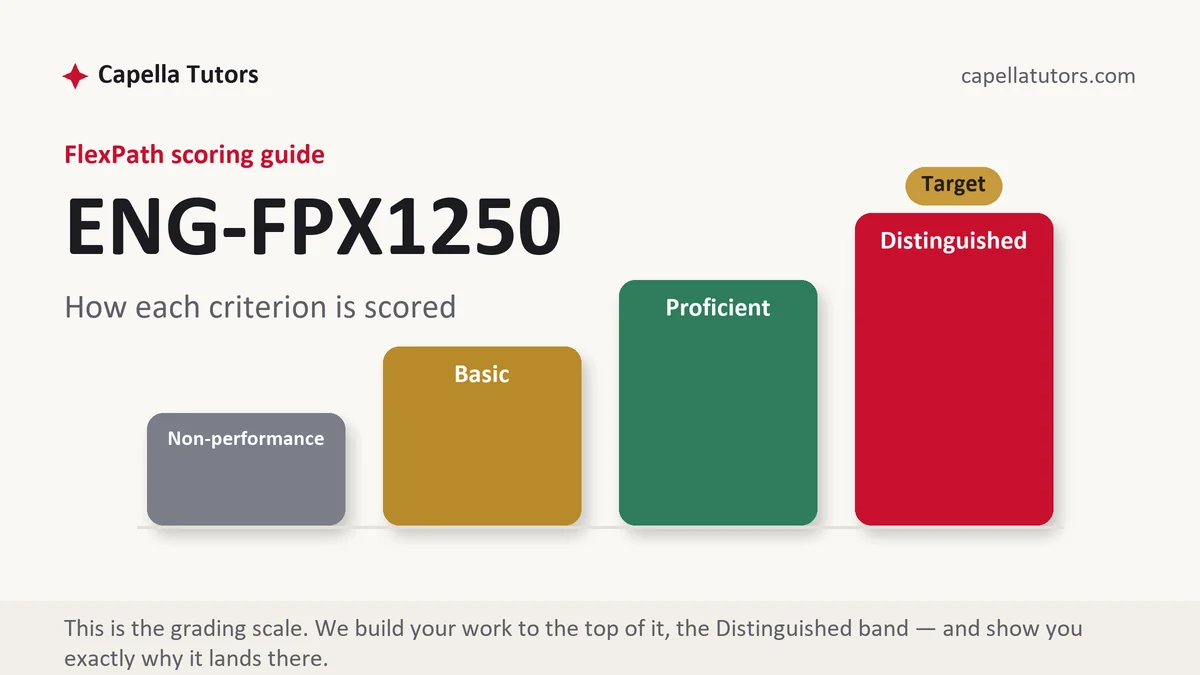
What ENG FPX 1250 actually grades
The move this course asks you to make is from writing that gets read to writing that gets used. An academic essay is read from the first word to the last by somebody whose job is to read it. A workplace document is scanned by somebody who did not want another document, on a phone, between two other things, looking for the part that concerns them. Every criterion in the course follows from that difference. Reader analysis, purpose, a structure that holds up under skimming, page design, and language plain enough to act on are the things being scored, and they are scored the same way whether the writer is heading into supply chain, a service desk, a clinic front office, a human resources team, or a software group.
Sequence is the first graded skill, and it is the opposite of what school teaches. Routine requests, approvals, and good news go in the direct pattern: the decision or the request occupies the first sentence, the supporting detail follows, and the closing states the next action. Refusals, and anything that has to change somebody's mind, go in the indirect pattern: an opening that is neutral rather than warm, then the reasoning, then the decision stated once and plainly, then a close that keeps the working relationship intact. Burying a request in the fourth paragraph is the single most reliable way to earn Basic on a memo, because the criterion for organization in this course is not asking whether the parts are present, it is asking whether they are in the order the reader needs them.
Design and honesty carry their own criteria, which surprises students who think formatting is decoration. Headings are graded on whether they name what the section settles rather than a topic, so Printer Replacement Cost tells a reader more than Discussion. Lists are graded on parallel form, meaning every item starts with the same part of speech and reads as a continuation of the stem above it. Tables get a number, a title, and a note saying where the data came from. Visuals are graded for truthfulness as much as clarity, so a bar chart whose vertical axis starts at forty rather than zero exaggerates a difference and a reader who notices stops trusting the rest. Accessibility belongs here too: real heading styles rather than bold text, alternative text on every image, and enough contrast to survive grayscale printing.
How we help in this course
Documents for this course get built as documents rather than as essays wearing headings. A short reader profile is written before the first sentence, naming who receives the file, what they already know, what they will do with it, and what they will push back on. The request goes in the opening line. Headings get drafted and then tested by reading only the headings from top to bottom, since that is how the file will actually be consumed. Lists are made parallel, tables are numbered and sourced, and every deliverable ends with a line that names a person, a verb, and a date. Tell us the scenario you were given, the reader you were assigned, and any constraint such as a budget figure or a deadline, and the document arrives shaped for that reader instead of for a generic office.
The commercial terms are the ones the whole studio runs on. A file passes through eight hands, and here the ones that show are the writer who builds the document, the reviewer who marks it against the guide row by row, and the editor who cuts sentence length back until the thing reads at speed, with research, an APA pass, and a proof alongside. You get it inside 24 to 48 hours, written to the Distinguished descriptor, with unlimited revisions until the guide is satisfied and no charge for handling evaluator feedback. That last part earns its keep in a flat-rate 12-week session where two courses can be open at once and each submitted attempt takes up to two business days to come back.
The assessments, one by one
Assessment 1
The first deliverable in Introduction to Technical and Business Writing usually asks for a document a reader will use rather than read, and instructions are the purest version of that. Read the full Assessment 1 manual.
Assessment 2
The middle deliverable in Introduction to Technical and Business Writing usually hands you data and a reader who has to act on it, then grades whether the document tells the truth quickly. Read the full Assessment 2 manual.
Assessment 3
The final deliverable in Introduction to Technical and Business Writing usually asks for the document that has to change somebody's mind: a recommendation with a real comparison behind it. Read the full Assessment 3 manual.
How to actually write ENG FPX 1250: where to begin
Read the scoring guide before you read the scenario, and notice what the criteria are named after. In composition they are named after parts of an essay. Here they tend to be named after the reader, using verbs like adapts, addresses, and conveys, which tells you the grader is judging the fit between the document and the person receiving it rather than the quality of the writing in the abstract. Turn each criterion into a heading, paste the Distinguished wording underneath, and add one line above it naming the reader that criterion is about. The assessments in this course usually ask you to produce a workplace genre for a named audience, though which genre, how long, and in what format are questions only your scoring guide answers.
Then write the opening sentence twice and keep the second one. Here is the buried version, which is what most first drafts look like: the shipping bay has been experiencing some challenges recently, and after reviewing the situation with the team over the past several weeks, a number of options have been considered. Four lines in, the reader still does not know what is being asked. The front-loaded version does the whole job at once, requesting $2,400 to replace the two label printers in the shipping bay before the holiday peak, with a decision needed by 14 November. Notice what the second version contains: the ask, the amount, the location, the reason for the timing, and the deadline for the answer. Everything after it is support, and a reader who stops there has still received the message.
Then handle instructions, which are graded on whether they work rather than on whether they read well. One action per numbered step. An imperative verb at the front of every step, so the reader is being told to do something instead of being told what happens. The condition before the action, because when the indicator turns amber, press reset warns the reader in time while press reset when the indicator turns amber arrives one beat late. Warnings sit above the step they protect. Screens and controls get named exactly as they are labeled on the device, capital letters and all, since a reader hunting for a button called Continue will not find one called Next. Then test the draft on somebody who has never done the task, watch without helping, and treat every pause as a defect in your writing.
Then cut, because concision is a scored criterion here and not a matter of taste. Three habits produce most of the fat. Nominalization turns a verb into a noun and then needs a weak verb to prop it up, so we performed an evaluation of the vendor becomes we evaluated the vendor. Empty openers announce that a sentence is coming, so it should be noted that the invoice was late becomes the invoice was late. And passive constructions hide the actor exactly where a workplace reader needs one, so the request was denied invites the question denied by whom. Read the finished document once with a single question in mind, which is whether a reader could act on it without replying to ask you something, and rewrite whatever forces that reply.
| Section | What goes in it | What Distinguished looks like |
|---|---|---|
| Reader and purpose | Who receives the document, what they know already, what decision they hold, and the constraint they work under. | A profile visible in the finished text, where word choice and detail level match the reader named. |
| Opening | The request, decision, or finding, stated in the first sentence for direct messages, or the neutral setup for a refusal. | An opening that delivers the message even if the reader stops reading immediately after it. |
| Body and headings | The reasoning, arranged under headings that name what each section settles. | Headings that read as a summary of the document when the paragraphs beneath them are hidden. |
| Visuals and data | Numbered tables and figures, each with a title, a source note, and a sentence saying what to see in it. | Axes that start at zero, comparable units, and a visual the surrounding prose actually interprets. |
| Action and close | What happens next, who owns it, by what date, and how to reach the writer. | A single unambiguous action line, with the date written out rather than implied by soon. |
| Sources and format | The genre conventions the document claims, plus citations in the style the guide names, matched both ways. | Format handled so consistently that a reader notices the message and never the mechanics. |
Developing the analysis
Recommendation documents are where this course stops being about format, and the failure mode is a report that describes two options then picks one for reasons that appear from nowhere. A recommendation is a claim somebody could argue against, which makes it the workplace version of a thesis, and it has to be defended the same way. Name the criteria before you compare anything, so the reader learns you are judging on cost, downtime during changeover, and support response before they see either option scored. Put the comparison in a table with the criteria down one side and the options across the top. Then say which option wins on which criterion, and where those conflict, say what you traded. The rejected option gets its real case rather than a caricature, because a reader who already prefers it stops reading the moment they see it misrepresented. Close by naming the assumption most likely to be wrong and what changes if it is.
Citations that survive faculty review
Workplace documents cite differently from essays, and this course grades whether you know the difference. Rank your sources by what each can prove. Regulators and government agencies establish what is required, so a safety rule or a state filing requirement comes from the body that issues it rather than from a summary. Standards organizations define terms and test methods, and naming a standard by its number and edition tells a reader which version you followed. Peer-reviewed research, reached through the Capella library, supports claims about effects. Trade publications carry market facts and vendor behavior, useful but not equivalent to research, and worth labeling as trade so a grader can see you know. Vendor material supplies specifications and never conclusions. Internal documents get cited by title, number, and revision date, since a policy without one might be the version somebody replaced last spring. Two mechanics finish the job. Data borrowed for a table needs a note under the table and a matching entry in the reference list, and an interview or internal conversation is cited in the text with a date but never appears in the list, because nobody else can retrieve it. Then read the text against the list and the list against the text, and fix whatever sits on only one side.
The mistakes that land Basic instead of Distinguished
- The ask arriving in paragraph four. A reader who stops early has received nothing, and the organization criterion is measuring exactly that risk.
- An essay with headings dropped in. Continuous prose broken by labels is still an essay, and the genre criterion notices.
- Lists that lose their parallel form. Items that switch between verbs, nouns, and full sentences make a skimmer reread the stem.
- A chart with no source and a cropped axis. The first is unverifiable and the second is misleading, and both are scored under ethics.
- A close with no owner and no date. Please let me know your thoughts is not an action, and it leaves the document with nothing to accomplish.
ENG FPX 1250 questions students actually ask
Is a memo really that different from an essay?
Different enough that the habits rewarded in a composition class will cost you marks here. An essay earns its conclusion, so the reader is expected to travel the whole argument before the payoff arrives. A memo is read by somebody deciding whether to keep reading, so the payoff arrives first and the reasoning supports it afterwards. The structural consequence is concrete. Your thesis becomes the subject line plus the opening sentence. Your topic sentences become headings a skimmer can read on their own. Your conclusion becomes an action line naming a person, a verb, and a date. Everything you learned about evidence still applies, and only the delivery order changes.
How do I write instructions somebody can actually follow?
Write one action per numbered step, start each step with an imperative verb, and put any condition in front of the action rather than behind it, so the reader knows whether the step applies before they perform it. Warnings go above the step they protect, never below it, because a caution read afterwards is an apology. Then test it, which is the part students skip and the part the criterion is really about. Hand the draft to somebody who has never done the task, watch them work, and say nothing. Every hesitation is a defect in your writing rather than in their attention. Count the steps they get wrong instead of asking whether it seemed clear, because people are polite and step counts are not.
Do workplace documents still need APA?
Your scoring guide decides the style, and in this course the answer is usually yes even though the deliverable looks like something an office would produce. Treat the two layers separately. The document layer follows the genre, so a memo keeps its heading block, a report keeps its front matter, and a set of instructions keeps its numbered steps. The citation layer follows the style your guide names, which means borrowed data carries a source note under the table and a matching entry in the reference list. One rule catches most learners out. An interview or an internal conversation is cited in the text with the person and the date and gets no reference entry at all, because a reader cannot retrieve it.
Memo, report, or instructions due?
Send the scenario, the reader you were assigned, and the criteria. Back comes a document that leads with the ask, survives skimming, and ends with somebody's name on a date. First premium sample free.