This manual is for ENG FPX 1250 Assessment 2, start to submission. The middle deliverable in Introduction to Technical and Business Writing usually hands you data and a reader who has to act on it, then grades whether the document tells the truth quickly. A finding in the first sentence, headings naming what each section settles, a numbered table with a source note, and a figure whose axis flatters nobody are what the criteria buy. Our tutors' method for a report like this is below, with a section order drawn from the rows and one annotated block. Rather we built it? A premium original report drafted against your own scoring guide comes back within 24 to 48 hours, with revisions free until it satisfies the rows. Capella's catalog lists the course as ENG-FPX1250, and some courserooms print ENG1250; both point to this same Assessment 2.
One honesty note before the manual: Capella revises courses and scoring guides over time, so always write to the exact scoring guide attached to your assessment in the courseroom. The course identity above is verified on capella.edu; the method and structure below are our tutors' approach to it, not Capella's official rubric text.
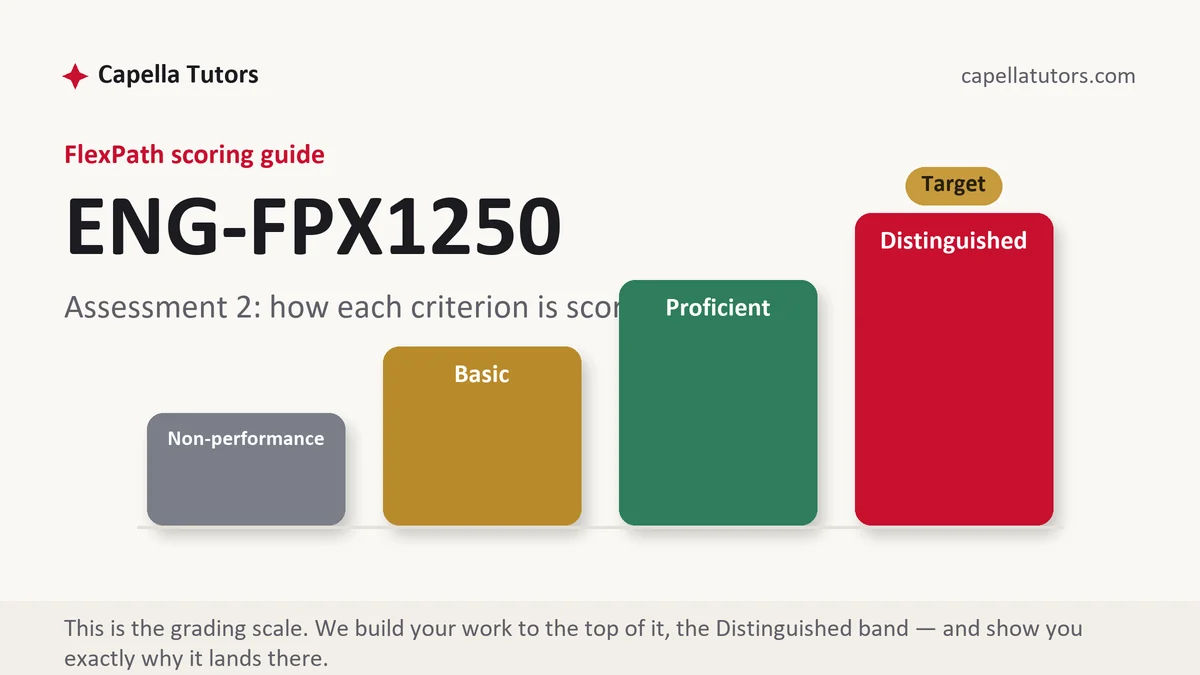
How ENG FPX 1250 Assessment 2 is scored
Nothing in FlexPath arrives as a letter grade. Every row is scored at one of four levels, and the description of the level you want is the brief:
| Level | What it means on a workplace report with data |
|---|---|
| Distinguished | The finding leads, headings summarize the document on their own, every table and figure carries a number, a title and a source, axes start at zero, and the prose says what to see in each visual and what it does not prove. The additional act sits in the row wording; locate it and do it. |
| Proficient | Accurate reporting, properly formatted visuals, and a structure a reader can follow. Competent, and one row short of the top. |
| Basic | An essay with headings dropped into it, or a chart the surrounding paragraphs never interpret. The most frequent landing place for a first attempt. |
| Non-performance | A required element is absent, most often the source note under borrowed data, or the summary a reader needs before anything else. |
The 3 points this course carries are general education points, so the reader of your report is a stranger to the site and to the project. Everything they will ever know about it has to be in the document, which is why the summary is not a courtesy but the part most likely to be read alone.
The ENG FPX 1250 Assessment 2 method, step by step
-
Turn the rows into headings, then name the decision the reader holds
Paste each criterion in as a heading with its Distinguished wording underneath, then write one line saying what the reader is supposed to do afterwards. Approve the next phase, release the remaining budget, or simply stop worrying are three different documents, and a report that has not decided which one it is will hedge in every section.
-
Put the finding in the first sentence and the detail behind it
Here is the buried opening most first drafts produce: work on the project has continued over recent weeks and several areas have now been addressed. Four lines in, nothing has been reported. The front-loaded version does the whole job at once, naming the percentage complete, the position against schedule, and the money still uncommitted. A reader who stops there has the report.
-
Build the table before you write about it
Put the numbers into a numbered, titled table with a note saying where they came from, then write the prose around it. That order stops you describing figures you do not have, and stops the table repeating sentences the reader has already met. A table and a paragraph should never carry the same content twice.
-
Draw the figure so it cannot flatter anybody
Start the vertical axis at zero, keep units comparable, label both axes, and give the figure a number and a caption. A bar chart whose axis begins at forty makes a small difference look like a collapse, and a reader who notices stops trusting the rest of the document. Then write the sentence saying what to see in it, because a visual nobody interprets is decoration.
-
Read only the headings, top to bottom
Hide the paragraphs and read the headings alone. If they read as a summary of the report, the organization row is satisfied. If they read as Discussion and Analysis, they are labels rather than headings, and Stairwell Fixtures Behind Schedule tells a reader more than either. Use real heading styles rather than bold text, since accessibility is graded here too.
-
Cut, check the mechanics, then score yourself
Three habits produce most of the fat: nouns doing the work of verbs, empty openers announcing that a sentence is coming, and passive constructions hiding whoever acted. Fix those, add alternative text to every image, confirm the document survives grayscale printing, then mark each row N, B, P or D yourself and submit early in the week.
A structure that maps to the criteria
Read the last column as planning targets our tutors use on an undergraduate report of this kind, not as Capella instructions; the scoring guide always wins.
| Section | What it must do | Guide |
|---|---|---|
| Summary | The finding, the position against plan, the money position, and what the reader has to decide, in one short block. | ~120 words |
| Purpose and scope | What the project is, what period this report covers, and what is deliberately outside it. | ~150 words |
| Work completed | What has been done, with counts and dates, arranged under headings that name outcomes rather than topics. | ~300 words |
| Data, tables and figures | Numbered visuals with titles and source notes, each interpreted by a sentence saying what to see and what it does not prove. | ~250 words |
| Issues and risks | What has slipped, why, what it costs, and the assumption most likely to be wrong. | ~200 words |
| Action, close and sources | Who does what by which date, how to reach you, and citations in the style your guide names. | ~150 words |
Annotated sample excerpt
A model summary block written by our team, at the register the Distinguished column describes. Take the ordering, then fill it with the figures your own scenario supplies.
The lighting retrofit is 68 percent complete, three weeks behind the schedule approved in March, and still inside budget with $9,400 of the $61,000 authorization uncommitted.1 The delay sits entirely in the two stairwells, where the fixtures shipped in the wrong voltage and were returned; every occupied floor is finished and metered.2 No decision is needed on funding. One decision is needed on access: please confirm by Friday 8 May whether the contractor may work the stairwells between 6 a.m. and 8 a.m., which recovers two of the three weeks.3
- 1Completion, schedule and money arrive in a single sentence with figures attached, so a reader who reads nothing else still knows the state of the project.
- 2The bad news is bounded rather than softened. Naming where the delay is not tells the reader more than an apology would.
- 3The close separates what needs no decision from the one that does, and the request carries a person, an action and a written-out date.
The full premium sample for your exact assessment, written fresh to your scoring guide and issue, is free to request. Study it, revise it into your own voice, and submit work you understand.
The five mistakes that cost Distinguished
- The finding arriving in paragraph four. A reader who scans the first screen and learns nothing files the document as information and moves on.
- An essay with headings pasted in. Continuous prose interrupted by labels is still an essay, and the genre row is written to notice.
- A cropped axis. A vertical scale starting above zero exaggerates a difference, and that is scored under ethics rather than under design.
- Borrowed data with no source note. A table nobody can trace back is unverifiable, whatever the number happens to say.
- Please let me know your thoughts. A close with no owner and no date leaves the document with nothing to accomplish.
Pre-submission checklist
- The finding, the schedule position and the money position appear in the first block
- Headings read as a summary of the report when the paragraphs are hidden
- Every table and figure numbered, titled, sourced, and interpreted in the prose
- Axes start at zero and units are comparable across visuals
- One action line naming a person, an action and a written-out date
- Real heading styles, alternative text on images, citations matched both ways, self-scored D
Report due with numbers you have not shaped yet?
Send the scenario, the data you were given and the criteria. A team of eight, including a research analyst and two QA reviewers, returns a premium original report in 24 to 48 hours with the finding on top, honest visuals, and revisions free until the guide is satisfied.