This manual is for ENG FPX 1250 Assessment 3, start to submission. The final deliverable in Introduction to Technical and Business Writing usually asks for the document that has to change somebody's mind: a recommendation with a real comparison behind it. Criteria named before either option is scored, a table a reader can check, the rejected option given its best case, and an admitted trade-off are what the top row buys. What our tutors do with a document like this is set out below, section order included, with one excerpt marked up. Prefer to hand the whole thing over? A premium original report written to your own criteria lands inside 24 to 48 hours, and revisions run free until the guide is met. Capella's catalog lists the course as ENG-FPX1250, and some courserooms print ENG1250; both point to this same Assessment 3.
One honesty note before the manual: Capella revises courses and scoring guides over time, so always write to the exact scoring guide attached to your assessment in the courseroom. The course identity above is verified on capella.edu; the method and structure below are our tutors' approach to it, not Capella's official rubric text.
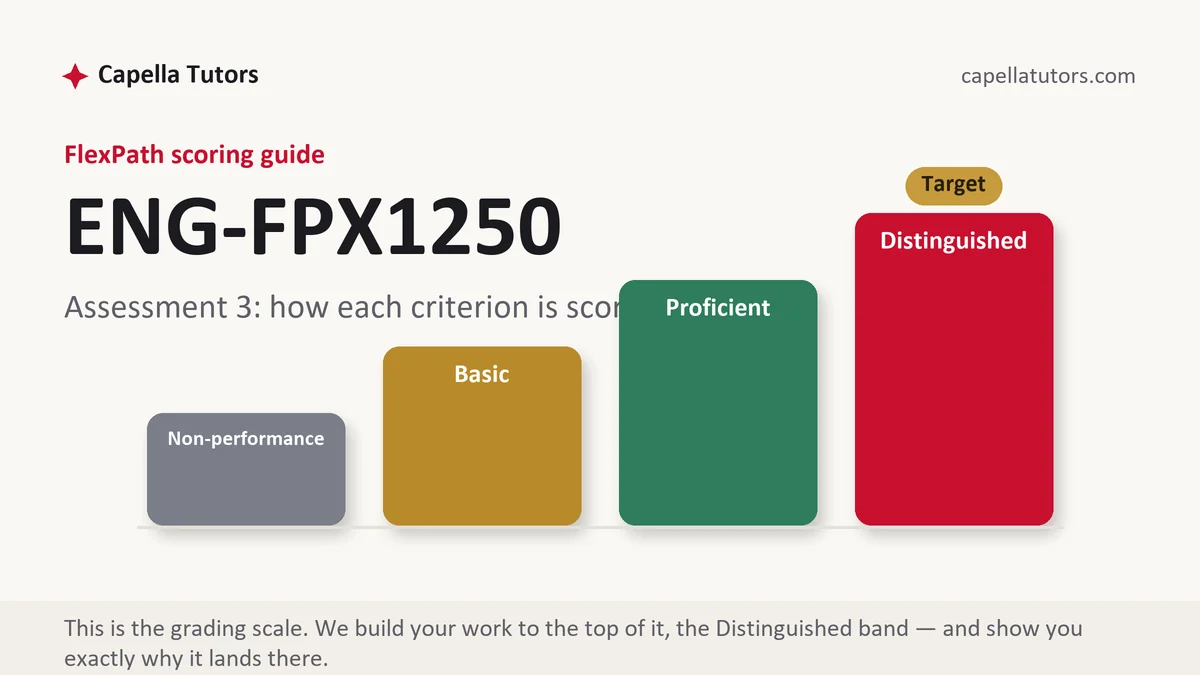
How ENG FPX 1250 Assessment 3 is scored
Each row of the scoring guide is marked on its own at one of four levels, with no letter grade anywhere in the process, and the level language is your specification:
| Level | What it means on a recommendation report |
|---|---|
| Distinguished | Comparison criteria are named and weighted before either option is judged, the matrix is complete, the recommendation follows from the table, the rejected option appears in the form its supporters would recognize, and the trade-off and the shakiest assumption are both stated. Read the top column word by word, because the move it asks for beyond Proficient is stated there and nowhere else. |
| Proficient | Two options compared accurately and a defensible recommendation reached. Solid work, one move below the top row. |
| Basic | Two options described in turn, then a preference announced for reasons that appear from nowhere. The classic shape of a first attempt at this document. |
| Non-performance | A required element is absent, most often the criteria themselves, or the cost analysis behind the recommendation. |
General education courses in the Communication category are taken by students heading into supply chain, service desks, clinic front offices, human resources and software teams at once, so this report is graded on transferable behavior rather than industry knowledge. Naming your criteria before you compare anything is the most transferable behavior in the course.
The ENG FPX 1250 Assessment 3 method, step by step
-
Name the criteria before you look at either option
Write the grounds first: total cost across the contract term, downtime during a changeover, response time on a call, and whether the vendor holds parts locally. A reader who learns the grounds before they see the scores can check your reasoning. A reader who meets the grounds after the recommendation has simply been told what to think.
-
Weight the criteria and say why
Not every ground matters equally, and pretending otherwise is where recommendation reports go soft. If a property runs one airport shuttle every twenty minutes, downtime outranks a small difference in annual price, and one sentence saying so does more work than a page of comparison. State the weighting in the prose, not only in a column.
-
Build the matrix and leave no empty cells
Criteria down one side, options across the top, every cell filled with a figure or a plain statement rather than a tick. Where a number is unavailable, write unavailable and say what you asked for, because an admitted gap is evidence of a real comparison while a blank cell reads as a comparison that never happened.
-
Give the option you reject its best case
State the strongest version of the argument for the contract you are turning down, in the terms its supporters would use. A reader who already prefers that option stops reading the moment they see it caricatured, and the persuasion row is scored on whether the document could move somebody who disagrees with you.
-
Write the recommendation as a decision, with its cost
One sentence naming the option, the term, the price and the date a signature is needed. Then the sentence most drafts leave out: what this choice gives up. Recommending the vendor with faster response at a higher annual price gives up eleven hundred dollars a year, and admitting it is what makes the rest of the report credible.
-
Name the assumption most likely to be wrong, then score yourself
Close on the thing that would change the recommendation if it turned out to be false, such as the shuttle staying on its current route. Then read the document as its reader would, from the summary down, timing how long it takes to find the ask, mark each row yourself, and submit early in the week.
A structure that maps to the criteria
Word targets in the last column are the ones our tutors plan against for an undergraduate recommendation report; treat them as guidance and let your scoring guide overrule them.
| Section | What it must do | Guide |
|---|---|---|
| Summary and recommendation | The recommendation, the price, the term, and the date a decision is needed, stated before any comparison. | ~130 words |
| Problem and constraints | What is failing now, what it costs, and the budget, schedule or policy limits the decision has to respect. | ~180 words |
| Criteria and weighting | The grounds for comparison, defined so a reader could apply them, with the reason one outranks another. | ~200 words |
| The comparison | A numbered matrix with every cell filled, plus prose that reads the table rather than repeating it. | ~300 words |
| The rejected option and the trade-off | The strongest case for what you turned down, your answer to it, and what your recommendation gives up. | ~250 words |
| Implementation, sources and close | The first three steps, who owns them, when, and citations in the style your guide names. | ~150 words |
Annotated sample excerpt
A model paragraph from our team, taken from the section that decides most of the grade. Learn the ordering, then apply it to the options your own scenario gives you.
Both maintenance contracts are judged here on four grounds, in this order: vehicle downtime per service event, response time on a roadside call, total cost across a 24 month term, and whether the vendor stocks brake and transmission parts within fifty miles.1 Downtime and response outrank price because the property runs a single airport shuttle on a twenty minute cycle, and one van out of service for a day costs 34 missed pickups and the two taxi vouchers per pickup the front desk currently issues.2 Table 1 scores both vendors against all four grounds; where a vendor declined to state a figure the cell reads unavailable, and the question put to them appears in the note.3
- 1The grounds are named, ordered and defined before either vendor is mentioned, which lets a reader dispute the criteria rather than only the conclusion.
- 2The weighting is argued with a number a reader could check, so the ranking is a finding rather than a preference.
- 3The table is introduced by number and its gaps are declared, which turns missing data from a weakness into evidence that the comparison was genuinely attempted.
The full premium sample for your exact assessment, written fresh to your scoring guide and issue, is free to request. Study it, revise it into your own voice, and submit work you understand.
The five mistakes that cost Distinguished
- A preference announced after two descriptions. Options described in turn and then chosen for unstated reasons leaves the analysis row with nothing to score.
- Ticks instead of figures. A matrix of check marks tells a reader that a comparison happened without telling them what it found.
- The rejected option in caricature. A weak version of the alternative is easy to beat and persuades nobody who holds it.
- A recommendation with no cost admitted. Every real choice gives something up, and a report that gives up nothing reads as advertising.
- Cost quoted for one year on a multi-year contract. A price with no term attached is not comparable, and it is the arithmetic evaluators check first.
Pre-submission checklist
- Criteria named, defined and weighted before either option is scored
- Every cell in the comparison filled with a figure or a stated gap
- The rejected option presented in the form its supporters would use
- The recommendation names option, term, price and the date a decision is needed
- The trade-off and the assumption most likely to be wrong both appear in writing
- Genre conventions held, citations matched both ways, self-scored D on every row
Recommendation report due and both options look the same?
Send the scenario, the two options and the criteria you were given. A team of eight, including a research analyst and two QA reviewers, returns a premium original report in 24 to 48 hours with weighted grounds, a complete matrix and a trade-off stated openly, revised free until the guide clears.