This manual is for ENG FPX 1250 Assessment 1, start to submission. The first deliverable in Introduction to Technical and Business Writing usually asks for a document a reader will use rather than read, and instructions are the purest version of that. Steps that work when somebody follows them, warnings placed where they still help, and controls named exactly as the equipment labels them are what the criteria buy. Our tutors' method for this document comes next, with the section order the rows imply and a short annotated excerpt. Would you sooner hand it off? A premium original document written to your own criteria arrives inside 24 to 48 hours, revised at no cost until the rows clear. Capella's catalog lists the course as ENG-FPX1250, and some courserooms print ENG1250; both point to this same Assessment 1.
One honesty note before the manual: Capella revises courses and scoring guides over time, so always write to the exact scoring guide attached to your assessment in the courseroom. The course identity above is verified on capella.edu; the method and structure below are our tutors' approach to it, not Capella's official rubric text.
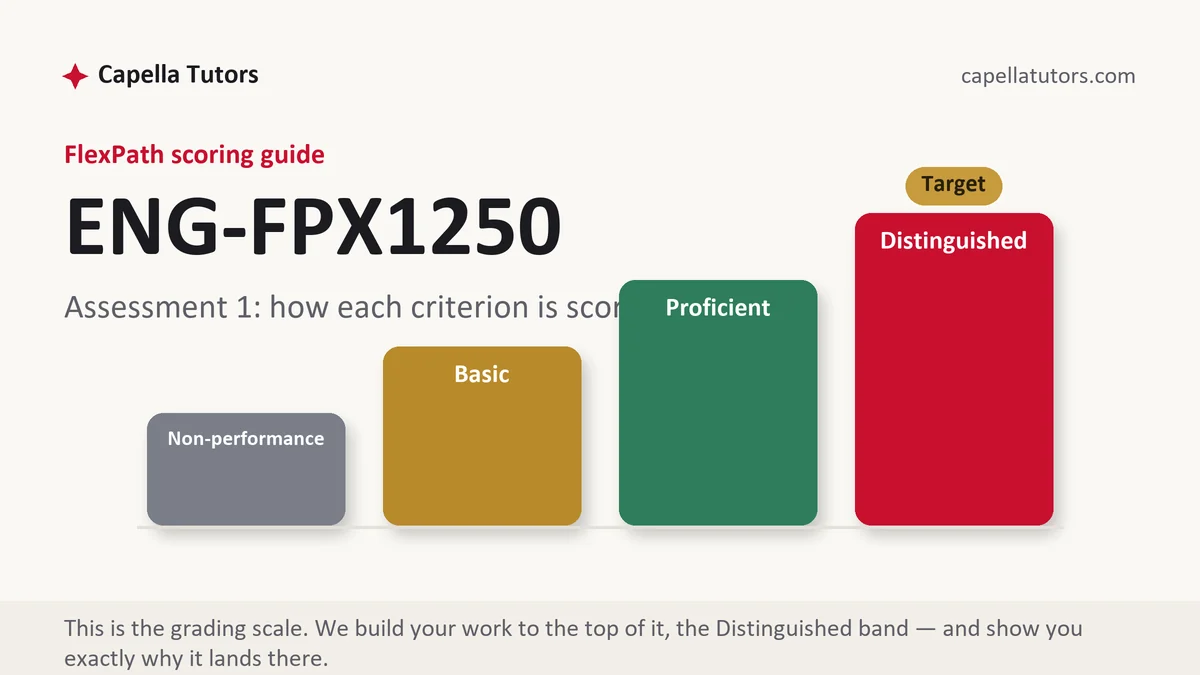
How ENG FPX 1250 Assessment 1 is scored
FlexPath issues no letter grades. Each criterion on your scoring guide is marked at one of four levels, and the level wording is the specification you are writing to:
| Level | What it means on a set of instructions |
|---|---|
| Distinguished | Every step is one action opening with an imperative verb, conditions arrive before the actions they govern, warnings sit above the steps they protect, controls are named as the equipment labels them, and the document shows evidence of having been tested on somebody. The one additional move is described in the column itself, so read it closely and then carry it out. |
| Proficient | Accurate, complete, correctly sequenced steps a competent reader could follow. Good work, one move below the row above. |
| Basic | A description of the procedure written in paragraphs, or numbered steps carrying two and three actions each. The usual outcome when an essay writer is asked for instructions. |
| Non-performance | A required element is absent, most often the safety information or the list of materials. Missing rather than thin is what puts a row on the floor. |
This is a 3-point general education course in the Communication category, which means the evaluator reading your instructions has never performed the task. That is not a handicap, it is the test: a document that only works for somebody who already knows the procedure has not done anything.
The ENG FPX 1250 Assessment 1 method, step by step
-
Turn the guide into headings and read its verbs
Criteria here tend to be named after the reader, with verbs such as adapts, addresses and conveys, which tells you the row is judging the fit between your document and the person holding it. Paste each row in as a heading, put the Distinguished wording underneath, and add one line naming the reader that row is about.
-
Write the reader profile before the first step
Four lines: who performs this task, what they already know, what tools they have within reach, and what they will get wrong. A student worker on their second shift needs the location of the key and the name printed on the guard; a technician needs neither. Every word choice in the document follows from those four lines.
-
Do the task yourself, slowly, writing as you go
Perform the procedure once with a notepad open and record every decision point, including the ones that feel obvious. The guard has to come off before the lock disengages, and a writer working from memory reliably puts those two in the wrong order. Instructions written from recollection fail at the same three places every time.
-
One action per step, verb first, condition in front
Number the steps and let each hold a single action. Start with the imperative: remove, align, tighten. Put the condition ahead of the action, because when the amber light clears, turn the key warns a reader in time and turn the key when the amber light clears arrives one beat late. Warnings go above the step they protect, never underneath it.
-
Name every part and control exactly as it is labeled
A reader hunting for a lever called release will not find one stamped UNLOCK. Copy the labels off the equipment, capital letters included, and give the parts a list of their own at the top alongside the materials and tools. Where a part carries no label, describe it by position rather than by color, since color survives neither grayscale printing nor a badly lit room.
-
Test it on somebody, then score yourself
Hand the draft to a person who has never done the task, watch, and say nothing. Every hesitation is a defect in your writing rather than in their attention. Count the steps they get wrong instead of asking whether it seemed clear, revise those steps, then mark each criterion N, B, P or D yourself and submit early in the week.
A structure that maps to the criteria
The word targets below are our tutors' planning numbers for a short undergraduate procedure, not Capella rules; a row your own guide asks more of should grow.
| Section | What it must do | Guide |
|---|---|---|
| Title and purpose | What the procedure is, who it is for, and what will be true once it is finished. | ~80 words |
| Reader and scope | The person performing the task, their assumed knowledge, and what this document deliberately does not cover. | ~120 words |
| Safety and materials | Hazards stated before anything begins, plus the tools, parts and permissions the reader needs in hand. | ~150 words |
| The numbered steps | One action per step, imperative verbs, conditions ahead of actions, warnings above the steps they guard. | ~450 words |
| Verification and troubleshooting | How the reader confirms the task worked, and what to do about the two or three things that commonly go wrong. | ~250 words |
| Format, sources and close | The genre conventions the document claims, citations in the style your guide names, and who to contact. | ~150 words |
Annotated sample excerpt
An original model from our team, showing the sequence the top of the guide describes. Use it as study material: take the pattern, then write the procedure your own scenario hands you.
Warning: the trimmer blade stays sharp on all four edges after removal. Wear the cut-resistant gloves stored in the drawer marked TRIMMER before beginning step 1.1 Step 1, turn the key on the front panel to OFF and remove it from the lock.2 Step 2, once the red panel light has gone out, lift the clear blade guard straight up and set it on the bench.3 Step 3, loosen the two hex bolts on the blade carrier one full turn each, working left to right.
- 1The hazard and the protection both arrive before step 1 rather than beside the step that cuts, and the gloves are located rather than merely required.
- 2One action, an imperative verb at the front, and the control named as the machine labels it. A reader can perform this step without interpreting it.
- 3The condition sits ahead of the action, so a reader knows whether the step applies before they reach into the machine.
The full premium sample for your exact assessment, written fresh to your scoring guide and issue, is free to request. Study it, revise it into your own voice, and submit work you understand.
The five mistakes that cost Distinguished
- Two actions in one step. Remove the guard and loosen the bolts is two steps, and a reader interrupted between them loses their place.
- The warning printed under the step it protects. A caution read afterwards is an apology, and this is the one sequencing error scored under both usability and ethics.
- Describing instead of directing. The guard is then lifted tells a reader what happens; lift the guard tells them what to do, and only the second is a step.
- Invented names for real controls. A part called the release in your document and UNLOCK on the machine sends the reader looking for something that does not exist.
- Never tested on a stranger. A procedure that works only for the person who wrote it has not been drafted for a reader, and the usability row exists to catch exactly that.
Pre-submission checklist
- Every step holds one action and begins with an imperative verb
- Conditions appear before the actions they govern, warnings above the steps they protect
- Parts, tools and controls named exactly as the equipment labels them
- Materials, permissions and hazards listed before step 1
- Somebody who had never done the task completed it from the draft, and their errors were fixed
- Genre conventions held, citations matched both ways, self-scored D on every row
Instructions due and the steps will not sit still?
Send the scenario, the reader you were assigned and the criteria. A team of eight, including a research analyst and two QA reviewers, returns a premium original document built to the Distinguished column in 24 to 48 hours, checked for sequence and revised free until the guide clears.