Send us the essay prompt together with its scoring guide, and a premium original draft comes back inside 24 to 48 hours with a thesis somebody could argue against, paragraphs that carry one claim each, and every borrowed idea attributed where it sits. Your enrollment records this one as ENG FPX 1000, English Composition, worth 3 points, a general education course taught in FlexPath. General education at Capella is assembled rather than handed to you: a bachelor's student builds at least 22.5 points of it and takes a minimum of 2 points from each of Communication, Humanities, Natural Science and Mathematics, and Social Science, and this course is one of the options inside the Communication category. In Capella's catalog the course code is written ENG-FPX1000.
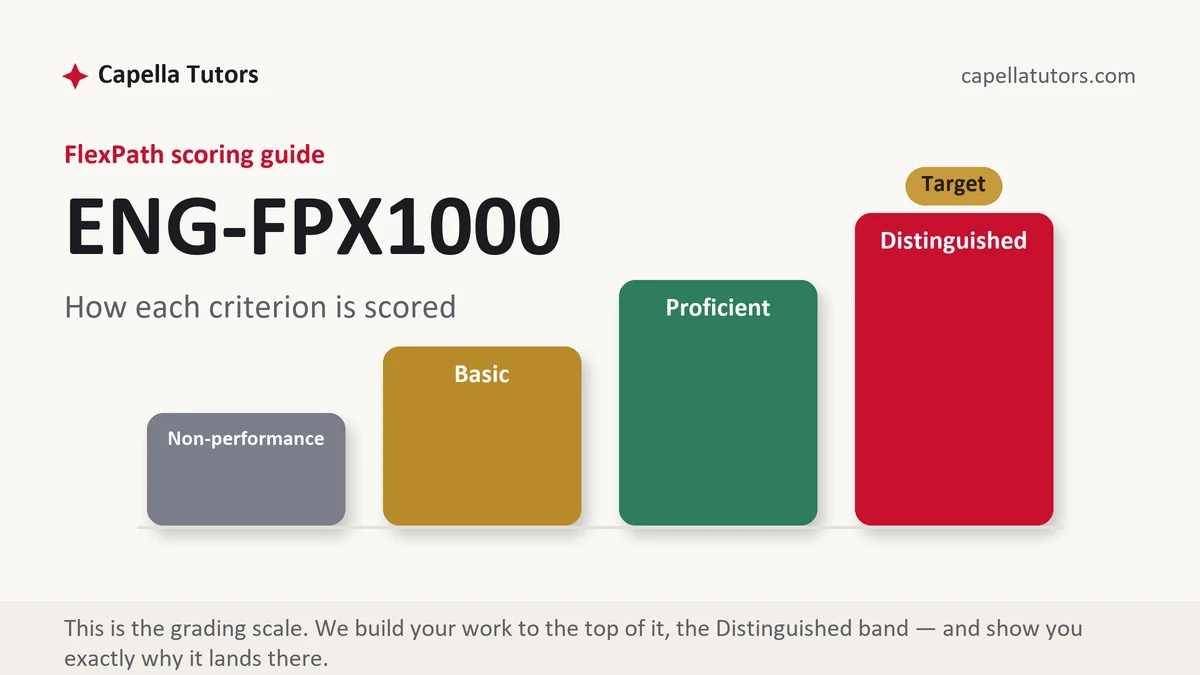
What ENG FPX 1000 actually grades
Composition is the course where writing stops being the delivery method and becomes the thing under examination. The criteria have very little interest in whether your topic is interesting. They ask whether a reader can find your claim, follow the order you put your reasons in, see where every piece of evidence came from, and reach the last page without rereading a sentence to work out who did what to whom. That is why the same guide fits an essay about warehouse scheduling and an essay about childhood sleep, and why students heading for business, information technology, health care administration, psychology, and computing all get marked on the same handful of behaviors.
The first behavior is the thesis, and it is where most Basic marks are earned before the writer notices. A sentence that announces a subject is a label, not a thesis. Put two openers on the same material side by side. The first says the essay will discuss the effects of remote work on employees, which commits to nothing, so no paragraph in the body can be wrong and none can be persuasive either. The second says employers who moved staff home should fund home office equipment, because the costs they quietly transferred are now surfacing as turnover. That version takes a position, names the reason it will defend, and predicts the shape of everything after it. A grader who reads it already knows what the body has to prove, and that gap is the whole thesis criterion.
The second behavior is paragraph shape, which the organization criterion measures whether or not it uses that word. A paragraph here does four things in a fixed order. It states its own claim in the first sentence, presents the evidence, explains what the evidence means, then hands the reader forward. The test takes ninety seconds. Cover everything except the opening sentence of each paragraph and read down the page. If that sequence reads as an outline of your argument, the organization criterion is satisfied. If it reads as a list of topics, or worse as a list of authors, the essay is describing rather than arguing, and describing is what the Basic column is for.
Two quieter criteria settle the rest. Source use asks whether a reader can tell your sentences from the sources' sentences without squinting, which is a question about attribution rather than about honesty. The communication criterion covers grammar, mechanics, spelling, and register, and three faults account for most of the comments here: comma splices joining two complete sentences, agreement lost across a long subject, and a drift into second person that turns an argument into advice. None are hard to fix once somebody names them, which is why they cost so many points when nobody does.
How we help in this course
Essays for this course get written in the order the criteria are read. The thesis is drafted first and sits at the top of the working file until the last paragraph is done, so nothing can wander away from it. Every paragraph is tagged with the criterion it serves before any prose goes in. Quotations stay short and never end a paragraph, because the sentence after a quotation is where the interpretation criterion is won. The reference list is built as the draft grows rather than reconstructed afterwards. Send the topic options you were given, any readings your instructor named, and the guide itself, and the draft returns with a thesis you can read aloud in one breath.
Terms here are the studio's usual ones. A file moves through eight people in sequence, and on a composition essay the heaviest lifting falls to the subject writer who builds the argument and the editor who reads only for sentences, with research, a scoring-guide review, an APA and originality pass, and a final proof around them. Delivery lands inside 24 to 48 hours, aimed at the Distinguished column instead of a pass, with revisions included until the guide is satisfied and faculty comments handled free in the same cycle. FlexPath bills a flat rate across a 12-week session with up to two courses open at once, and an evaluator has two business days to assess a submitted attempt, so a rewrite done before you submit costs one evening while the same rewrite after a return costs a place in the queue.
The assessments, one by one
Assessment 1
The first graded piece in English Composition usually asks you to take somebody else's published argument apart and show how it works: what it claims, what it offers as support, where it leans on the reader, and where it goes quiet. Read the full Assessment 1 manual.
Assessment 2
The middle deliverable in English Composition usually asks for the essay the course exists to teach: a thesis somebody could argue against, paragraphs that each hold one claim, sources placed inside your own sentences, and an objection answered rather than dismissed. Read the full Assessment 2 manual.
Assessment 3
The last deliverable in English Composition usually asks for the harder version of the same skill: an essay built out of sources that do not agree with each other. Read the full Assessment 3 manual.
How to actually write ENG FPX 1000: where to begin
Open the scoring guide and turn it into an empty document before you write a sentence of prose. Each criterion becomes a heading, the Distinguished wording gets pasted underneath it, and the essay is drafted into that skeleton. Composition guides are unusually literal, which works in your favor. When a column asks for a thesis that is clear, arguable, and specific, those three adjectives are three separate tests you can check one at a time. When a column asks for integrated evidence, the word integrated is doing real work and it does not mean present. The assessments in this course usually ask for continuous prose built around one position, but the deliverable and its length are whatever your scoring guide says.
Then narrow the topic until the claim can actually be defended in the space you have. Start with something a whole book covers, such as student debt. Cut it to one population, such as adults returning for a bachelor's degree after thirty. Cut it again to a single decision that population faces, such as whether paying out of pocket for a prior learning assessment is worth it when the credit may not transfer. Now the thesis has a subject small enough to prove, and the claim goes at the end of the introduction where a grader looks for it.
Then practise the one move the rest of the degree assumes you can already make, which is putting a source inside your own sentence rather than parking it beside one. The dropped version reads like this: adult learners face different barriers, then a full stop, then a citation in brackets. The reader is handed a fact and left to work out its job. The integrated version names the source in the sentence and does something with what it found, so that Reyes (2023) found withdrawals in accelerated programs clustering in the first eight weeks, which puts the risk squarely in the window when a returning student is still arranging childcare. The citation is now load-bearing, because removing it breaks the sentence. Keep the mechanics straight while you are there: a narrative citation puts the author in the sentence and the year in brackets after the name, a parenthetical citation puts both at the end before the full stop, and a direct quotation carries a page or paragraph number while a paraphrase does not have to.
Then revise before you proofread, because they are different jobs and doing them in the wrong order wastes the evening. Revision moves, cuts, and merges. Proofreading fixes commas. The tool that makes revision quick is the reverse outline: beside each paragraph write its claim in five words. Two paragraphs carrying the same five words get merged. A paragraph you cannot label in five words is doing two jobs. A paragraph whose five words have nothing to do with the thesis belongs in a different essay. Only when the margin reads as an argument do you start reading for sentences, and read that pass aloud, since the ear catches a comma splice the eye has already forgiven three times.
| Section | What goes in it | What Distinguished looks like |
|---|---|---|
| Title page and format | The student title page elements, running page numbers, double spaced body text, and whatever heading levels the prompt asks for. | Formatting nobody notices, because nothing in it makes the grader stop and work out what happened. |
| Introduction | The few sentences of context a reader needs, the narrowing move, and the thesis as the final sentence. | An opening that could introduce this essay and no other, ending on a claim specific enough to predict the body. |
| Body paragraphs | One claim per paragraph, cited evidence, an interpretation of that evidence, and a link forward. | First sentences that read as an outline of the argument when everything else on the page is covered. |
| Evidence and integration | Quotation, paraphrase, and summary used deliberately, each attached to the sentence it supports. | Sources named inside sentences that make an argument, with the writer's judgment on every one. |
| Counterargument | The strongest objection to the thesis, stated fairly, then answered rather than dismissed. | The objection given its best version, and a concession that narrows the claim instead of abandoning it. |
| Conclusion and references | What follows from the argument, and a reference list in current APA on its own page. | A close that states a consequence rather than restating the opening, with citations and entries matched both ways. |
Developing the synthesis
Two sources that agree with each other teach a reader almost nothing, so find a disagreement and stand inside it. Say one survey reports that most employees prefer a hybrid schedule while a second study reports that promotion rates fall for the people who take one. The Basic version of that paragraph states both findings in consecutive sentences and moves on, leaving the reader to do the thinking. The Distinguished version puts them in a single sentence joined by a word that does work, notices that preference and consequence are pulling in opposite directions, then says which one the recommendation follows and why. Synthesis is a sentence-level habit rather than a section bolted on at the end. Two smaller habits travel with it. Two works inside one set of brackets go in alphabetical order separated by a semicolon, not in the order you happened to read them. And when sources genuinely cannot be reconciled, say so plainly, because naming a limit is one of the extras the top column asks for most often.
Citations that survive faculty review
This is the course where the two-way match is first graded, and it is the cheapest criterion on the page to win. Start with sources that hold up. Peer-reviewed articles reached through the Capella library carry any claim about what research has found. Government statistical agencies that publish their methods, the Bureau of Labor Statistics and the Census Bureau among them, carry numbers about work, population, and cost. Established news organizations carry events and dates but not causes. Anything a source describes at second hand gets read in the original before you cite it, because a paraphrase of a paraphrase drifts. What will not survive review is an unsigned web page, a content site with no author and no date, a dictionary definition used to open the essay, or text produced by a generative model and cited as though it were a study. Then run the match itself, in both directions and on paper if you can. Read the essay through and tick every entry on the reference list as you meet it. Then read the list from the top and find each entry back in the essay. An unticked line is either a source you cut and forgot to remove or a citation that never made it in, and both are ordinary revision requests costing two business days each.
The mistakes that land Basic instead of Distinguished
- A thesis that announces instead of claiming. If nobody could disagree with the sentence, the criterion has nothing to reward.
- Paragraphs that open with a source. A paragraph beginning with a name and a year has handed its topic sentence to somebody else.
- Quotations left to speak for themselves. Evidence that goes uninterpreted reads as filler however apt it was.
- Calling proofreading revision. Fixing the punctuation of a paragraph that should not be there makes the problem tidier and no smaller.
- A reference list built the night before. Citations reconstructed from memory are where the two-way match breaks.
ENG FPX 1000 questions students actually ask
How do I know whether my thesis is arguable?
Write the opposite of it. If the opposite sentence is something no sane person would defend, you have written a fact and called it a thesis, and the essay has nothing to prove. If the opposite is a position somebody could hold with reasons of their own, you have a claim and the body now has work to do. Two more tests catch the rest. Can you name the reason inside the same sentence, so a grader can predict your paragraphs from the thesis alone? Can you point at the evidence that would change your mind? A sentence surviving all three is already in the Distinguished column.
Can I write in first person?
Read the prompt and the communication criterion, because they decide it. Some composition prompts invite a personal position and expect the word I. Others ask for an academic register, which means the argument carries itself and the writer stays out of the sentence. Two rules hold either way. One experience is an illustration and not evidence, so a personal example earns its place by making an abstract claim concrete, never by standing in for a source. Second person is the riskier habit, because an essay that starts telling the reader what you should do has slid into advice, and that gets marked as register rather than content.
How many sources does the essay need?
Your scoring guide decides, and any number you find on a study forum is somebody else's assignment. What the criteria reward is how hard each source works. Four sources, each cited two or three times in different paragraphs and each one interpreted rather than quoted and abandoned, reads as an argument built from reading. Nine sources cited once each, in the order they appeared in the search results, reads as a shopping list, and it is the most common way an otherwise clean essay lands on Basic for source use. If the guide names a minimum, meet it and stop hunting.
Essay due and the thesis will not sit still?
Send the prompt, the criteria, and the topic you were leaning towards. Back comes the claim, the paragraphs that prove it, and a reference list that matches the text both ways. First premium sample free.