This manual is for ENG FPX 1000 Assessment 2, start to submission. The middle deliverable in English Composition usually asks for the essay the course exists to teach: a thesis somebody could argue against, paragraphs that each hold one claim, sources placed inside your own sentences, and an objection answered rather than dismissed. Length and topic belong to your prompt; the behaviors stay the same. What comes next is our tutors' working method, a section order assembled from the rows, and an excerpt with its moves marked. Want it handed over instead? A premium original sample written to your own scoring guide arrives within 24 to 48 hours, with free revisions until every row is satisfied. Capella's catalog lists the course as ENG-FPX1000, and some courserooms print ENG1000; both point to this same Assessment 2.
One honesty note before the manual: Capella revises courses and scoring guides over time, so always write to the exact scoring guide attached to your assessment in the courseroom. The course identity above is verified on capella.edu; the method and structure below are our tutors' approach to it, not Capella's official rubric text.
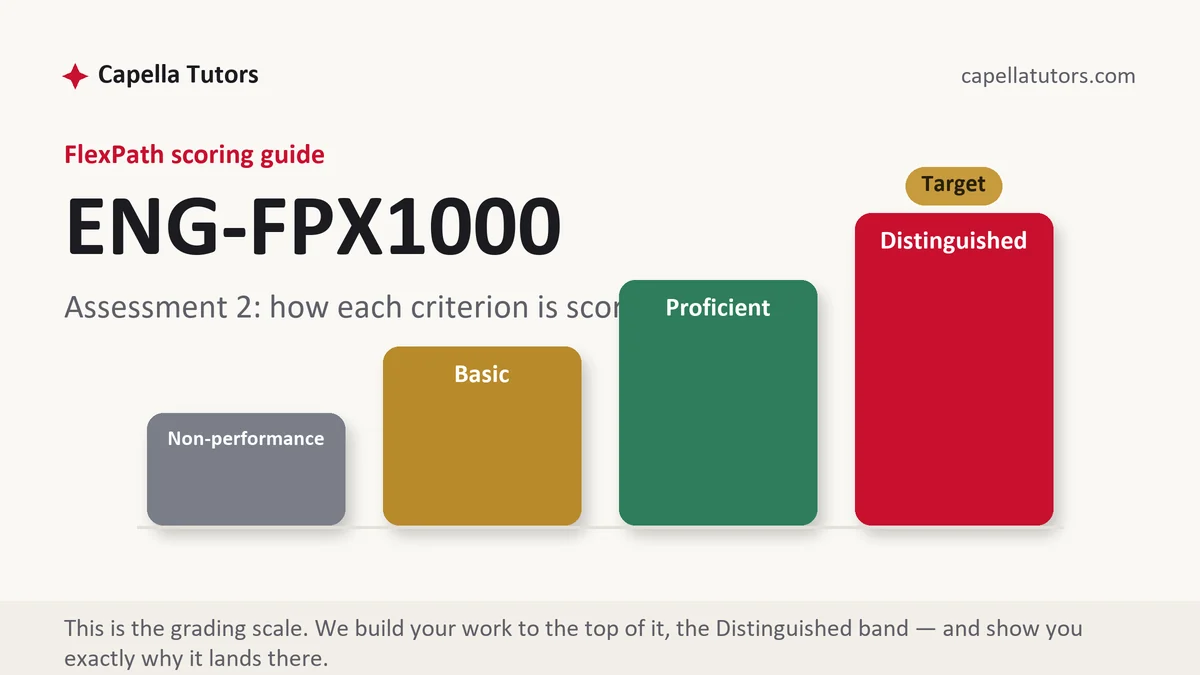
How ENG FPX 1000 Assessment 2 is scored
There are no letter grades in FlexPath. Every criterion lands on one of four levels, and the level language tells you what to write:
| Level | What it means on an argumentative essay |
|---|---|
| Distinguished | The thesis names a position and the reason behind it, every paragraph proves one thing, sources are interpreted inside argument sentences, and the strongest objection is met with evidence plus a concession that narrows the claim. The additional act is written into the row; locate it and do it. |
| Proficient | A defensible thesis supported completely, paragraph by paragraph, with sources attached where they belong. Solid, and still short of the top row. |
| Basic | An organized tour of what has been written about the topic, position implied and never argued. The single most common outcome for a first attempt at this deliverable. |
| Non-performance | Something required is missing outright, most often the counterargument. A row falls to the floor for what is missing, never for what is merely thin. |
Three general education points sit behind this course, and the essay it grades is the one every later assessment quietly assumes you can already write. Learning here that a thesis is a sentence somebody could refuse costs one evening; learning it in an upper-division course costs a resubmission and two business days.
The ENG FPX 1000 Assessment 2 method, step by step
-
Read the criteria first, then choose a topic that fits them
The prompt lists options; the guide decides marks. Copy each criterion into an empty file as a heading with its Distinguished wording underneath, then pick the topic you can defend against those rows rather than the one you find most interesting. A subject you already hold a position on is faster to write and far easier to narrow.
-
Narrow until one essay can hold it
Start where a whole book lives, such as remote work. Cut to one population, such as employees moved home in a role that was never designed to be done there. Cut again to one decision that population faces, such as who pays for the desk, the chair and the second monitor. A claim about a decision can be proved in the space you have; a claim about a trend cannot.
-
Write the thesis as a sentence with a because in it
Finish this: employers who moved staff home should fund home office equipment, because the costs they transferred are coming back as turnover. Then write the opposite sentence. If nobody could hold the opposite, you have stated a fact and the body has nothing to prove. If the opposite is a position with reasons of its own, the essay has work to do and a reader can predict its shape.
-
Give every source a job before you draft
List the sources your guide asks for and write one line beside each naming what it is for: one establishes how widespread the arrangement is, two carry the claim, one supplies the cost figures, and one, chosen deliberately, disagrees with you. A source with no job attached ends up quoted and abandoned, which is exactly what the source row penalizes.
-
Draft one claim per paragraph, citation inside the argument
Open each paragraph with its own claim, put the source in the sentence that argues, and end on the meaning rather than the quotation. Reyes and Okafor (2024) surveyed 1,180 remote employees and found a third had bought equipment they expected the employer to supply, which turns a courtesy into a payroll cost nobody budgeted. The same fact with the citation stapled after a full stop only gestures.
-
Reverse-outline, answer the objection, then score yourself
Beside each paragraph write its claim in five words. Merge duplicates, split any paragraph you cannot label, and delete any label with nothing to do with the thesis. Then write the objection an informed opponent would raise, answer it with evidence, and concede the part that narrows your claim without abandoning it. Mark each criterion yourself and submit early in the week.
A structure that maps to the criteria
The targets below are the planning numbers our tutors work to on a first-year argument, not Capella requirements; any row your guide asks more of should grow.
| Section | What it must do | Guide |
|---|---|---|
| Introduction | Two or three sentences of context, the narrowing move, and the thesis as the final sentence with its reason attached. | ~150 words |
| The situation established | How common the arrangement is and what it costs whom, drawn with figures and dates rather than adjectives. | ~250 words |
| The case, argued | Your reason carried by the evidence, one claim per paragraph, each source doing the job you assigned it. | ~450 words |
| The objection answered | The strongest opposing position in its own best form, met with evidence, plus the concession that narrows your claim. | ~250 words |
| Conclusion | What follows if the argument holds, written as a consequence a reader could act on rather than as a restatement. | ~150 words |
| References | Current APA on its own page, alphabetized, every citation matched to an entry and every entry back to the text. | as needed |
Annotated sample excerpt
A model introduction written by our team at the register the Distinguished column describes. It is study material: learn the moves, then write the version your own topic needs.
Three years after the office emptied, the desk, the chair and the second monitor are still sitting in somebody's spare bedroom, bought with their money.1 Reyes and Okafor (2024) surveyed 1,180 employees working from home in roles that had never been remote before, and a third of them had paid for equipment they assumed the employer would supply, at a median of $410 each.2 This essay argues that employers who moved staff home should fund the equipment those roles require, because a cost transferred quietly to employees is returning as turnover in exactly the jobs that are hardest to refill.3
- 1The opening puts the reader inside one concrete room rather than inside a trend, and it does it without defining remote work or announcing what the essay will discuss.
- 2The source arrives inside a sentence that argues, with its sample and its number, so removing the citation would break the sentence rather than tidy it.
- 3The thesis states a position and the reason for it in one breath, which lets an evaluator predict every section that follows.
The full premium sample for your exact assessment, written fresh to your scoring guide and issue, is free to request. Study it, revise it into your own voice, and submit work you understand.
The five mistakes that cost Distinguished
- A subject announced instead of a claim made. An essay that promises to discuss the effects of something has committed to nothing, and the thesis row has nothing to reward.
- Paragraphs that open with a name and a year. A paragraph beginning with a citation has handed its topic sentence to a stranger, and the organization row notices.
- Quotations left to speak for themselves. The sentence after the evidence is where the interpretation row is won, and skipping it turns apt material into filler.
- An objection built to lose. A weak version of the opposing view is easy to answer and reads as avoidance to anybody who actually holds the real one.
- Proofreading mistaken for revision. Fixing the punctuation of a paragraph that should have been cut leaves the essay tidier and no better organized.
Pre-submission checklist
- Every criterion has its own labeled section and the verb inside it is answered
- The thesis is one sentence carrying a position and a reason, and its opposite is arguable
- Every source has a stated job, and none is cited once and dropped
- First sentences read as an outline of the argument when the rest of the page is covered
- The objection appears in its strongest form and is answered with evidence
- Citations matched to entries both ways, current APA, self-scored D on every row
Argument due and the thesis will not hold still?
Send the prompt, the criteria and the topic you were leaning toward. A team of eight, including a research analyst and two QA reviewers, returns a premium original sample built to the Distinguished column in 24 to 48 hours, revised free until the guide clears, with faculty comments handled at no charge.