This manual is for ENG FPX 1000 Assessment 3, start to submission. The last deliverable in English Composition usually asks for the harder version of the same skill: an essay built out of sources that do not agree with each other. Reporting both sides is the entry fee, and the criteria pay for the sentence explaining why the evidence splits and what follows for your position. The method our tutors use on it is below, followed by a section order drawn from the rows and one annotated excerpt. Prefer to pass it across? A premium original sample for the assessment in front of you is back inside 24 to 48 hours, and it keeps being revised until the guide is met. Capella's catalog lists the course as ENG-FPX1000, and some courserooms print ENG1000; both point to this same Assessment 3.
One honesty note before the manual: Capella revises courses and scoring guides over time, so always write to the exact scoring guide attached to your assessment in the courseroom. The course identity above is verified on capella.edu; the method and structure below are our tutors' approach to it, not Capella's official rubric text.
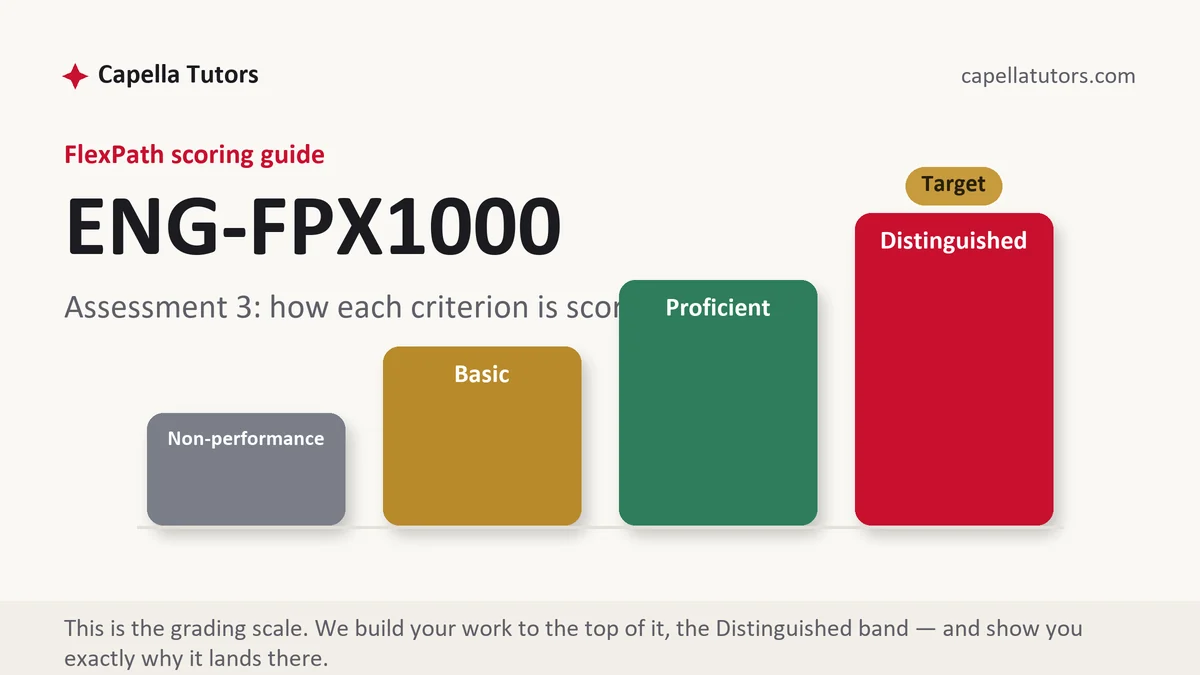
How ENG FPX 1000 Assessment 3 is scored
Nothing here is graded on a curve or with a letter. Each criterion is marked at one of four levels, and the wording of the level you are aiming at is your brief:
| Level | What it means on a synthesis essay |
|---|---|
| Distinguished | Paragraphs are organized around ideas rather than authors, agreements and disagreements are both explained, the reason the sources split is named from their methods, and the paper says what the evidence still cannot settle. Whatever that column asks for beyond Proficient is printed in it; read the wording and do the thing it names. |
| Proficient | Sources are connected accurately and the argument holds them together. Genuinely good work, one move below the row above. |
| Basic | One paragraph per source, in the order they were found, with a closing line about there being many viewpoints. This is the shape that caps an otherwise clean essay. |
| Non-performance | A required element never appears, most often the treatment of conflicting evidence. Missing outright is what puts a row on the floor. |
Because this course sits in the Communication category of the general education menu, your essay is read by an evaluator with no stake in your topic. Everything persuasive about the paper therefore has to happen in the arrangement of the evidence, which is precisely what the synthesis row measures.
The ENG FPX 1000 Assessment 3 method, step by step
-
Let the criteria name the sections, then go looking for a disagreement
Turn each row into a heading before drafting, then hunt for evidence that pulls in two directions, because a body of sources that all agree gives the top row nothing to reward. Two studies reaching opposite conclusions about the same practice are worth more to this essay than six that nod along with each other.
-
Build a matrix before you write a sentence
Sources down the left, the themes you keep meeting across the top, each cell holding what that source says about that theme. An empty column is a theme nobody has studied, which is worth a line in the paper. A row that fills every cell usually belongs to a review rather than a study, and it should be cited as one.
-
Write one paragraph per theme, never one per source
The paragraph opens with what several sources agree on, names the one that disagrees, and closes with your reading of why they differ. A reader who finishes it knows something no single source said, and that is the whole working definition of synthesis in a first-year course.
-
Explain the split by reading the methods
Two honest studies rarely disagree at random. Read who was studied, over how long, and what was actually counted. Guests surveyed the week a policy started and staff earnings measured across a full year are answering different questions, and saying so converts a contradiction into an explanation.
-
Keep the numbers honest
A percentage means little without its denominator and its window, and a difference a study calls significant may still be too small for anybody to notice. Report what was measured, over what period, on how many people, then say what the figure is good for. One clause of that kind lifts the source row on its own.
-
State the limit, then score yourself
Name the thing your sources cannot settle, in a sentence a reader will not mistake for hedging. Then mark every criterion N, B, P or D against your own draft, give anything under D one more pass, and submit early in the week rather than late, since an attempt can wait two business days for evaluation.
A structure that maps to the criteria
Treat the numbers in the last column as our tutors' planning targets for an undergraduate synthesis, not as instructions from Capella; your guide outranks them everywhere.
| Section | What it must do | Guide |
|---|---|---|
| Introduction | The question the sources disagree about, why it is live, and your position as the last sentence. | ~160 words |
| What the evidence agrees on | The common ground across sources, attributed and grouped by idea rather than by author. | ~250 words |
| Where the evidence splits | The disagreement stated fairly in both directions, with the studies named and their designs on the page. | ~300 words |
| Why it splits | Your explanation of the difference, drawn from populations, periods and what each source actually counted. | ~250 words |
| Your position and its limits | What you conclude that the sources license, and the question they leave open. | ~200 words |
| References | Current APA, alphabetized, DOIs where they exist, matched line by line against the text. | as needed |
Annotated sample excerpt
One paragraph from a model our team wrote, chosen because it is the paragraph most drafts get wrong. Study the sequence, then build your own from your own sources.
Two lines of evidence on replacing tips with a flat service charge look contradictory until the timing is examined.1 Fenwick (2023) surveyed diners in the first month after four restaurants adopted the charge and found satisfaction down eleven points, while Kaur and Lindstrom (2025) followed staff earnings and turnover across eighteen months at nine sites and found earnings steadier and departures down by a fifth.2 The studies are not measuring the same thing at the same moment: one captures a reaction to an unfamiliar line on a receipt, the other captures a working condition after the receipt stopped being news, which is why a policy argument should rest on the second and account for the first.3
- 1The paragraph opens by announcing that the conflict is explainable, which tells an evaluator the section will do work rather than report a stalemate.
- 2Both sources arrive with their design and their sample in front of their findings, so the comparison a reader is about to be offered can be checked.
- 3The explanation is the sentence the top row is written for, and it closes by saying which evidence governs the argument and what it still owes the other side.
The full premium sample for your exact assessment, written fresh to your scoring guide and issue, is free to request. Study it, revise it into your own voice, and submit work you understand.
The five mistakes that cost Distinguished
- A source list with paragraph breaks. One summary per article, in the order they were found, is a filing system rather than an essay, whatever the title says.
- Averaging a disagreement. Splitting the difference between two findings produces a number nobody reported and hides the judgment being graded.
- Themes borrowed from the sources' own headings. Organizing by the categories one article happened to use lets that article write your outline for you.
- A limit written as an apology. Saying more research is needed says nothing; naming the population your sources never studied says something checkable.
- Citations stacked at the end of a paragraph. Three names in one set of brackets after four sentences leaves a reader unable to tell which source claimed what.
Pre-submission checklist
- No paragraph in the body is organized around a single source
- The disagreement is stated in both directions with designs and samples on the page
- One sentence explains why the sources differ, drawn from method rather than opinion
- Every figure carries its denominator and the period it covers
- One named limit appears in the paper, specific enough to be checked
- Reference list matched to the text in both directions, current APA, self-scored D throughout
Sources disagreeing and the essay pulling apart?
Send the prompt, the criteria and whatever you have found so far. A team of eight, including a research analyst and two QA reviewers, returns a premium original sample organized by theme rather than by author in 24 to 48 hours, revised free until the guide is satisfied.